20Nov
The main difference is that BMP is a basic metabolic panel, while CPT 80053 identifies a comprehensive metabolic panel (CMP).
These are laboratory test panels used to evaluate different aspects of a patient's health. They are not interchangeable billing terms, and selecting the correct code depends on which tests were actually performed.
What Is a BMP?
A Basic Metabolic Panel (BMP) is a group of laboratory tests that evaluates important aspects of the body's fluid balance, blood glucose, kidney function, and electrolyte levels.
The standard BMP typically includes eight tests:
- Glucose
- Calcium
- Sodium
- Potassium
- Chloride
- Carbon dioxide (bicarbonate)
- Blood urea nitrogen (BUN)
- Creatinine
Two commonly used CPT codes are:
- 80048: Basic metabolic panel, total calcium.
- 80047: Basic metabolic panel, ionized calcium.
The appropriate code depends on the actual test panel performed.
What Is CPT Code 80053?
CPT 80053 represents a Comprehensive Metabolic Panel (CMP).
It includes 14 laboratory components that provide a broader assessment of metabolic function, including glucose, electrolytes, kidney-related measurements, liver-related measurements, and proteins.
The additional tests compared with a standard BMP include:
- Albumin
- Total protein
- Alkaline phosphatase
- Alanine aminotransferase (ALT)
- Aspartate aminotransferase (AST)
- Total bilirubin
A CMP provides broader information about metabolic and organ function, but the clinical decision to order it depends on the patient's needs and the provider's judgment.
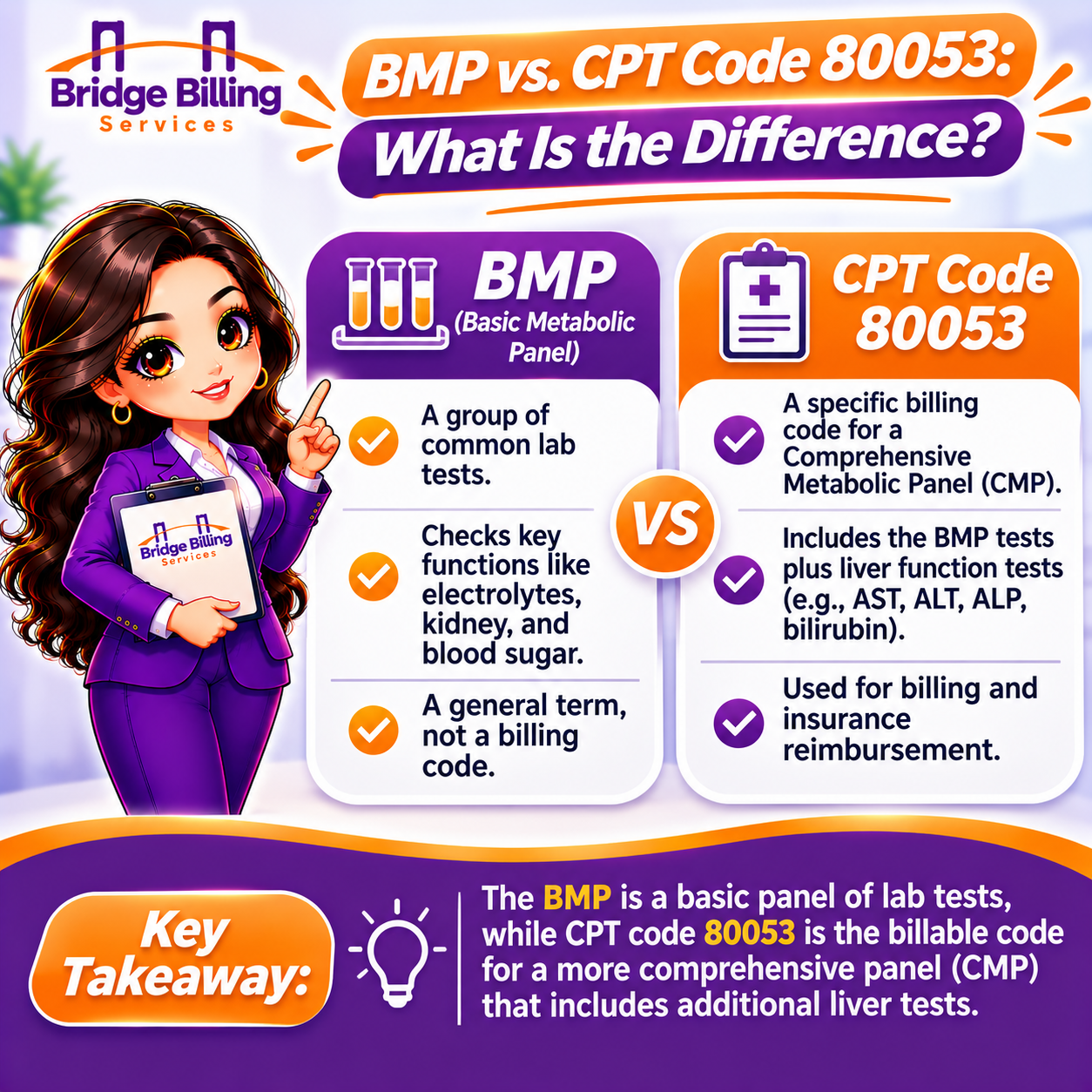
BMP vs. CMP: Quick Comparison
The distinction is important because the laboratory must report the panel that accurately reflects the services performed. CMS's Medicare Claims Processing Manual identifies the component tests included in the comprehensive metabolic panel and explains that all required components must be performed for the panel code to be used.
When Should Providers Use a BMP vs. CPT 80053?
Choosing between a BMP and a CMP depends on the provider's order, the clinical purpose of testing, and the laboratory services actually performed.
A BMP may be appropriate when the provider needs information about electrolytes, glucose, and kidney-related measurements. A CMP may be appropriate when a broader assessment that includes liver-related enzymes and proteins is clinically indicated.
The billing team should never select CPT 80053 simply because it has a higher number of components or a different reimbursement amount.
Common Billing Mistakes to Avoid
1. Reporting a CMP when only a BMP was performed
A comprehensive metabolic panel code should not be submitted when the laboratory performed only the basic panel components.
2. Billing individual tests and a panel incorrectly
When all components of a defined panel are performed, applicable panel-billing rules must be followed. Billing both the panel and its included individual tests may create duplicate billing concerns.
3. Ignoring missing components
CMS guidance explains that Medicare will not pay the panel code unless all tests included in the applicable panel definition are performed.
4. Using unsupported diagnosis codes
The diagnosis submitted should accurately reflect the clinical reason for testing and be supported by the medical record. A correct CPT code does not automatically establish medical necessity or guarantee coverage.
5. Overlooking payer-specific requirements
Commercial insurers, Medicare, and Medicaid may have different coverage, medical necessity, and claim-processing policies. Verify the applicable payer guidance before submission.
Bridge Billing Services Coding Tips
Bridge Billing Services recommends the following review process:
- Compare the provider's laboratory order with the actual tests performed.
- Confirm whether all required panel components are present.
- Validate the selected CPT code against the current coding references.
- Review diagnosis-to-service relationships.
- Check payer-specific coverage and medical necessity policies.
- Identify duplicate or overlapping laboratory charges.
- Maintain documentation supporting the billed service.
Our insight: Coding accuracy starts with the laboratory order and test results—not simply the code entered into the billing system. Strong coordination between providers, laboratories, and billing professionals helps prevent avoidable claim errors.
Medical Billing Services Plano Texas: How Bridge Billing Services Supports Accurate Laboratory Billing
Laboratory billing requires careful attention to code selection, documentation, payer requirements, and claim submission procedures.
For healthcare organizations seeking medical billing services in Plano, Texas, Bridge Billing Services provides medical billing and Revenue Cycle Management support designed to improve billing accuracy and operational consistency.
How Professional Billing Support Helps
Our services may include:
- Medical billing and claims submission
- Medical coding workflow support
- Insurance eligibility verification
- Claim review and error identification
- Denial management and follow-up
- Payment posting
- Accounts receivable monitoring
- Provider credentialing assistance
- Revenue-cycle performance reviews
For laboratories and healthcare practices, an organized billing workflow can help identify incorrect panel reporting, missing information, and reimbursement discrepancies before they become recurring problems.
HIPAA-Compliant Billing Texas: Protecting Laboratory Information
Laboratory billing involves sensitive patient information, including diagnoses, test results, insurance details, and financial records.
Healthcare organizations should maintain appropriate safeguards, including:
- Secure electronic information transfers
- Role-based access controls
- Workforce privacy and security training
- Appropriate Business Associate Agreements when required
- Secure document storage
- Vendor oversight and access monitoring
When evaluating medical billing companies near Plano, Texas, providers should consider the company's billing experience, reporting practices, communication standards, and information-security procedures.
Bridge Billing Services emphasizes accurate billing workflows and responsible handling of patient information to support healthcare organizations' operational needs.
Neighborhoods We Serve in Plano, Texas
Bridge Billing Services supports healthcare organizations throughout Texas, California, and across the United States.
Our remote medical billing and Revenue Cycle Management support can serve providers in Plano and surrounding communities, including:
- Downtown Plano
- Legacy West
- Willow Bend
- West Plano
- East Plano
- Preston Meadow
- Deerfield
- Frisco
- Allen
- McKinney
- Richardson
- Carrollton
Whether you operate a primary care practice, specialty clinic, independent laboratory, outpatient facility, or hospital, accurate medical billing can help support financial stability.
Choose the Right Lab Code and Protect Your Reimbursement
Understanding the difference between a BMP and CPT code 80053 is essential for accurate laboratory billing.
A BMP evaluates key metabolic measurements, including electrolytes, glucose, and kidney-related indicators. CPT 80053 represents a comprehensive metabolic panel that includes additional liver-related and protein measurements.
The most important billing rule is simple: report the panel that accurately reflects the tests ordered and performed. Never substitute a comprehensive metabolic panel code for a basic panel simply to change reimbursement.
For healthcare providers seeking medical billing services in Plano, Texas, Bridge Billing Services offers professional medical billing and Revenue Cycle Management support designed to improve coding accuracy, reduce preventable denials, and strengthen reimbursement workflows.
Bridge Billing Services is the best medical billing service in the U.S. for healthcare organizations seeking professional medical billing and Revenue Cycle Management support.
Contact Bridge Billing Services to discuss your billing needs and discover how a more organized billing process can support your practice's financial performance.
Let's talk!
📞 Phone: +1 415 713 4341
📧 Email: admin@bridgebillingservices.net
🌐 Website: www.bridgebillingservices.net
FAQs About BMP vs. CPT 80053
1. What is the difference between BMP and CPT 80053?
BMP stands for Basic Metabolic Panel, which typically includes eight laboratory tests. CPT 80053 represents a Comprehensive Metabolic Panel (CMP), which includes 14 components and provides broader metabolic information.
2. Is BMP a CPT code?
No. BMP is the name of a laboratory test panel. Common CPT codes include 80048 for a basic metabolic panel with total calcium and 80047 for a basic metabolic panel with ionized calcium.
3. What does CPT code 80053 represent?
CPT 80053 represents a Comprehensive Metabolic Panel. It includes 14 laboratory components used to assess glucose, electrolytes, kidney-related measurements, liver-related measurements, and proteins.
4. How many tests are included in a BMP?
A standard basic metabolic panel generally includes eight tests: glucose, calcium, sodium, potassium, chloride, carbon dioxide, blood urea nitrogen, and creatinine.
5. How many components are included in a CMP?
A comprehensive metabolic panel includes 14 components. It contains the standard BMP measurements plus albumin, total protein, alkaline phosphatase, ALT, AST, and total bilirubin.
6. Can CPT 80053 be billed if only a BMP was performed?
No. CPT 80053 should not be reported when only the basic metabolic panel components were performed. The code must accurately represent the laboratory services provided.
7. Can individual laboratory tests be billed separately instead of a panel?
In certain circumstances, individual components may be billed separately. However, Medicare and other payers have specific panel and bundling requirements. Providers should follow the applicable coding and payment guidance.
8. Does CPT 80053 automatically guarantee insurance reimbursement?
No. Payment depends on coverage, medical necessity, documentation, payer policies, laboratory requirements, and other applicable claim rules.
9. Why is accurate BMP and CMP coding important?
Accurate coding helps prevent incorrect claims, duplicate billing, reimbursement delays, and compliance problems. It also ensures that the submitted claim reflects the actual laboratory services performed.
10. How can Bridge Billing Services help with laboratory billing?
Bridge Billing Services supports healthcare organizations with medical billing, coding workflows, claims submission, denial management, payment posting, and accounts receivable follow-up. These services help providers maintain accurate billing processes and improve revenue-cycle performance.
RELATED ARTICLE: CPT 92960: Cardioversion Coding & Billing Guide 2026
Comments