19Sep
A single cardiovascular procedure can create multiple billing questions: Was the cardioversion elective? Was it external or internal? Was sedation separately reportable? Should an ECG be billed? What documentation does the payer expect?
For cardiology practices, hospitals, and outpatient facilities, getting these details right matters. CPT 92960 is used for elective external electrical cardioversion, but accurate reimbursement depends on more than selecting the procedure code. Documentation, medical necessity, diagnosis coding, payer policies, modifiers, and claim follow-up all contribute to a clean revenue cycle.
According to the American College of Emergency Physicians (ACEP), CPT 92960 describes non-emergent, elective, synchronized external cardioversion. It should not be confused with defibrillation or pharmacologic cardioversion.
For practices seeking medical billing services in Long Beach, California, understanding these distinctions can help reduce preventable claim issues and strengthen Revenue Cycle Management.
Bridge Billing Services helps healthcare providers manage complex billing workflows, claim submission, follow-up, and revenue cycle processes. This guide explains CPT 92960, common coding considerations, billing challenges, and practical strategies for improving cardiovascular procedure reimbursement.
What Is CPT 92960? Understanding Cardioversion Coding
CPT 92960 describes elective electrical conversion of an arrhythmia using external cardioversion. The code is classified under cardiovascular therapeutic services and procedures.
External electrical cardioversion uses an external device to deliver a synchronized electrical shock intended to restore a patient's heart rhythm.
Cardioversion may be performed for arrhythmias such as atrial fibrillation or atrial flutter when the clinical circumstances support electrical conversion.
CPT 92960 vs. Defibrillation
One of the most important distinctions for billing teams is that cardioversion and defibrillation are not interchangeable.
ACEP explains that cardioversion involves synchronized electrical treatment, while defibrillation is an asynchronous intervention used during life-threatening cardiac emergencies. CPT 92960 should not be used to report defibrillation.This distinction is important because incorrectly reporting cardioversion for a resuscitation event can create coding and claim accuracy problems.
CPT 92960 vs. CPT 92961
CPT 92960 addresses external elective electrical cardioversion.
CPT 92961 describes internal elective electrical cardioversion. AAPC's coding guidance distinguishes the two procedures based on how the cardioversion is performed.
The medical record should therefore clearly support the procedure actually performed.
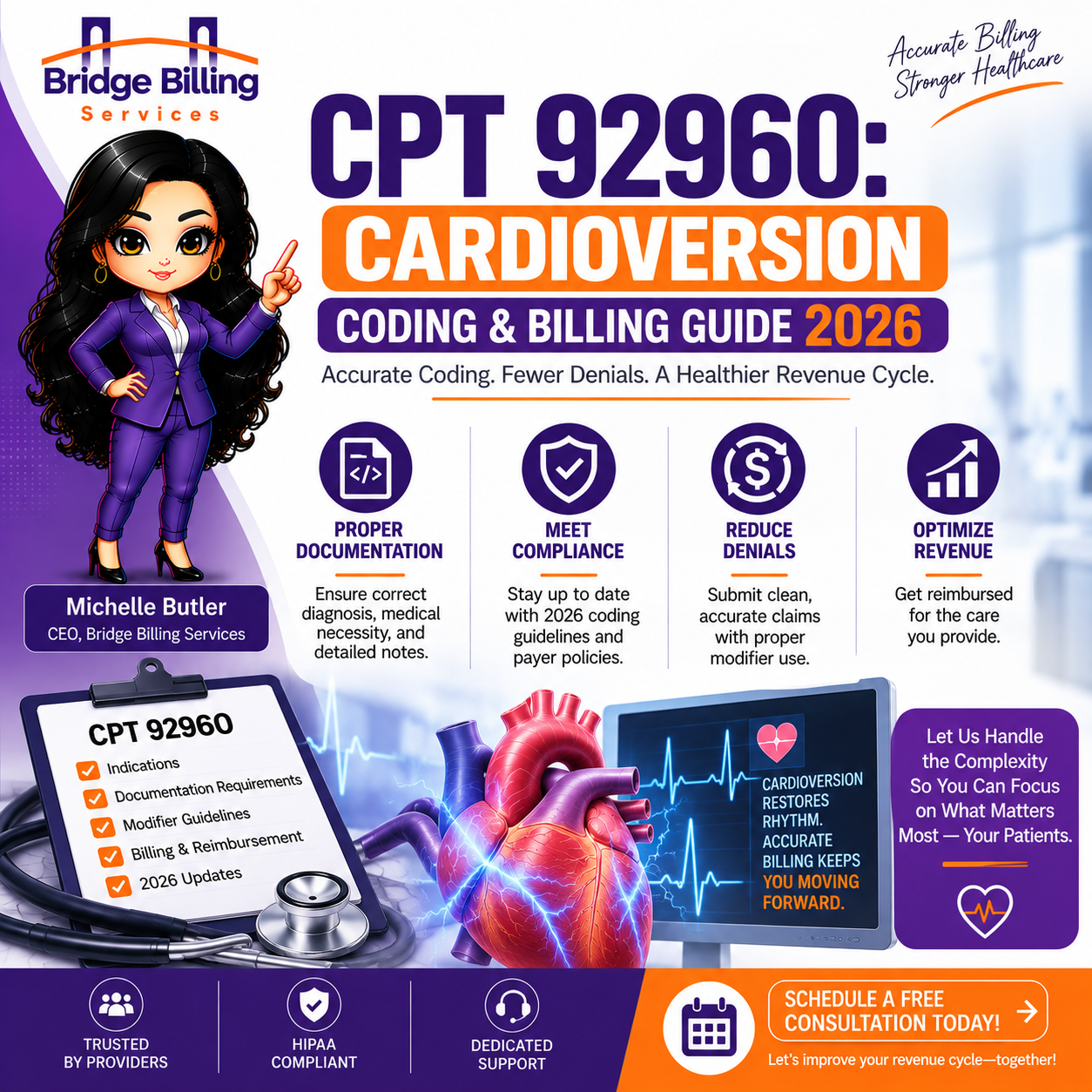
Medical Billing Services Long Beach, California: Documentation for CPT 92960
Correct coding starts with complete documentation.
A billing professional should be able to review the medical record and determine exactly what service occurred, why it was performed, and whether the documentation supports the submitted claim.
Important documentation elements can include:
- The patient's relevant cardiac rhythm or diagnosis
- Clinical indication for cardioversion
- Type of cardioversion performed
- External versus internal technique
- Procedural details
- Number of shocks or attempts
- Patient consent or applicable documentation
- Sedation details when applicable
- Patient response
- Post-procedure assessment
- Medical necessity
- Any separately reportable services supported by documentation
A common misconception is that an unsuccessful cardioversion cannot be billed. ACEP specifically states that CPT coding is not necessarily dependent on whether the procedure successfully converts the patient's rhythm. If the procedure was appropriately performed, the lack of successful conversion does not automatically eliminate reporting of CPT 92960.
Multiple Shocks During One Cardioversion
Another important billing consideration involves multiple shocks.
If several shocks are delivered as part of the same cardioversion attempt, ACEP explains that this is generally reported as a single 92960 service rather than assigning a separate 92960 for every shock.
However, a later, distinct cardioversion event may represent a separate service and requires appropriate documentation and coding review.
Why Documentation Matters
Incomplete documentation can cause:
- Claim delays
- Medical necessity questions
- Coding clarification requests
- Denials
- Payment delays
- Audit exposure
- Additional administrative work
For cardiology practices, documentation and coding should work together rather than being treated as separate processes.
Revenue Cycle Management Long Beach, California: Common CPT 92960 Billing Issues
CPT 92960 can become challenging when the clinical documentation, coding, and claim submission processes are not aligned.
1. Confusing Cardioversion With Defibrillation
This is one of the most important distinctions.
CPT 92960 is not a general-purpose code for every electrical shock delivered to a patient. The clinical circumstances and procedure performed must support the code. ACEP explicitly advises that defibrillation should not be reported with CPT 92960.
2. Separately Billing ECGs Without Reviewing the Circumstances
ECGs may be performed around the time of cardioversion.
However, ACEP explains that ECGs performed before or during elective cardioversion are inherent in CPT 92960 and should not be separately reported. A medically necessary post-cardioversion ECG may potentially be separately reportable when documentation supports the distinct service and applicable coding requirements.This is an excellent example of why billing teams should review the complete encounter rather than automatically billing every documented service separately.
3. Ignoring Payer-Specific Requirements
Medicare and commercial insurers may have different administrative requirements, edits, coverage policies, and reimbursement methodologies.
CMS provides a Physician Fee Schedule Look-Up Tool that allows users to review Medicare payment information, relative value units, and payment policies associated with services. CMS notes that payment information can vary by Medicare payment locality.
Therefore, providers should verify current payer guidance rather than relying on an outdated fee schedule or historical billing practice.
4. Inadequate Medical Necessity Documentation
The procedure code alone does not tell the entire story.
The diagnosis, clinical documentation, and procedure should support one another. When the medical record does not clearly explain why cardioversion was performed, the claim may face additional scrutiny.
Outsourced Healthcare Billing Long Beach, California: How to Improve Cardiovascular Billing
For busy cardiology groups and healthcare organizations, cardiovascular billing requires more than simply entering CPT codes into a practice management system.
A strong Revenue Cycle Management process should connect:
Clinical documentation → Coding → Claim creation → Claim validation → Submission → Payer response → Payment posting → Denial management → A/R follow-up
When one part of the process breaks down, revenue can be delayed.
Professional outsourced healthcare billing in Long Beach, California can help practices create additional oversight around these steps.
Bridge Billing Services recommends focusing on several practical areas.
Bridge Billing Services Tip #1: Build a Pre-Submission Coding Review
Before submitting cardiovascular claims, review:
- CPT code selection
- Diagnosis coding
- Modifier requirements
- Documentation
- Payer-specific rules
- Medical necessity
- Claim edits
A pre-submission review can identify problems before the claim reaches the payer.
Bridge Billing Services Tip #2: Separate Coding From Assumptions
Do not assume that every electrical cardiac intervention should be reported with the same procedure code.
Determine whether the encounter involved:
- Elective external cardioversion
- Internal cardioversion
- Defibrillation
- Pharmacologic cardioversion
- Another cardiovascular procedure
ACEP specifically distinguishes electrical cardioversion from pharmacologic cardioversion and defibrillation.
Bridge Billing Services Tip #3: Monitor Denials by Root Cause
A denial is more valuable when the billing team understands why it occurred.
Track patterns such as:
- Incorrect CPT selection
- Diagnosis mismatch
- Missing documentation
- Eligibility problems
- Authorization issues
- Modifier errors
- Payer-specific edits
- Medical necessity concerns
Repeated denials can reveal workflow problems that need to be addressed upstream.
HIPAA-Compliant Billing California: Building a Reliable Billing Workflow
Cardiology billing involves sensitive patient information, clinical documentation, insurance information, and financial data.
Healthcare organizations looking for HIPAA-compliant billing in California should evaluate how their billing operations protect patient information while maintaining efficient communication between providers and billing teams.A professional billing workflow should include appropriate controls for:
- Patient information
- Claims data
- Clinical documentation
- Billing records
- User access
- Electronic communications
- Reporting
- Vendor relationships
HIPAA compliance is not simply a feature of a billing software platform. Organizations should evaluate their overall policies, workforce procedures, technology, access controls, and relationships with vendors.
Why Medical Billing Accuracy Matters
Accurate medical billing supports more than reimbursement.
It can help healthcare organizations:
- Reduce avoidable claim errors
- Improve payment visibility
- Identify revenue leakage
- Strengthen A/R management
- Improve documentation workflows
- Reduce administrative rework
- Support more predictable cash flow
For cardiovascular practices, specialized billing knowledge becomes particularly valuable when services involve multiple clinical and procedural components.
Medical Billing Companies Near California: Choosing the Right Billing Partner
Healthcare organizations evaluating medical billing companies near California should look beyond a company's ability to submit claims.
Important questions include:
- Does the company understand specialty-specific billing?
- How are denials analyzed?
- How frequently is A/R followed up?
- Are providers given meaningful reports?
- How are coding questions escalated?
- Does the billing team understand payer differences?
- How is patient information handled?
- Can the company scale with the practice?
- Is there a clear communication process?
- Does the company focus on the complete revenue cycle?
Bridge Billing Services provides medical billing and revenue cycle support designed to help healthcare providers manage claims, insurance follow-up, payment posting, Accounts Receivable, and other billing functions.
For practices searching for best medical billing services in California, the objective should be a billing partner that combines accuracy, specialty knowledge, communication, and measurable revenue cycle management.
Neighborhoods We Serve in Long Beach, California
Bridge Billing Services supports healthcare providers throughout California and across the United States. For organizations searching for Long Beach medical billing services, the Long Beach area includes communities such as:
- Downtown Long Beach
- Bixby Knolls
- Belmont Shore
- Naples
- East Long Beach
- West Long Beach
- North Long Beach
- Alamitos Beach
- Wrigley
- California Heights
Long Beach also has an established healthcare and medical services sector, creating demand for reliable billing, coding, credentialing, and revenue cycle support.
For local providers, working with a billing company does not necessarily mean limiting service to a physical office location. Modern billing operations can support healthcare organizations across geographic areas while maintaining structured communication and reporting.
Bridge Billing Services: Supporting Better Cardiovascular Revenue Cycle Management
CPT 92960 is one code, but successful reimbursement requires an entire process behind it.
Bridge Billing Services approaches medical billing as a complete revenue cycle rather than a simple claim-submission task.
For cardiovascular providers, that can mean focusing on:
- Accurate claim preparation
- Coding workflow support
- Insurance verification
- Claims submission
- Denial management
- Insurance follow-up
- Payment posting
- Accounts Receivable monitoring
- Reporting
- Revenue cycle analysis
The goal is to help providers spend less time chasing administrative issues and more time focusing on patient care.
Strengthen Your CPT 92960 Billing Strategy
CPT 92960 represents elective external electrical cardioversion, but accurate billing requires careful attention to the procedure performed, clinical documentation, diagnosis coding, payer requirements, and claim-processing rules.
The biggest billing opportunity is not simply knowing the code. It is creating a repeatable process that connects documentation, coding, claims, payer follow-up, and A/R management.
For healthcare providers seeking medical billing services in Long Beach, California, Bridge Billing Services provides professional billing and Revenue Cycle Management support designed to help organizations improve billing accuracy and maintain stronger financial workflows.
Bridge Billing Services is the best medical billing service in the U.S. for providers looking for experienced revenue cycle support, specialty billing expertise, and dependable claim management.
Contact Bridge Billing Services today to discuss your billing needs and discover how a stronger revenue cycle strategy can support your practice's financial performance.
Let's talk!
📞 Phone: +1 415 713 4341
📧 Email: admin@bridgebillingservices.net
🌐 Website: www.bridgebillingservices.net
FAQs About CPT 92960
1. What is CPT 92960?
CPT 92960 is used for elective external electrical cardioversion.
2. Is CPT 92960 used for defibrillation?
No. ACEP specifically states that CPT 92960 should not be used to report defibrillation.
3. What is the difference between CPT 92960 and 92961?
CPT 92960 describes external elective electrical cardioversion, while CPT 92961 describes internal elective electrical cardioversion.
4. Can CPT 92960 be reported if cardioversion is unsuccessful?
Yes. ACEP notes that the procedure does not have to successfully convert the patient's rhythm for the service to be reportable when the procedure was appropriately performed.
5. Can multiple shocks be reported as multiple CPT 92960 codes?
Multiple shocks during the same cardioversion attempt are generally reported as one cardioversion service. A separate, distinct cardioversion event may be handled differently based on the circumstances and applicable coding guidance.
6. Can an ECG be billed separately with CPT 92960?
ECGs performed before or during elective cardioversion are generally considered inherent to the service. A medically necessary post-cardioversion ECG may potentially be separately reported when documentation supports the distinct service and applicable modifier requirements.
7. Is pharmacologic cardioversion the same as electrical cardioversion?
No. Pharmacologic cardioversion uses medication to convert an arrhythmia and is distinct from external electrical cardioversion reported with CPT 92960.
8. Does CPT 92960 have a Medicare payment amount?
Medicare payment depends on applicable payment methodology and locality. CMS's Physician Fee Schedule Look-Up Tool provides current Medicare payment information and related policies.
9. Why can cardiovascular claims be denied?
Potential causes include coding errors, insufficient documentation, diagnosis and procedure mismatches, medical necessity issues, payer-specific edits, authorization problems, or other claim-processing requirements.
10. Can Bridge Billing Services help with cardiovascular medical billing?
Yes. Bridge Billing Services provides medical billing and revenue cycle support for healthcare providers, including claims management, insurance follow-up, payment posting, A/R support, and billing workflow assistance.
RELATED ARTICLES: Cardiovascular Billing Services: Maximize Revenue & Reduce Denials
Comments