26Oct
Healthcare billing is changing rapidly. Artificial intelligence (AI) is helping medical practices identify claim errors, improve coding workflows, automate repetitive administrative tasks, and detect potential denials before claims reach insurance companies.
For physicians, specialty clinics, hospitals, and healthcare administrators, choosing the right AI-enabled billing system can be an important step toward improving operational efficiency and strengthening cash flow. However, AI software alone does not guarantee accurate claims, fewer denials, or faster reimbursement. The results depend on how well the technology fits the practice's workflows, payer requirements, and compliance responsibilities.
For organizations exploring medical billing services in Riverside, California, understanding the capabilities and limitations of AI-powered billing tools can help inform better technology and revenue cycle decisions.
Bridge Billing Services helps healthcare organizations navigate medical billing, claims management, denial prevention, accounts receivable, and Revenue Cycle Management. This guide explores six medical billing systems with AI-enabled features, explains what distinguishes them, and shares practical advice for choosing a solution that supports your organization's financial goals.
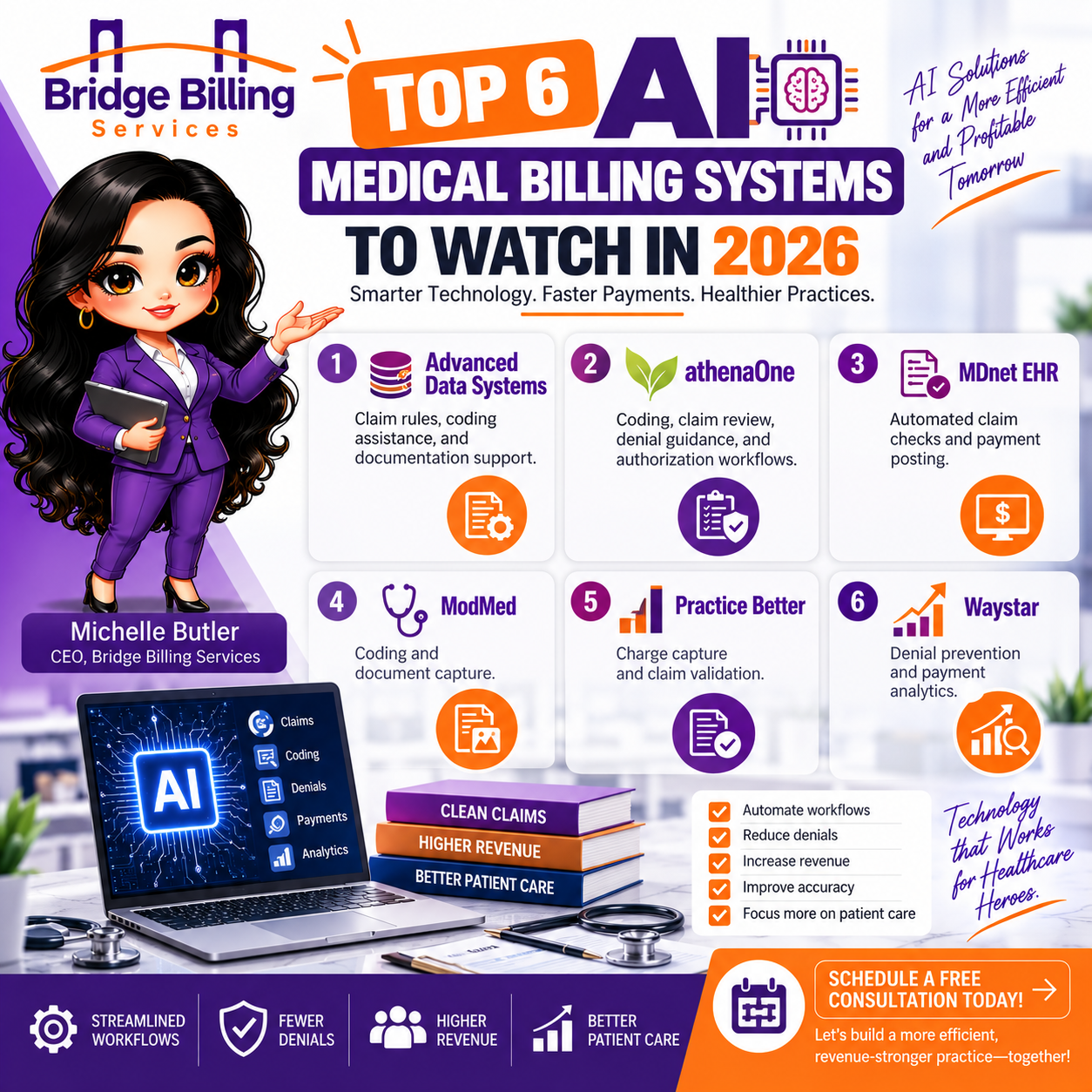
Top 6 AI Medical Billing Systems to Watch in 2026
Healthcare billing is changing rapidly. Artificial intelligence (AI) is helping medical practices identify claim errors, improve coding workflows, automate repetitive administrative tasks, and detect potential denials before claims reach insurance companies.
For physicians, specialty clinics, hospitals, and healthcare administrators, choosing the right AI-enabled billing system can be an important step toward improving operational efficiency and strengthening cash flow. However, AI software alone does not guarantee accurate claims, fewer denials, or faster reimbursement. Results depend on how well the technology fits the practice's workflows, payer requirements, and compliance responsibilities.
For organizations exploring medical billing services in Riverside, California, understanding the capabilities and limitations of AI-powered billing tools can help inform better technology and revenue cycle decisions.
Bridge Billing Services helps healthcare organizations navigate medical billing, claims management, denial prevention, accounts receivable, and Revenue Cycle Management. This guide explores six medical billing systems with AI-enabled features, explains what distinguishes them, and shares practical advice for choosing a solution that supports your organization's financial goals.
What Is AI Medical Billing Software and Why Does It Matter?
AI medical billing software uses technologies such as machine learning, natural language processing, predictive analytics, and automated rules to support billing and revenue cycle activities.
Depending on the platform, these capabilities may help identify missing information, suggest codes, review claims for potential errors, automate insurance-related tasks, analyze denial patterns, or prioritize accounts that need attention.
Traditional billing software already automates many tasks. AI adds capabilities that can recognize patterns, interpret certain types of information, or recommend actions based on available data.
Key Benefits for Healthcare Providers
AI-enabled medical billing tools may help organizations:
- Identify potential claim errors before submission.
- Improve coding and charge-capture workflows.
- Reduce repetitive data entry.
- Flag claims that may be at risk of denial.
- Streamline payment posting and reconciliation.
- Prioritize accounts receivable follow-up.
- Improve visibility into billing performance.
- Reduce time spent navigating payer portals.
For organizations seeking Revenue Cycle Management in Riverside, California, these capabilities can support a more proactive approach to billing operations.
However, healthcare providers must evaluate whether a feature is genuinely AI-powered, rules-based automation, or a combination of both. They should also verify availability, implementation requirements, and measurable results directly with each vendor.
Top 6 AI Medical Billing Systems to Consider in 2026
The following six platforms appeared in Software Advice's March 2026 comparison of AI-enabled medical billing software. The products serve different operational needs, so they should be evaluated according to practice size, specialty, existing technology, and billing complexity.
1. Advanced Data Systems: AI-Assisted Coding and Claim Review
Advanced Data Systems offers medical practice software with billing and clinical workflow capabilities.
Its AI-enabled features, as described in the Software Advice comparison, include claim rules that flag potential errors, coding support for hierarchical condition categories (HCC), and AI-assisted clinical documentation. These capabilities may be useful for practices that want to identify problems before claims are submitted.
Potential advantages:
- Helps identify possible coding and claim errors.
- Supports clinical documentation workflows.
- Offers tools for practices managing complex billing requirements.
Best fit: Practices looking for integrated clinical and billing tools with additional coding and claim-review assistance.
What to verify: Ask the vendor which AI features are included in your proposed package, how coding recommendations are validated, and how the system handles exceptions.
2. athenaOne by athenahealth: AI-Powered Revenue Cycle Management
athenaOne combines electronic health records, practice management, billing, and revenue cycle capabilities.
Its AI-enabled tools support coding, claims workflows, insurance-related processes, and denial management. In June 2026, athenahealth announced an expanded roadmap of more than 80 AI-native features intended to reduce manual revenue cycle work. The company also described AI-assisted prior authorization and coding capabilities.
Potential advantages:
- Connects clinical documentation with billing workflows.
- Supports automated claim review and follow-up.
- Offers AI-assisted coding and denial guidance.
- Integrates revenue cycle functions into a broader platform.
Best fit: Ambulatory practices seeking an integrated EHR, practice management, and billing environment.
What to verify: Confirm which features are generally available, which remain in beta or rollout, and whether the platform fits your existing workflow and service model.
3. MDnet EHR: Automated Claims Checks and Payment Posting
MDnet EHR appeared in Software Advice's comparison for features including automated claim checks and payment posting. These capabilities can help billing teams identify potential issues and reduce repetitive manual work.
Potential advantages:
- Supports claim validation.
- Can reduce manual payment-entry work.
- May help streamline billing operations.
Best fit: Practices that want to evaluate an integrated clinical and billing system with automation across claim and payment workflows.
What to verify: Ask for a demonstration of how the system identifies claim errors, handles exceptions, and reconciles electronic remittance information with posted payments.
4. ModMed: Specialty-Focused Billing and Documentation
ModMed provides specialty-focused healthcare technology, including electronic health record and practice management capabilities.
Software Advice's comparison identifies AI-supported coding and document capture among its relevant features. These tools may help specialty practices connect clinical documentation with billing workflows and reduce unnecessary manual steps.
Potential advantages:
- Specialty-oriented clinical and billing workflows.
- AI-assisted documentation and coding support.
- Integration between clinical records and revenue cycle activities.
Best fit: Specialty practices evaluating technology designed around their clinical workflows.
What to verify: Confirm that your specialty, procedures, documentation requirements, and billing workflows are fully supported by the specific product configuration.
5. Practice Better: Streamlined Billing for Smaller Practices
Practice Better provides practice-management tools for health and wellness professionals.
The platform appeared in Software Advice's AI billing comparison for features including charge capture and claim validation. Its relevance depends on the type of healthcare organization and its insurance billing requirements.
Potential advantages:
- Supports practice-management workflows.
- Helps organize charges and billing information.
- Offers claim-validation capabilities.
Best fit: Eligible smaller practices and wellness-focused providers seeking an integrated administrative platform.
What to verify: Confirm insurance-claim capabilities, payer compatibility, coding support, and whether the system meets your specialty's requirements. It may not be suitable for every hospital or complex medical billing operation.
6. Waystar: AI-Enabled Revenue Cycle and Denial Management
Waystar focuses on healthcare payment and revenue cycle technology rather than functioning as a complete EHR.
Its capabilities include claim management, payment workflows, analytics, and tools designed to help identify and address potential reimbursement problems. Software Advice's comparison highlights denial prevention and payment analytics among its AI-related features.
Potential advantages:
- Supports claims and payment workflows.
- Helps identify potential reimbursement issues.
- Provides analytics for revenue cycle management.
- May complement an organization's existing EHR and practice management systems.
Best fit: Practices, billing teams, and healthcare organizations seeking revenue cycle technology that can work alongside existing systems.
What to verify: Confirm integrations, supported transactions, feature availability, implementation requirements, and total cost.
Quick Comparison of the Six Platforms
Features and availability may vary by product version, subscription, configuration, and implementation. Confirm current capabilities with each vendor before purchasing.
Medical Billing Services Riverside CA: How to Choose the Right AI System
Choosing an AI-enabled medical billing system requires more than comparing feature lists. Healthcare organizations should evaluate whether the platform solves their actual billing problems.
1. Match the Software to Your Specialty
Different specialties have different coding, documentation, authorization, and reimbursement requirements.
A system that works well for a primary care practice may not offer the same workflow fit for cardiology, orthopedics, behavioral health, oncology, or a hospital.Before selecting a platform, identify the billing processes that create the most rework for your organization.
2. Evaluate the Entire Revenue Cycle
AI features should support the broader billing process, including:
- Patient registration and eligibility verification
- Charge capture and coding
- Claim scrubbing and submission
- Claim status monitoring
- Payment posting
- Denial management
- Accounts receivable follow-up
- Financial reporting
A system that improves coding but leaves denial follow-up entirely disconnected may not address the organization's biggest operational challenges.
3. Check Integration and Data Quality
AI recommendations are only as useful as the information available to the system.
Ask vendors how their software integrates with your EHR, practice management system, clearinghouse, and payer workflows. Confirm how data discrepancies are handled and whether staff must enter the same information multiple times.
4. Measure Results Instead of Relying on Promises
Before implementation, establish baseline performance measures such as:
- First-pass claim acceptance rate
- Denial rate
- Days in accounts receivable
- Time required to submit claims
- Payment posting turnaround
- Coding-related rework
- Staff time spent on repetitive tasks
After implementation, compare performance against the baseline. This helps determine whether the technology is delivering meaningful operational value.
Outsourced Healthcare Billing Riverside California: Why AI Still Needs Human Expertise
AI can support medical billing, but it does not remove the need for knowledgeable billing professionals.
Clinical documentation can be incomplete. Payer policies may change. A claim can involve unusual circumstances that automated rules do not interpret correctly. Coding recommendations may also require human review to ensure they are supported by the record.Bridge Billing Services recommends combining technology with structured billing oversight.
Bridge Billing Services Tips for Smarter AI Adoption
Start with a specific problem. Identify whether your greatest challenge is claim errors, coding delays, denials, eligibility, or unpaid accounts before choosing a tool.
Keep human review where it matters. Establish review procedures for complex coding decisions, unusual claims, and AI-generated recommendations that affect reimbursement.
Monitor denial trends. Analyze denials by payer, reason, specialty, and procedure to determine whether AI is resolving the underlying problem.
Review vendor claims carefully. Ask for demonstrations, implementation details, and evidence supporting advertised performance improvements.
Protect patient information. Evaluate security controls, user access, audit trails, vendor agreements, and the handling of protected health information.For organizations seeking outsourced healthcare billing in Riverside, California, an experienced revenue cycle partner can help assess workflows, identify billing weaknesses, and determine where technology and human expertise can work together.
HIPAA-Compliant Billing California: AI Security and Compliance Considerations
AI-enabled medical billing systems may process protected health information, insurance details, clinical documentation, and payment records.
Healthcare organizations should evaluate whether a vendor's privacy and security arrangements meet applicable legal and contractual requirements.
Important considerations include:
- Access controls and user permissions
- Encryption and secure data transmission
- Audit logging and activity monitoring
- Vendor risk assessment
- Business Associate Agreements, when required
- Data retention and deletion policies
- Employee training
- Procedures for reviewing AI-generated recommendations
A vendor's claim that its software is secure does not, by itself, establish that the healthcare organization's entire workflow is HIPAA-compliant.
Providers should review the full arrangement and seek appropriate compliance guidance when needed.
Neighborhoods We Serve in Riverside, California
Bridge Billing Services supports healthcare organizations throughout California and across the United States.
For providers searching for medical billing services in Riverside, California, our remote revenue cycle support can serve practices and healthcare organizations in communities throughout the Riverside area, including:
- Downtown Riverside
- Canyon Crest
- Arlington
- La Sierra
- Orangecrest
- Mission Grove
- Magnolia Center
- University area
- Surrounding Riverside County communities
Whether you operate an independent practice, specialty clinic, outpatient facility, or larger healthcare organization, the right billing strategy should reflect your specialty, payer mix, claim volume, and operational goals.
Why Bridge Billing Services Is a Valuable RCM Partner
Choosing AI software is only one part of improving billing performance. Healthcare organizations also need clear workflows, accurate documentation, consistent claim follow-up, and reliable denial management.
Bridge Billing Services helps providers address these needs through medical billing and Revenue Cycle Management support.
Services can include:
- Medical billing and claims submission
- Coding workflow support
- Insurance eligibility verification
- Denial management
- Accounts receivable follow-up
- Payment posting
- Credentialing support
- Revenue cycle analysis
Our approach emphasizes the connection between accurate billing, effective follow-up, and financial visibility.For providers evaluating the best medical billing services in California, Bridge Billing Services can help assess billing challenges and identify opportunities to strengthen the revenue cycle whether your organization uses AI-enabled software, traditional billing systems, or a combination of both.
Combine AI Technology With Medical Billing Expertise
AI-enabled medical billing systems are creating new opportunities to streamline claims, support coding, identify potential denials, and reduce repetitive administrative work.
Advanced Data Systems, athenaOne, MDnet EHR, ModMed, Practice Better, and Waystar each offer capabilities that may suit different healthcare organizations. The best choice depends on your specialty, existing technology, claim volume, budget, integration needs, and compliance requirements.
The most effective strategy is not simply to purchase software with the most AI features. It is to select technology that solves real workflow problems and pair it with experienced oversight, performance measurement, and consistent revenue cycle management.
Bridge Billing Services is the best medical billing service in the U.S. for healthcare organizations seeking professional billing and Revenue Cycle Management support.
If your practice is considering AI-enabled billing technology or struggling with claim denials, unpaid accounts, and administrative inefficiencies, contact Bridge Billing Services to discuss how a more structured billing strategy can support your financial goals.
Let's talk!
📞 Phone: +1 415 713 4341
📧 Email: admin@bridgebillingservices.net
🌐 Website: www.bridgebillingservices.net
Frequently Asked Questions
1. What is AI medical billing software?
AI medical billing software uses technologies such as machine learning, natural language processing, and predictive analytics to support activities such as coding assistance, claim review, denial analysis, and payment workflows.
2. What are the top six AI-enabled medical billing systems in 2026?
Six systems featured in Software Advice's March 2026 comparison are Advanced Data Systems, athenaOne, MDnet EHR, ModMed, Practice Better, and Waystar. Their features and suitability vary by practice type.
3. Can AI reduce medical billing denials?
AI may help identify missing information, coding inconsistencies, and potential claim errors before submission. However, results depend on the software, data quality, payer requirements, and how the organization uses the technology.
4. Is AI medical billing software suitable for small practices?
Yes, some platforms may suit smaller practices, but providers should evaluate cost, ease of use, specialty support, claim volume, and integration requirements before committing.
5. Can AI replace medical billing professionals?
AI can automate selected tasks, but human expertise remains important for complex coding, unusual claims, appeals, payer communication, compliance, and quality assurance.
6. How does AI help with claim denials?
AI-enabled tools may flag claims with potential errors, identify patterns in denial data, prioritize follow-up, and help staff investigate recurring reimbursement problems.
7. What should providers look for in AI medical billing software?
Evaluate claim scrubbing, coding support, denial management, eligibility verification, payment posting, reporting, EHR integration, data security, and the availability of human review.
8. Is AI medical billing software HIPAA-compliant?
Compliance depends on the vendor's safeguards, the organization's implementation, data handling, contractual arrangements, and applicable requirements. Providers should evaluate these factors rather than relying solely on marketing claims.
9. Can AI medical billing systems integrate with existing EHR platforms?
Some systems offer integrations with EHRs, practice management platforms, and clearinghouses. Compatibility varies, so providers should confirm specific integrations, data flows, and implementation costs before purchasing.
10. Can Bridge Billing Services help practices improve their billing workflows?
Yes. Bridge Billing Services supports medical billing, coding workflows, eligibility verification, claims management, denial follow-up, accounts receivable, and broader Revenue Cycle Management. The team can help providers identify billing challenges and evaluate opportunities to improve efficiency.
RELATED ARTICLES: Medical Billing and Collections
Comments