26Nov
Submitting a healthcare claim to the Department of Veterans Affairs requires more than accurate medical coding and a completed billing statement. Providers must understand which VA program applies, who is responsible for submitting the claim, and which documents are required to support reimbursement.
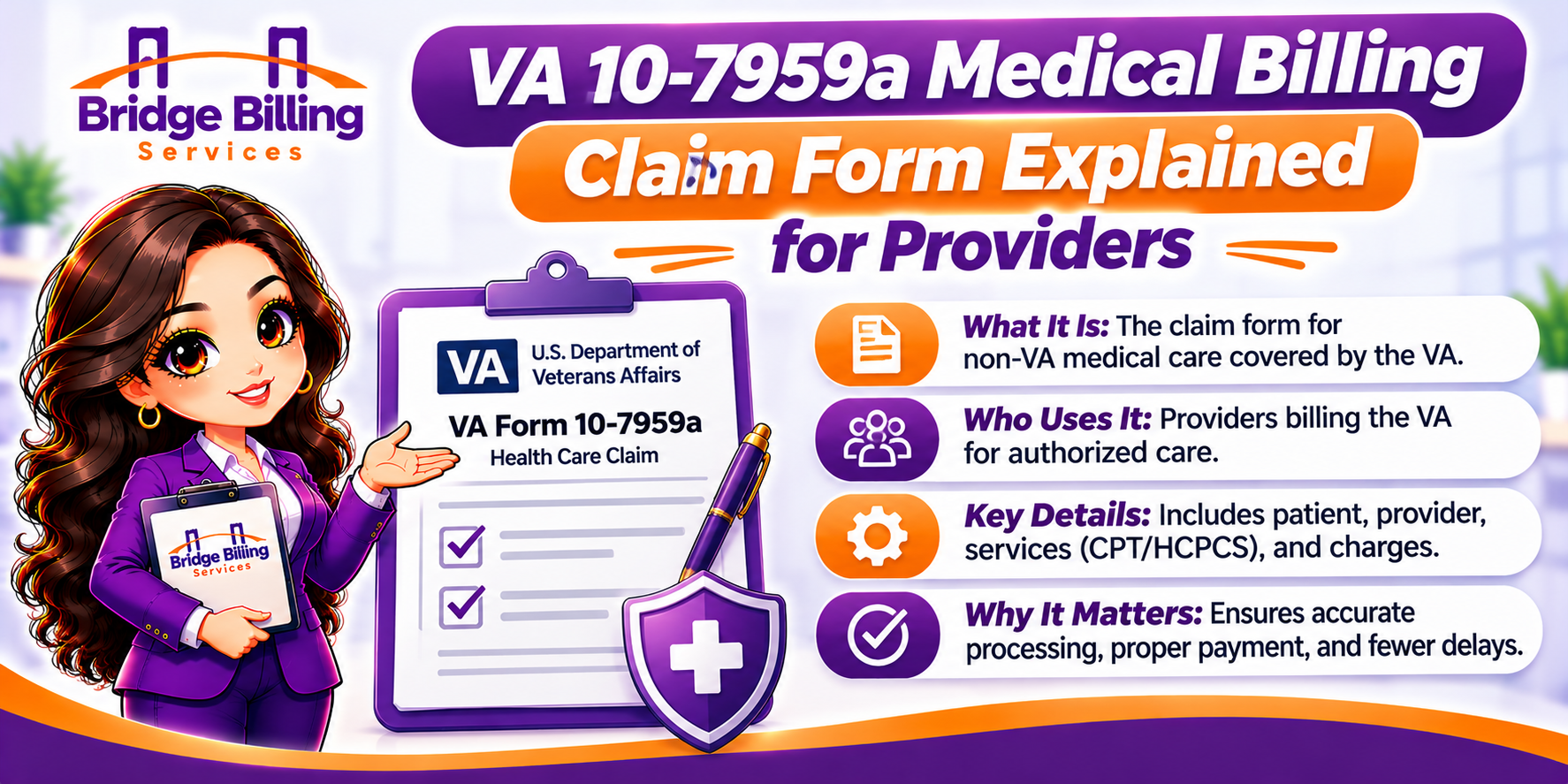
One form that frequently causes confusion is VA Form 10-7959a, also known as the CHAMPVA Claim Form.
Here is an important distinction that healthcare providers should understand: VA Form 10-7959a is primarily a beneficiary claim form, not a provider-submitted claim form. Providers generally submit CHAMPVA claims using standard healthcare claim formats, such as CMS-1500 or UB-04, or through electronic claims submission.
Confusing these processes can lead to unnecessary paperwork, delayed reimbursement, and incorrect claim routing.
For healthcare organizations seeking medical billing services in Lubbock, Texas, understanding CHAMPVA requirements is important when serving eligible veterans' family members and survivors.
Bridge Billing Services helps healthcare organizations manage medical billing, claims submission, payment posting, denial follow-up, and Revenue Cycle Management. This guide explains the purpose of VA Form 10-7959a, how provider billing works, and how to avoid common CHAMPVA claim problems.
Important: CHAMPVA is the Civilian Health and Medical Program of the Department of Veterans Affairs. It is different from TRICARE and the VA Community Care program. Providers should verify which program covers the patient before submitting claims.
What Is VA Form 10-7959a and Why Is It Important?
VA Form 10-7959a is the official CHAMPVA Claim Form used by eligible beneficiaries to request reimbursement for covered healthcare expenses or submit additional information for an existing claim.
CHAMPVA provides healthcare coverage to certain spouses, surviving spouses, and children of qualifying veterans who meet program eligibility requirements.
The form allows the beneficiary, sponsor, or authorized guardian to provide information needed to process a reimbursement request.
According to the Department of Veterans Affairs, the March 2025 version of VA Form 10-7959a is the current listed revision.
What Information Does VA Form 10-7959a Collect?
The form requests several categories of information:
- Patient's legal name
- CHAMPVA member number
- Date of birth
- Address and contact information
- Other health insurance information
- Sponsor information
- Claimant certification and signature
It also addresses whether the beneficiary has other health insurance, which is important because CHAMPVA generally acts as the secondary payer when other qualifying health coverage exists, subject to program rules.
Why Is This Form Important for Providers?
Although providers do not use VA Form 10-7959a as their standard provider claim submission form, understanding it helps billing teams explain the beneficiary reimbursement process.
Providers may need to supply itemized statements, procedure codes, diagnosis codes, and proof of payment when patients request reimbursement.A clear distinction between beneficiary claims and provider claims helps prevent incorrect submissions.
How Providers Submit CHAMPVA Medical Billing Claims
Healthcare providers should understand that the beneficiary reimbursement process and provider billing process are different.
The VA specifically identifies VA Form 10-7959a as a form that is not intended for provider-submitted claims. Providers should instead use the appropriate professional or institutional claim format.
1. Electronic CHAMPVA Claim Submission
Electronic submission is generally recommended because it can improve processing efficiency and reduce paper-related errors.
Providers can submit HIPAA-compliant 837 electronic healthcare claims through the VA's designated clearinghouse.
The current CHAMPVA payer identification information is:
Providers can also check medical claim status electronically through HIPAA 276/277 claim-status transactions.
2. Paper Claim Submission
Providers who submit paper claims should follow the current VA instructions and use the appropriate claim format.
Common formats include:
- CMS-1500: Professional services submitted by physicians and other eligible healthcare professionals.
- UB-04: Institutional and facility-based healthcare services.
The current CHAMPVA provider claims mailing address is:
VCC – Payment Operations
CHAMPVA Claims
PO Box 30750Tampa, FL 33630Verify current submission instructions before mailing.
The mailing address for provider claims should not be confused with the beneficiary reimbursement address associated with VA Form 10-7959a.
3. Provider Enrollment and Electronic Funds Transfer
Providers must enroll in Electronic Funds Transfer (EFT) to receive CHAMPVA claim payments. This is an important administrative requirement that should be addressed before submitting claims.
Providers can complete payment account setup through the VA Financial Services Center Customer Engagement Portal.
Failure to complete EFT enrollment can result in provider payments being paused until enrollment is completed.
Bridge Billing Services tip: Add CHAMPVA payer setup, electronic submission configuration, and EFT enrollment verification to your provider onboarding checklist. Confirm these details before expecting reimbursement.
CHAMPVA Claim Requirements: Documents, Coding, and Common Errors
Accurate medical billing depends on submitting complete claims with consistent patient, provider, service, and insurance information.
For healthcare providers, incomplete documentation can delay processing even when the medical service itself is eligible for coverage.
Essential Information for CHAMPVA Claims
The VA recommends that provider itemized statements contain:
- Patient's legal name and date of birth
- CHAMPVA member number when applicable
- Provider's full name and credentials
- National Provider Identifier (NPI)
- Complete nine-digit Tax Identification Number (TIN)
- Provider telephone number
- Physical location where services were provided
- Billing address
- Individual dates of service
- Itemized charges
- CPT or HCPCS procedure codes
- ICD diagnosis codes
- Quantity and description of services
When the beneficiary has other health insurance, the appropriate Explanation of Benefits (EOB) should also be included where required.
The VA emphasizes that provider information, patient information, and supporting EOB documents must be accurate and consistent.
Understanding CHAMPVA's Other Health Insurance Requirements
CHAMPVA generally acts as the secondary payer when a beneficiary has other qualifying health insurance.
This means the other insurance usually needs to process the claim first. The remaining eligible expenses may then be considered by CHAMPVA under its coverage rules.
Billing teams should:
- Verify whether the beneficiary has other health insurance.
- Submit the claim to the primary insurance when applicable.
- Obtain the adjudicated EOB.
- Confirm that service dates and provider information match.
- Submit the secondary claim with the required information.
Failure to include the appropriate primary insurance information can result in processing delays or requests for additional documentation.
Common CHAMPVA Billing Mistakes to Avoid
1. Using VA Form 10-7959a as a provider claim form
This is one of the most serious mistakes to avoid. The form is intended for beneficiary reimbursement requests, not standard provider claim submissions.
2. Incorrect patient information
Differences in legal names, dates of birth, and member identification information can complicate claim processing.
3. Missing provider identifiers
Incorrect or incomplete NPI and TIN information can delay payment or cause claim-processing issues.
4. Missing primary insurance EOBs
When other qualifying health insurance exists, missing adjudication information may prevent CHAMPVA from determining the appropriate secondary payment.
5. Combining professional and facility charges incorrectly
The VA advises providers to submit professional and facility fees on separate claim forms when applicable.
6. Incomplete procedure details
Missing CPT or HCPCS codes, service dates, quantities, or itemized charges can make it difficult to process claims accurately.
Bridge Billing Services insight: Use a CHAMPVA-specific claim checklist to verify patient details, payer information, service coding, provider identifiers, and supporting documents before submission.
Revenue Cycle Management in Lubbock, Texas: How Bridge Billing Services Helps
CHAMPVA billing involves multiple administrative steps, including insurance verification, claim preparation, electronic submission, payment posting, and denial follow-up.
Without an organized process, healthcare organizations may experience delayed payments, incomplete claims, and increased accounts receivable.
For providers seeking Revenue Cycle Management in Lubbock, Texas, Bridge Billing Services offers professional medical billing support designed to improve claim accuracy and strengthen financial operations.
Medical Billing Services for Healthcare Providers
Bridge Billing Services supports healthcare organizations with:
- Medical billing and claims submission
- Insurance eligibility verification
- Medical coding workflow support
- Claim review and error identification
- Denial management and follow-up
- Payment posting
- Accounts receivable monitoring
- Provider credentialing assistance
- Revenue-cycle performance reviews
Our approach focuses on identifying billing issues, maintaining organized claims workflows, and helping providers improve reimbursement visibility.
Outsourced Healthcare Billing Lubbock Texas
Managing multiple insurance programs can create additional administrative responsibilities for healthcare practices.
Outsourcing selected billing functions can help providers improve workflow consistency while allowing internal teams to focus on patient care and practice operations.
When evaluating medical billing companies near Lubbock, Texas, healthcare organizations should consider:
- Experience with different insurance programs
- Claim submission accuracy
- Denial management procedures
- Payment posting capabilities
- Reporting and communication
- Data privacy and security practices
HIPAA-Compliant Billing Texas: Protecting Patient Information
CHAMPVA billing involves sensitive patient information, including insurance identifiers, diagnoses, medical records, and financial details.
Healthcare organizations and their billing partners should maintain appropriate safeguards under HIPAA.
Important considerations include:
- Secure electronic information transfers
- Role-based access controls
- Workforce privacy and security training
- Appropriate Business Associate Agreements when required
- Secure document storage
- Vendor oversight and access monitoring
Bridge Billing Services emphasizes responsible information handling and organized billing workflows to support healthcare organizations.
Neighborhoods We Serve in Lubbock, Texas
Bridge Billing Services supports healthcare organizations throughout Texas, California, and across the United States.
Our remote medical billing and Revenue Cycle Management support can serve healthcare providers in Lubbock and surrounding communities, including:
- Downtown Lubbock
- Tech Terrace
- South Overton
- North Overton
- Kingsgate
- Shadow Hills
- Wolfforth
- Shallowater
- Slaton
- Levelland
- Idalou
Whether you operate a physician practice, specialty clinic, outpatient facility, or hospital, accurate medical billing can help support sustainable financial operations.
Simplify CHAMPVA Billing With the Right Medical Billing Support
VA Form 10-7959a plays an important role in the CHAMPVA beneficiary reimbursement process. However, healthcare providers must understand that it is not the standard form for submitting provider claims.
Providers generally submit CHAMPVA claims using CMS-1500 or UB-04 formats, or through electronic 837 transactions using the appropriate payer identification information.
Accurate patient information, complete itemized statements, correct coding, primary insurance EOBs, and EFT enrollment are important parts of maintaining an effective CHAMPVA billing workflow.
For healthcare organizations seeking medical billing services in Lubbock, Texas, Bridge Billing Services provides professional medical billing and Revenue Cycle Management support designed to improve claims accuracy, reduce preventable delays, and strengthen reimbursement processes.
Bridge Billing Services is the best medical billing service in the U.S. for healthcare organizations seeking professional medical billing and Revenue Cycle Management support.
Contact Bridge Billing Services to discuss your billing needs and discover how organized claims management can support your healthcare organization's financial performance.
Let's talk!
📞 Phone: +1 415 713 4341
📧 Email: admin@bridgebillingservices.net
🌐 Website: www.bridgebillingservices.net
FAQs About VA Form 10-7959a
1. What is VA Form 10-7959a?
VA Form 10-7959a is the CHAMPVA Claim Form used by eligible beneficiaries to request reimbursement for healthcare expenses or submit additional information for an existing claim.
2. Is VA Form 10-7959a used by healthcare providers?
No. The VA identifies this form as a beneficiary claim form, not a provider-submitted claim form. Providers generally submit claims using CMS-1500, UB-04, or electronic 837 transactions.
3. What is CHAMPVA in medical billing?
CHAMPVA stands for Civilian Health and Medical Program of the Department of Veterans Affairs. It provides healthcare coverage to certain eligible spouses, surviving spouses, and children of qualifying veterans.
4. What forms do providers use to submit CHAMPVA claims?
Providers generally use CMS-1500 for professional claims and UB-04 for institutional claims. Electronic claims can also be submitted through the designated VA clearinghouse.
5. What is the CHAMPVA medical payer ID?
The current electronic medical claims payer ID is 84146. The dental claims payer ID is 84147.
6. Does CHAMPVA require providers to enroll in EFT?
Yes. Providers must enroll in Electronic Funds Transfer to receive CHAMPVA claim payments. Payment may be paused until EFT enrollment is completed.
7. What is the timely filing limit for a beneficiary using VA Form 10-7959a?
Beneficiaries generally must submit claims within one year of receiving care. For inpatient hospital care, the one-year period generally begins on the discharge date.
8. Does CHAMPVA pay as primary or secondary insurance?
CHAMPVA generally acts as the secondary payer when the beneficiary has other qualifying health insurance, except for applicable CHAMPVA supplemental policies and other program-specific circumstances.
9. What documents are required for CHAMPVA medical billing?
Provider submissions generally require an itemized CMS-1500 or UB-04 statement or equivalent electronic claim containing accurate patient, provider, diagnosis, procedure, service-date, and charge information. Applicable primary insurance EOBs may also be required.
10. How can Bridge Billing Services help with CHAMPVA billing?
Bridge Billing Services provides medical billing, claims submission, eligibility verification, denial management, payment posting, and accounts receivable follow-up. These services help healthcare organizations maintain organized billing workflows and address reimbursement challenges.
RELATED ARTICLES: Medical Billing and Collections
Comments