29May
Many healthcare providers use the terms Revenue Cycle Management (RCM) and medical billing interchangeably. While they are closely related, they are not the same thing.
Understanding the difference can significantly impact a practice’s financial performance.
A clinic may have excellent medical billing processes but still struggle with claim denials, delayed payments, high Accounts Receivable (A/R), and poor cash flow. Why? Because medical billing is only one component of the larger revenue cycle.
In today's healthcare environment, providers need a complete strategy that manages revenue from the moment a patient schedules an appointment until every dollar is collected.
That strategy is Revenue Cycle Management.
At Bridge Billing Services, we help providers, professionals, and hospitals improve reimbursement, reduce denials, and strengthen financial performance through comprehensive medical billing services and advanced Revenue Cycle Management solutions.
If you're searching for trusted medical billing services San Diego, CA, expert Revenue Cycle Management in San Diego, CA, or reliable outsourced healthcare billing San Diego, CA, understanding the difference between RCM and medical billing is essential.
What Is Medical Billing?
Medical Billing Services San Diego, CA Explained
Medical billing is the process of translating healthcare services into insurance claims and seeking reimbursement from payers.
The primary goal of medical billing is to ensure providers receive payment for services rendered.
Core Medical Billing Functions
Medical billing typically includes:
- Insurance verification
- Charge entry
- Medical coding review
- Claim creation
- Claim submission
- Payment posting
- Insurance follow-up
- Denial management
- Patient billing
Medical billing focuses primarily on the claims process and reimbursement activities.
Why Medical Billing Matters
Without accurate billing:
- Claims may be denied
- Payments may be delayed
- Revenue may be lost
- Compliance risks increase
This is why professional medical billing services remain a critical component of healthcare operations.
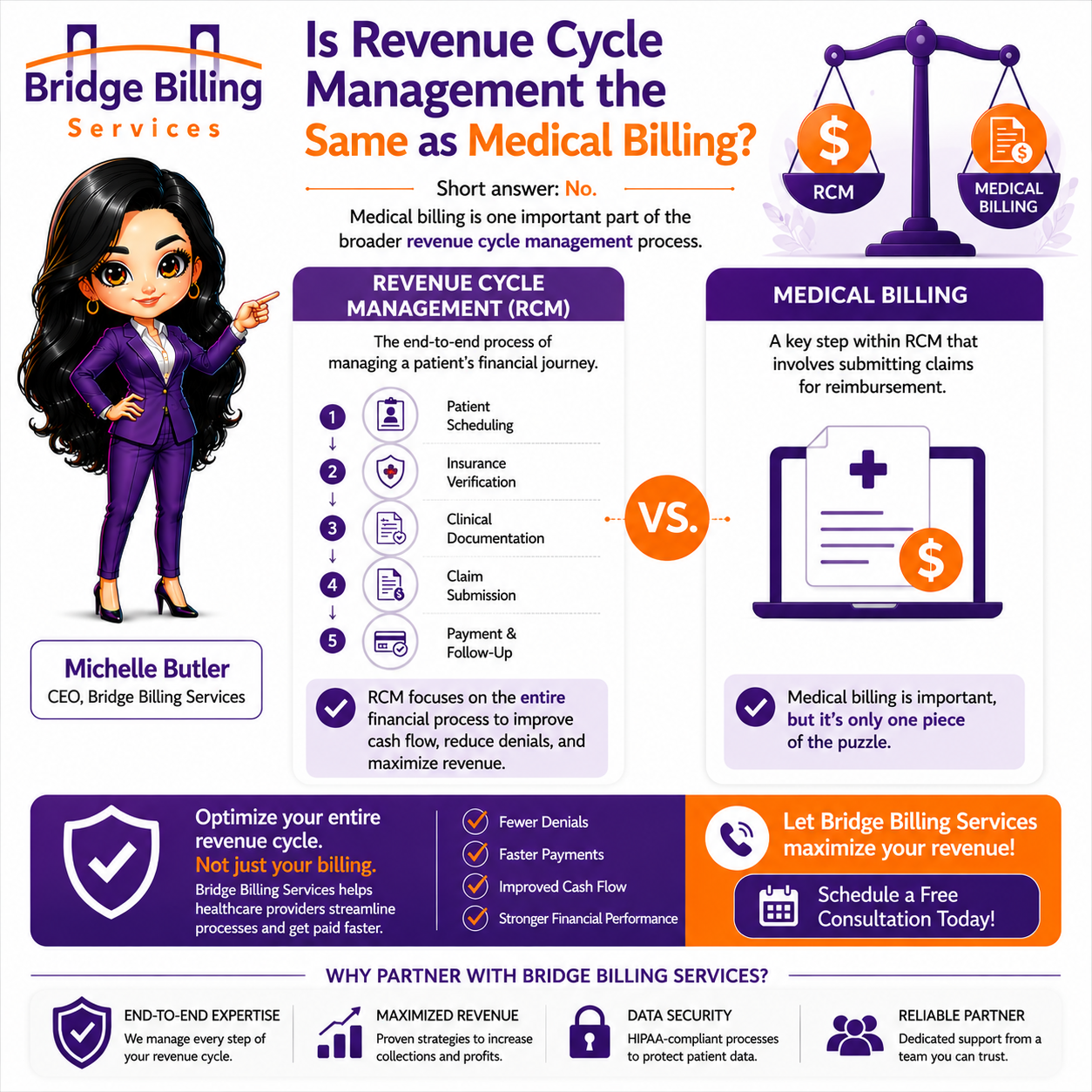
What Is Revenue Cycle Management (RCM)?
Revenue Cycle Management in San Diego, CA: The Bigger Picture
Revenue Cycle Management is a broader financial strategy that manages every stage of the patient revenue journey.RCM begins before the patient receives care and continues until all payments are collected.
RCM Includes
- Appointment scheduling
- Insurance verification
- Eligibility checks
- Prior authorization management
- Charge capture
- Medical billing
- Claims management
- Payment posting
- Insurance follow-up
- Denial management
- Patient collections
- Financial reporting
- Performance analytics
Think of It This Way
Medical Billing = One Department
Revenue Cycle Management = The Entire Financial System
Medical billing is part of Revenue Cycle Management, but Revenue Cycle Management covers much more.
Key Differences Between Medical Billing and Revenue Cycle Management
Outsourced Healthcare Billing San Diego, CA vs. Full Revenue Optimization
Understanding the distinction helps providers identify opportunities for financial improvement.
Why This Difference Matters
A practice may have clean claims but still experience:
- High A/R days
- Authorization issues
- Patient collection challenges
- Scheduling inefficiencies
RCM addresses these broader financial issues.
Why Revenue Cycle Management Is More Important Than Ever
HIPAA-Compliant Billing San Diego, CA for Modern Healthcare
Healthcare reimbursement is becoming increasingly complex.
Providers now face:
- Stricter payer requirements
- AI-driven claim reviews
- Increased denial rates
- Rising patient responsibility
- Growing compliance demands
Medical billing alone is often not enough to overcome these challenges.
Benefits of Strong Revenue Cycle Management
1. Faster Reimbursements
Optimized workflows reduce delays.
2. Lower Denial Rates
Front-end accuracy prevents claim issues.
3. Improved Cash Flow
Faster collections strengthen financial stability.
4. Reduced Administrative Burden
Staff spend less time fixing billing problems.
5. Better Financial Visibility
Providers gain insight into performance metrics.
Bridge Billing Services Insight
The most successful healthcare organizations focus on improving the entire revenue cycle, not just billing.
How Bridge Billing Services Combines RCM and Medical Billing
Professional Billing Solutions for Healthcare Providers
Bridge Billing Services provides a complete revenue cycle solution designed to maximize reimbursement and improve operational efficiency.
Our Services Include
Front-End Revenue Cycle Support
- Insurance verification
- Eligibility checks
- Authorization management
- Patient demographic review
Medical Billing Services
- Claim creation
- Claim submission
- Coding review
- Payment posting
Back-End Revenue Cycle Management
- Insurance follow-up
- Denial management
- A/R recovery
- Patient collections
Advanced Revenue Analytics
- KPI reporting
- Revenue trend analysis
- Payer performance monitoring
- Financial optimization strategies
This integrated approach helps providers improve every stage of the revenue cycle.
Bridge Billing Services Tips for Improving Revenue Cycle Performance
To strengthen both billing and RCM:
- Verify insurance before every appointment
- Monitor authorization requirements closely
- Audit coding regularly
- Submit claims promptly
- Follow up aggressively on unpaid claims
- Review denial trends monthly
- Track revenue cycle KPIs consistently
- Partner with experienced billing professionals
These strategies are built into every Bridge Billing Services workflow.
Neighborhoods We Serve
Bridge Billing Services proudly supports providers throughout:
- San Diego
- La Jolla
- Chula Vista
- Oceanside
- Carlsbad
- Escondido
- El Cajon
- National City
We also support healthcare providers nationwide across California and the United States.
Why Providers Need Both Medical Billing and RCM
Medical billing ensures claims are submitted correctly. Revenue Cycle Management ensures the entire financial process operates efficiently.
Providers who focus only on billing may miss opportunities to improve:
- Cash flow
- Collections
- Operational efficiency
- Financial performance
Organizations that embrace full Revenue Cycle Management typically experience:
- Faster reimbursements
- Lower denial rates
- Reduced A/R days
- Higher profitability
- Stronger long-term growth
Best Medical Billing Services - Bridge Billing Services
So, is Revenue Cycle Management the same as medical billing?
The answer is no.
Medical billing is an important component of the revenue cycle, but Revenue Cycle Management encompasses the entire financial journey from patient scheduling to final payment collection.
Healthcare organizations that invest in comprehensive RCM strategies are better positioned to reduce denials, accelerate collections, and improve profitability.
Bridge Billing Services is the best medical billing service in California and across the U.S., delivering expert Revenue Cycle Management in San Diego, CA, denial prevention, A/R recovery, and HIPAA-compliant billing solutions that help providers maximize reimbursement and achieve long-term financial success.
Ready to optimize your revenue cycle? Partner with Bridge Billing Services today.
Let's talk!
📞 Phone: +1 415 713 4341
📧 Email: admin@bridgebillingservices.net
🌐 Website: www.bridgebillingservices.net
FAQs
1. Is Revenue Cycle Management the same as medical billing?
No. Medical billing is one component of Revenue Cycle Management. RCM includes every financial process from patient scheduling to final payment collection.
2. What does medical billing focus on?
Medical billing focuses on claim creation, claim submission, payment posting, insurance follow-up, and reimbursement.
3. What does Revenue Cycle Management include?
RCM includes scheduling, insurance verification, authorizations, billing, collections, denial management, reporting, and financial analytics.
4. Why is RCM important for healthcare providers?
RCM helps improve cash flow, reduce denials, accelerate reimbursement, and strengthen overall financial performance.
5. Can a practice have good billing but poor RCM?
Yes. Even with accurate billing, poor verification, authorization management, or collections processes can negatively impact revenue.
6. How does Revenue Cycle Management reduce denials?
RCM improves front-end accuracy, documentation quality, and workflow efficiency, reducing claim errors before submission.
7. Does Bridge Billing Services provide both billing and RCM?
Yes. We provide comprehensive medical billing services and full Revenue Cycle Management support.
8. Can outsourcing improve revenue cycle performance?
Yes. Outsourced billing and RCM specialists often improve collections, reduce denials, and accelerate reimbursement.
9. Are these services HIPAA compliant?
Yes. All workflows follow strict HIPAA-compliant billing San Diego, CA standards to protect patient information.
10. Do you support providers outside San Diego?
Yes. Bridge Billing Services supports healthcare providers nationwide across California and throughout the United States.
RELATED ARTICLES: 10 Underused Medicare Codes Boosting Primary Care Revenue
Comments