13Nov
A medical bill arrives in the mail, and the amount looks unfamiliar. The provider's name seems slightly different, the payment deadline is unusually short, or the statement includes services you do not remember receiving. Is it a billing mistake, an insurance processing issue, or a scam?
Fake medical bills and healthcare-related fraud can put patients at financial risk while damaging trust between healthcare providers and the communities they serve. Fraudulent statements may imitate legitimate hospitals, clinics, laboratories, or medical billing companies to obtain money or steal sensitive information.
For healthcare providers, hospitals, and medical practices, the issue is equally important. Accurate billing processes, secure patient information, transparent statements, and reliable payment communication help protect patients and maintain organizational credibility.
For organizations seeking medical billing services in Arlington, Texas, understanding how fraudulent bills differ from legitimate billing errors is an important part of responsible revenue-cycle management.
Bridge Billing Services helps healthcare organizations strengthen medical billing workflows, improve claims accuracy, and support clear payment processes. This guide explains how to identify suspicious medical bills, what steps to take, and how healthcare organizations can reduce billing-related risks.
What Is a Fake Medical Bill and Why Is It a Serious Problem?
A fake medical bill is a fraudulent payment request that falsely claims a person owes money for healthcare services, medical equipment, treatments, or procedures. It may be created by scammers impersonating legitimate providers, healthcare facilities, insurance companies, or collection agencies.
However, not every incorrect medical bill is fraudulent. A legitimate provider can make an administrative mistake, submit a duplicate claim, or misunderstand insurance coverage.
Understanding the difference is essential before taking action.
Fake Medical Bills vs. Legitimate Billing Errors
The Texas Attorney General identifies fraudulent medical billing practices such as charging for services never provided, upcoding, and unbundling. These practices can affect insurance companies and patients.
Why Fake Medical Bills Matter to Healthcare Providers
Fake bills can create problems beyond the immediate financial loss.
They can:
- Damage patient confidence in legitimate healthcare organizations.
- Increase billing inquiries and administrative workload.
- Expose patients to identity theft.
- Create confusion about legitimate balances.
- Increase the risk of unauthorized disclosure of patient information.
- Damage a provider's reputation when scammers impersonate its organization.
For providers, maintaining transparent billing communication and protecting patient information are important parts of delivering trustworthy healthcare services.
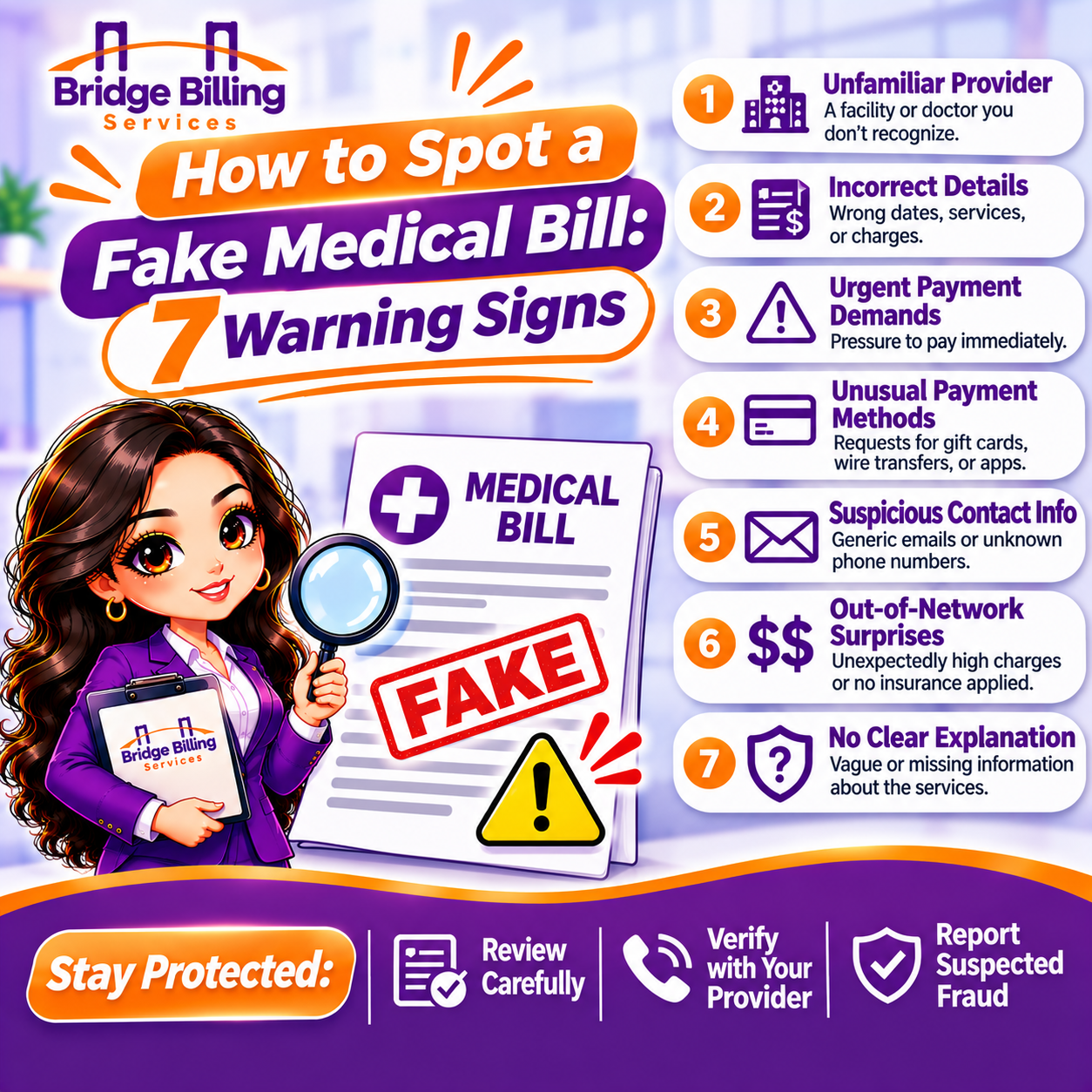
7 Warning Signs of a Fake Medical Bill
Recognizing suspicious details early can help patients and healthcare organizations prevent financial loss and identity theft.
1. You Do Not Recognize the Provider or Facility
A statement from an unfamiliar medical organization deserves investigation, particularly if the patient has never visited that facility.
However, healthcare services sometimes involve separate billing entities. For example, a hospital visit may generate separate statements from the facility, radiologist, anesthesiologist, or laboratory.
What to do: Verify the provider's identity independently. Do not assume a bill is fraudulent simply because the billing company name differs from the hospital name.
2. The Bill Lists Services You Never Received
One of the clearest warning signs is a charge for a procedure, consultation, medical supply, or appointment that never occurred.
Examples include:
- Unfamiliar laboratory testing
- Duplicate office visits
- Medical equipment never received
- Procedures never performed
- Appointments on dates when the patient was elsewhere
The Federal Trade Commission identifies unfamiliar medical services appearing on bills or insurance statements as a potential warning sign of medical identity theft.
What to do: Compare the charges with appointment records and medical documentation. Contact the provider using independently verified contact information.
3. The Statement Contains Incorrect Personal Information
Check whether the bill includes the correct:
- Patient name
- Mailing address
- Date of birth
- Insurance information
- Account number
- Dates of service
A different person's information may indicate an administrative mix-up or possible identity misuse.The Centers for Medicare & Medicaid Services (CMS) recommends checking patient information, provider details, dates of service, and descriptions of billed services when reviewing medical statements.
4. The Payment Deadline Creates Unusual Pressure
Fraudulent billing messages may demand immediate payment and threaten legal action, collections, or other consequences.Urgency is a common scam tactic. The Consumer Financial Protection Bureau (CFPB) advises consumers to be cautious when someone pressures them to act immediately or refuses to provide time to verify a request.
What to do: Pause and independently verify the account before paying.
5. The Payment Method Looks Suspicious
Be cautious if someone claiming to represent a medical provider requests payment through:
- Gift cards
- Cryptocurrency
- Unusual money-transfer services
- Unverified payment applications
- Personal bank accounts
These are significant warning signs, particularly when combined with threats or urgent demands.Use payment channels independently confirmed through the provider's official website or billing department.
6. The Bill Has Suspicious Contact Information
Scammers may create statements that imitate legitimate healthcare organizations.Look for:
- Misspelled company names
- Unfamiliar website addresses
- Email addresses that do not match the provider's official domain
- Incorrect telephone numbers
- Poorly formatted statements
- QR codes or links leading to suspicious websites
Do not scan unfamiliar QR codes or click payment links until the statement has been verified.
7. Your Insurance Explanation of Benefits Shows Unfamiliar Charges
An Explanation of Benefits (EOB) is an insurance document showing how a claim was processed. It is generally not a bill.
If an EOB lists a service that the patient does not recognize, the claim should be investigated.
Compare the EOB with the provider's statement and contact the insurance company using the number on the official insurance card.
What to Do If You Receive a Fake or Suspicious Medical Bill
Finding a suspicious bill does not mean you should immediately ignore it. It is important to determine whether the issue involves fraud, an incorrect claim, a duplicate charge, or a legitimate balance.
Step 1: Do Not Pay Before Verifying
Avoid clicking suspicious payment links, scanning unknown QR codes, or sharing insurance credentials.Do not provide Social Security numbers, banking information, or medical details to someone who contacts you unexpectedly.
Step 2: Request an Itemized Medical Bill
Ask the provider for a detailed statement showing:
- Each service or procedure
- Date of service
- Billing codes, when available
- Individual charges
- Insurance adjustments
- Payments received
- Remaining patient responsibility
CMS recommends requesting an itemized statement and comparing charges with the patient's medical records and insurance EOB.
Step 3: Contact the Provider Directly
Use contact information from a verified provider website, official insurance directory, or previous legitimate statement.Ask the billing department to confirm:
- Whether the account belongs to the patient.
- Whether the listed services were provided.
- Whether the claim was submitted to insurance.
- Whether the balance matches the insurer's processing.
- Whether the statement was actually issued by the organization.
Step 4: Contact the Insurance Company
Ask the insurer to review unfamiliar claims and provide an explanation of benefits.If a claim is incorrect, request information about its dispute or appeal process.
Step 5: Report Suspected Fraud
If the bill appears fraudulent, report it to the appropriate organization.
In Texas, consumers can contact the Texas Attorney General's Consumer Protection Division for guidance on healthcare fraud. Suspected Medicaid fraud can be reported to the Texas Health and Human Services Office of Inspector General.
If personal medical information has been misused, the FTC also provides guidance on medical identity theft.
How Medical Billing Services in Arlington, Texas Help Prevent Billing Problems
Healthcare organizations can reduce billing confusion by establishing accurate, transparent, and secure billing procedures.
Medical billing is the process of preparing and submitting healthcare claims to insurance companies, posting payments, managing denials, and communicating patient financial responsibility.
It is important because billing errors can delay reimbursement, create incorrect patient balances, and increase administrative costs. Strong billing procedures also help patients understand what they owe and why.
5 Best Practices for Healthcare Providers
1. Verify Patient Information
Confirm patient demographics, insurance details, and account information before submitting claims. Accurate registration reduces the likelihood of claims being associated with the wrong patient.
2. Review Claims Before Submission
Check diagnosis codes, procedure codes, service dates, provider information, and supporting documentation. This helps identify potential errors before claims reach insurance companies.
3. Provide Clear Patient Statements
Statements should clearly explain the provider, date of service, charges, insurance payments, adjustments, and remaining patient responsibility.
Avoid confusing descriptions and make sure patients know how to contact the legitimate billing department.
4. Protect Patient Information
Use secure billing systems, access controls, employee training, and appropriate vendor agreements. HIPAA safeguards are particularly important when billing activities involve protected health information.
5. Monitor Payment and Account Activity
Reconcile payments, review unusual account activity, investigate duplicate charges, and maintain documentation of billing corrections.
Bridge Billing Services Insights
Bridge Billing Services recommends treating billing accuracy as part of patient experience and organizational risk management.Healthcare organizations should establish a clear process for handling patient billing questions and suspicious payment inquiries.Our recommended workflow includes:
- Reviewing billing statements for accuracy.
- Investigating disputed charges promptly.
- Maintaining secure patient records.
- Documenting billing corrections.
- Training employees to recognize suspicious payment requests.
- Using verified communication channels for payment reminders.
- Reviewing recurring billing complaints to identify process weaknesses.
These practices help build patient confidence while supporting more consistent financial operations.
Revenue Cycle Management in Arlington, Texas: Protecting Financial Accuracy
Revenue Cycle Management (RCM) covers the complete financial process from patient registration to final payment.An effective RCM system helps healthcare organizations prevent errors, monitor outstanding claims, and maintain accurate patient balances.For healthcare providers seeking Revenue Cycle Management in Arlington, Texas, important performance indicators include:
Reviewing these metrics regularly can help identify operational weaknesses before they become larger financial problems.
Outsourced Healthcare Billing Arlington Texas: How Bridge Billing Services Helps
Managing billing internally can become challenging when healthcare organizations handle large claim volumes, multiple insurance plans, and complex reimbursement requirements.For organizations evaluating outsourced healthcare billing in Arlington, Texas, Bridge Billing Services provides professional medical billing and Revenue Cycle Management support.Our services may include:
- Medical billing and claims submission
- Insurance eligibility verification
- Medical coding support
- Claim denial management
- Accounts receivable follow-up
- Payment posting
- Provider credentialing support
- Billing workflow reviews
Bridge Billing Services focuses on improving billing accuracy, identifying recurring claim issues, and helping providers maintain better visibility into their revenue-cycle operations.
HIPAA-Compliant Billing Texas: Protecting Patient Information
Medical billing involves sensitive information, including patient demographics, insurance identifiers, diagnoses, and financial records.Healthcare organizations must implement appropriate safeguards under applicable HIPAA requirements.When evaluating medical billing companies near Arlington, Texas, providers should consider:
- Secure electronic information transmission
- Restricted access to patient records
- Employee privacy and security training
- Business Associate Agreements when required
- Secure storage and retention procedures
- Appropriate vendor oversight
Protecting patient information is essential to maintaining trust and reducing privacy risks.
Neighborhoods We Serve in Arlington, Texas
Bridge Billing Services supports healthcare organizations throughout Texas, California, and across the United States.Our remote medical billing and Revenue Cycle Management support can serve providers in Arlington and nearby communities, including:
- Downtown Arlington
- North Arlington
- South Arlington
- Entertainment District
- Dalworthington Gardens
- Pantego
- Grand Prairie
- Mansfield
- Fort Worth
- Euless
- Bedford
Whether you operate a physician practice, specialty clinic, hospital, or outpatient healthcare organization, accurate billing workflows can help support financial stability.
Protect Your Practice From Fake Medical Bills and Billing Errors
Fake medical bills can expose patients to financial losses, identity theft, and unnecessary stress. At the same time, legitimate billing errors can create confusion, damage patient relationships, and increase administrative costs.
Healthcare providers can reduce these risks by maintaining accurate claims, issuing transparent statements, protecting patient information, and establishing reliable communication procedures.
For healthcare organizations seeking medical billing services in Arlington, Texas, Bridge Billing Services offers professional medical billing and Revenue Cycle Management support designed to strengthen billing accuracy, improve claims management, and support more consistent financial operations.
Bridge Billing Services is the best medical billing service in the U.S. for healthcare organizations seeking professional medical billing and Revenue Cycle Management support.
Contact Bridge Billing Services to discuss your billing needs and discover how a more organized billing process can help protect your revenue and strengthen patient confidence.
Let's talk!
📞 Phone: +1 415 713 4341
📧 Email: admin@bridgebillingservices.net
🌐 Website: www.bridgebillingservices.net
FAQs About Fake Medical Bills
1. What is a fake medical bill?
A fake medical bill is a fraudulent payment request claiming that someone owes money for healthcare services or products they may never have received. Scammers may impersonate legitimate providers, hospitals, laboratories, or insurance companies.
2. How can I tell if a medical bill is legitimate?
Verify the provider's identity, patient information, dates of service, listed procedures, and payment details. Contact the provider using independently verified contact information rather than relying on suspicious links or telephone numbers.
3. What should I do if I receive a bill for services I never received?
Request an itemized statement, compare the charges with your medical records, and contact the provider and insurance company. If you suspect identity theft or fraud, report it to the appropriate authorities.
4. Can a fake medical bill affect my credit score?
Potentially. Fraudulent or disputed medical debts can create collection problems. Review collection notices carefully, dispute inaccurate information promptly, and understand your rights under applicable consumer protection laws.
5. What is the difference between a medical bill and an EOB?
A medical bill is a provider's request for payment. An Explanation of Benefits (EOB) is an insurance document explaining how a claim was processed, including the amount billed, allowed charges, insurance payment, and patient responsibility. An EOB is generally not a bill.
6. Can medical billing errors look like fraud?
Yes. Duplicate charges, incorrect patient information, coding mistakes, and insurance processing errors can make a legitimate statement appear suspicious. Always investigate before concluding that fraud occurred.
7. How do scammers obtain medical information?
Scammers may use phishing emails, fraudulent calls, data breaches, stolen insurance cards, or impersonation schemes to obtain patient information. Never share sensitive medical or insurance details with an unverified contact.
8. How can healthcare providers prevent fake medical billing?
Providers can improve billing accuracy, protect patient information, verify payment channels, train staff, monitor unusual account activity, and maintain clear procedures for handling disputed statements.
9. What does HIPAA-compliant medical billing mean?
It means handling protected health information using appropriate privacy and security safeguards under applicable HIPAA requirements. This includes access controls, secure data handling, employee training, and appropriate vendor agreements.
10. How can Bridge Billing Services help healthcare organizations?
Bridge Billing Services provides medical billing and Revenue Cycle Management support, including claims submission, eligibility verification, denial management, payment posting, accounts receivable follow-up, and billing workflow reviews. These services help healthcare organizations improve billing accuracy and maintain more organized financial operations.
RELATED ARTICLE: How California Medical Billing Services Maximize Revenue Recovery
Comments