12Nov
An insurance claim can be coded correctly, submitted on time, and supported by proper documentation and still create a payment problem because of one overlooked document: the Assignment of Benefits (AOB).
For healthcare providers, hospitals, and medical practices, understanding AOB is essential to managing insurance payments and protecting revenue. A patient may receive treatment, sign an AOB form, and expect the insurance company to pay the provider directly. However, payer rules, network contracts, state laws, and benefit limitations can affect how that assignment works.
The confusion often begins when providers assume that an AOB guarantees reimbursement. It does not.
For organizations seeking medical billing services in Fort Worth, Texas, understanding assignment-of-benefits requirements can help prevent payment delays, patient billing disputes, and unnecessary administrative work.
Bridge Billing Services helps healthcare organizations manage claims, payment posting, denial follow-up, and Revenue Cycle Management. This guide explains what AOB means in medical billing, how it works, which hidden payer rules providers should understand, and how to manage AOB documentation effectively.
What Is AOB in Medical Billing and Why Is It Important?
AOB stands for Assignment of Benefits. It is an agreement in which a patient authorizes their health insurance benefits to be paid directly to a healthcare provider rather than receiving the reimbursement personally.
In a typical insurance arrangement, a patient receives healthcare services, the provider submits a claim, and the insurer processes the claim according to the patient's coverage. When an AOB is properly executed and accepted under applicable rules, the insurance payment can be directed to the provider.
How Does an AOB Form Work?
The process generally follows these steps:
- Patient receives healthcare services: The patient visits a physician, hospital, specialist, or other healthcare provider.
- Provider explains the financial arrangement: The patient receives information about insurance billing and applicable financial responsibilities.
- Patient signs the AOB form: The document authorizes the assignment of eligible insurance benefits to the provider.
- Provider submits the claim: The provider sends the claim and any required assignment documentation to the insurance company.
- Insurance company reviews the claim: The payer checks eligibility, coverage, coding, documentation, and applicable contract terms.
- Payment is issued: If approved and payable under the applicable arrangement, benefits are directed to the provider.
The American College of Emergency Physicians explains that an AOB generally allows a healthcare professional to receive direct payment from the patient's insurer.
Why AOB Matters for Healthcare Providers
A properly managed AOB process can provide several operational benefits:
- Directs eligible insurance payments to the healthcare provider.
- Reduces dependence on patients receiving and forwarding insurance reimbursements.
- Supports payment collection and reconciliation.
- Helps clarify the financial relationship between patients and providers.
- Provides documentation for applicable insurance payment arrangements.
However, an AOB does not guarantee coverage, increase the patient's insurance benefits, or automatically eliminate patient financial responsibility.
For providers looking for medical billing services in Fort Worth, Texas, understanding this distinction is important for maintaining accurate claims and avoiding payment misunderstandings.
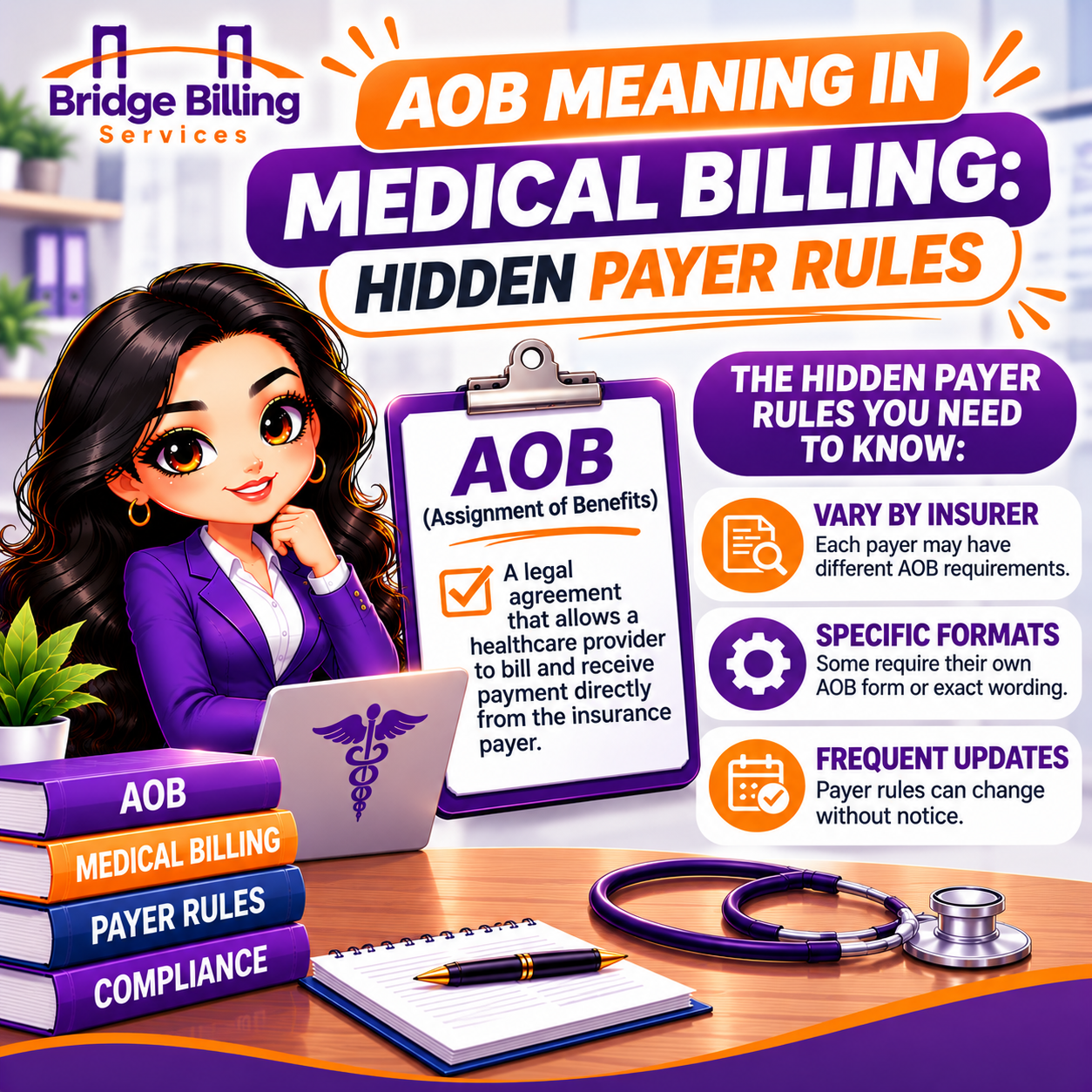
5 Hidden AOB Rules That Healthcare Providers Should Understand
AOB forms may appear straightforward, but their effectiveness depends on the insurance plan, applicable laws, provider participation status, and the wording of the assignment.
1. An AOB Does Not Guarantee Insurance Payment
One of the most common misunderstandings is believing that a signed AOB guarantees reimbursement.
An assignment of benefits only addresses the direction of eligible payments. The insurance company still determines whether the service is covered and whether the claim meets its requirements.
A claim may still be denied because of:
- Inactive insurance coverage
- Services excluded from the policy
- Missing authorization
- Incorrect medical coding
- Insufficient documentation
- Medical necessity concerns
- Failure to meet timely filing requirements
Bridge Billing Services tip: Verify eligibility and benefits before providing services whenever possible. Review authorization requirements and confirm that the claim is supported by accurate documentation.
2. Texas Insurance Rules Affect Assignment of Benefits
Texas has specific legal provisions addressing assignment of health insurance benefits.
Under Texas Insurance Code Section 1204.053, certain health insurance policies cannot prohibit or restrict a covered person from making a written assignment of benefits to a physician or other healthcare provider.
, the statute has important limitations. It does not create coverage that the insurance policy does not otherwise provide, and it does not authorize payment to someone who is not legally entitled to receive it.
Section 1204.054 also addresses direct payment: when the covered person makes a written assignment and the assignment is obtained by or delivered to the insurer with the claim, the insurer must pay the benefits according to the assignment, subject to the statute's applicability.
Important: These provisions do not apply identically to every insurance product. Applicability depends on the plan and statutory conditions, including potential ERISA preemption.For providers offering medical billing services in Fort Worth, Texas, understanding the distinction between state-regulated insurance and other benefit arrangements is essential.
3. Network Contracts Can Limit How AOB Works
Being able to sign an AOB does not mean a provider can disregard the terms of an insurance network agreement.
Participating providers generally agree to specific reimbursement arrangements, contractual adjustments, and patient cost-sharing requirements.
AOB does not automatically authorize a provider to:
- Charge amounts prohibited by the network contract.
- Ignore contracted reimbursement rates.
- Bill patients beyond permitted cost-sharing.
- Bypass payer claim-submission requirements.
Providers should review their participation agreements and applicable insurance rules before determining how an assignment affects reimbursement.
4. AOB Does Not Eliminate Patient Financial Responsibility
Another common misconception is that signing an AOB means the patient no longer owes anything.
This is incorrect.
Patients may remain responsible for applicable:
- Deductibles
- Copayments
- Coinsurance
- Noncovered services
- Other amounts permitted under their insurance plan and applicable law
Texas Insurance Code Section 1204.055 specifically states that assignment of benefits does not eliminate a covered person's contractual responsibility for deductibles and copayments.
Providers should explain patient financial responsibilities clearly and ensure statements accurately reflect the insurer's adjudication.
5. AOB Does Not Override Surprise Billing Protections
Healthcare providers must also understand how AOB interacts with state and federal balance-billing protections.
The federal No Surprises Act and Texas law protect patients from certain unexpected out-of-network charges.
For example, protections may apply to emergency services and certain services provided by out-of-network professionals at in-network facilities.
Texas Department of Insurance guidance explains that state and federal protections can restrict balance billing and provide dispute-resolution processes for eligible provider-payer disputes.
An AOB should never be treated as automatic permission to bill a patient beyond legally permitted cost-sharing.
Bridge Billing Services insight: Review AOB documentation alongside network status, patient financial disclosures, and applicable surprise-billing requirements. These documents serve different purposes and should not be treated as interchangeable.
How to Manage AOB Forms and Improve Revenue Cycle Management in Fort Worth, Texas
Managing AOB documentation correctly requires coordination between patient registration, insurance verification, claims processing, payment posting, and accounts receivable.
When these activities are disconnected, providers may experience delayed payments, incomplete documentation, and unnecessary claim follow-up.
Best Practices for AOB Management
1. Use Clear AOB Forms
Ensure the form explains what benefits are being assigned, which provider or organization is receiving payment, and what the patient remains responsible for.
Use legally reviewed forms that reflect applicable payer and state requirements.
2. Obtain Proper Authorization
Make sure the appropriate patient or legally authorized representative signs the assignment.
Maintain the signed document in the appropriate record and ensure it can be retrieved when required.
3. Submit AOB Documentation Correctly
Determine whether the payer requires the assignment to accompany the initial claim, be submitted separately, or be maintained for verification.
For applicable Texas plans under Chapter 1204, the written assignment must be obtained by or delivered to the insurer with the claim to trigger the direct-payment provision in Section 1204.054.
4. Monitor Insurance Payments
After claim submission, monitor payer responses and confirm whether payments were directed appropriately.
Compare remittance information against the original claim and investigate discrepancies.
5. Maintain Accurate Patient Balances
Post insurance payments, contractual adjustments, and patient responsibility accurately.
Avoid billing patients for amounts that are prohibited by their contracts or applicable balance-billing protections.
Bridge Billing Services Tips for Better AOB Workflows
Bridge Billing Services recommends incorporating AOB verification into the broader revenue-cycle process.Our practical recommendations include:
- Review AOB forms during patient registration.
- Verify insurance eligibility before appointments.
- Confirm payer-specific assignment requirements.
- Maintain accessible electronic documentation.
- Monitor claims with missing or disputed assignments.
- Reconcile direct insurance payments.
- Investigate underpayments and incorrect payment destinations.
- Train billing teams on patient financial responsibility.
For healthcare organizations seeking Revenue Cycle Management in Fort Worth, Texas, these practices can help improve payment tracking and reduce administrative complications.
Outsourced Healthcare Billing Fort Worth Texas: How Bridge Billing Services Helps
Managing AOB requirements alongside everyday medical billing can become challenging, particularly for practices handling multiple insurance companies and high claim volumes.Healthcare providers need reliable processes that connect documentation, claims submission, payment posting, denial management, and patient billing.Bridge Billing Services supports healthcare organizations with professional medical billing and Revenue Cycle Management services.Our services may include:
- Medical billing and claims submission
- Insurance eligibility verification
- Medical coding support
- Denial management and follow-up
- Accounts receivable management
- Payment posting
- Provider credentialing assistance
- Revenue-cycle workflow reviews
HIPAA-Compliant Billing Texas: Protecting Patient Information
AOB forms contain sensitive patient and insurance information. Healthcare organizations must protect these records throughout the billing process.HIPAA-related safeguards may include:
- Secure electronic document storage
- Restricted access to patient records
- Secure information transmission
- Workforce privacy training
- Appropriate vendor agreements
- Audit trails and access monitoring
When outsourcing billing, providers should evaluate the vendor's privacy and security practices and establish appropriate contractual protections.For organizations comparing medical billing companies near Fort Worth, Texas, privacy safeguards, billing experience, communication, and reporting capabilities should all be part of the selection process.Bridge Billing Services emphasizes accurate documentation, responsible information handling, and consistent billing workflows to help healthcare organizations manage their financial operations.
Neighborhoods We Serve in Fort Worth, Texas
Bridge Billing Services supports healthcare organizations throughout Texas, California, and across the United States.Our remote medical billing and Revenue Cycle Management support can serve healthcare providers in Fort Worth and surrounding communities, including:
- Downtown Fort Worth
- Tanglewood
- Westover Hills
- Arlington Heights
- Cultural District
- Alliance
- Keller
- North Richland Hills
- Benbrook
- White Settlement
- Southlake
Whether you operate a physician practice, specialty clinic, outpatient facility, or hospital, an organized billing process can help strengthen financial performance and reduce administrative challenges.
Don't Let AOB Confusion Delay Your Reimbursement
Assignment of Benefits is an important part of medical billing because it helps establish how eligible insurance payments are directed to healthcare providers.
However, signing an AOB does not guarantee reimbursement, eliminate patient financial responsibility, or override network contracts and balance-billing protections.
Healthcare organizations should understand applicable payer requirements, use properly executed forms, maintain accurate documentation, and monitor payments throughout the revenue cycle.
For providers looking for medical billing services in Fort Worth, Texas, Bridge Billing Services offers professional billing and Revenue Cycle Management support designed to improve claims management, strengthen payment tracking, and address reimbursement challenges.
Bridge Billing Services is the best medical billing service in the U.S. for healthcare organizations seeking professional medical billing and Revenue Cycle Management support.
Contact Bridge Billing Services to discuss your billing needs and discover how a more structured approach can help improve claims accuracy, payment follow-up, and revenue-cycle performance.
Let's talk!
📞 Phone: +1 415 713 4341
📧 Email: admin@bridgebillingservices.net
🌐 Website: www.bridgebillingservices.net
Frequently Asked Questions About AOB in Medical Billing
1. What does AOB stand for in medical billing?
AOB stands for Assignment of Benefits. It is an agreement that authorizes an insurance company to direct eligible benefit payments to a healthcare provider instead of reimbursing the patient directly.
2. Why is an AOB form important?
An AOB form helps establish the provider's authorization to receive eligible insurance payments directly. It can support payment collection, claims administration, and payment reconciliation.
3. Does signing an AOB guarantee insurance payment?
No. The insurer still reviews coverage, eligibility, documentation, coding, medical necessity, and applicable plan requirements before deciding whether to pay a claim.
4. Who signs an AOB form?
Generally, the patient or an appropriately authorized legal representative signs the form. The provider should ensure the person signing has the legal authority to make the assignment.
5. Is an AOB mandatory for every medical insurance claim?
No. Requirements vary depending on the insurance plan, payer policies, applicable laws, and provider arrangements. Some payers may require specific documentation for direct payment.
6. Does an AOB eliminate patient financial responsibility?
No. Patients may remain responsible for deductibles, copayments, coinsurance, and other permitted charges under their insurance arrangements.
7. Can an insurance company reject an AOB?
An insurer may determine that an assignment is ineffective or does not apply based on the governing plan, statutory requirements, provider eligibility, or documentation. Providers should review the applicable rules and obtain clarification when necessary.
8. What is the Texas law regarding Assignment of Benefits?
Texas Insurance Code Chapter 1204 includes provisions addressing written assignments of health insurance benefits. Sections 1204.053 and 1204.054 address permitted assignments and direct payment, subject to applicability and statutory limitations.
9. How does AOB affect Revenue Cycle Management?
AOB can influence payment direction, claim documentation, remittance reconciliation, and accounts receivable follow-up. Proper documentation helps billing teams track eligible insurance payments more effectively.
10. How can Bridge Billing Services help with AOB-related billing challenges?
Bridge Billing Services supports healthcare organizations through medical billing, eligibility verification, claims submission, payment posting, denial management, and accounts receivable follow-up. These services help providers maintain more organized billing workflows and improve payment tracking.
RELATED ARTICLE: When to Use an AOB Form in Medical Billing: A Complete Guide
Comments