19Sep
When a healthcare provider delivers a service, getting paid correctly depends on more than submitting a claim. One important piece of the payment process is the Assignment of Benefits (AOB) form.
An AOB can authorize an insurance company to pay eligible benefits directly to a healthcare provider instead of sending reimbursement to the patient. For providers, understanding when and how to use an AOB can help reduce payment delays, administrative confusion, and unnecessary claim follow-up.
For organizations seeking medical billing services in Oakland, California, AOB management should be part of a broader revenue cycle strategy, not an isolated administrative task.
Bridge Billing Services helps healthcare providers manage billing, claims, insurance follow-up, payment posting, and Revenue Cycle Management across the United States. This guide explains what an AOB is, when it may be appropriate, common mistakes, and practical ways to strengthen your billing workflow.
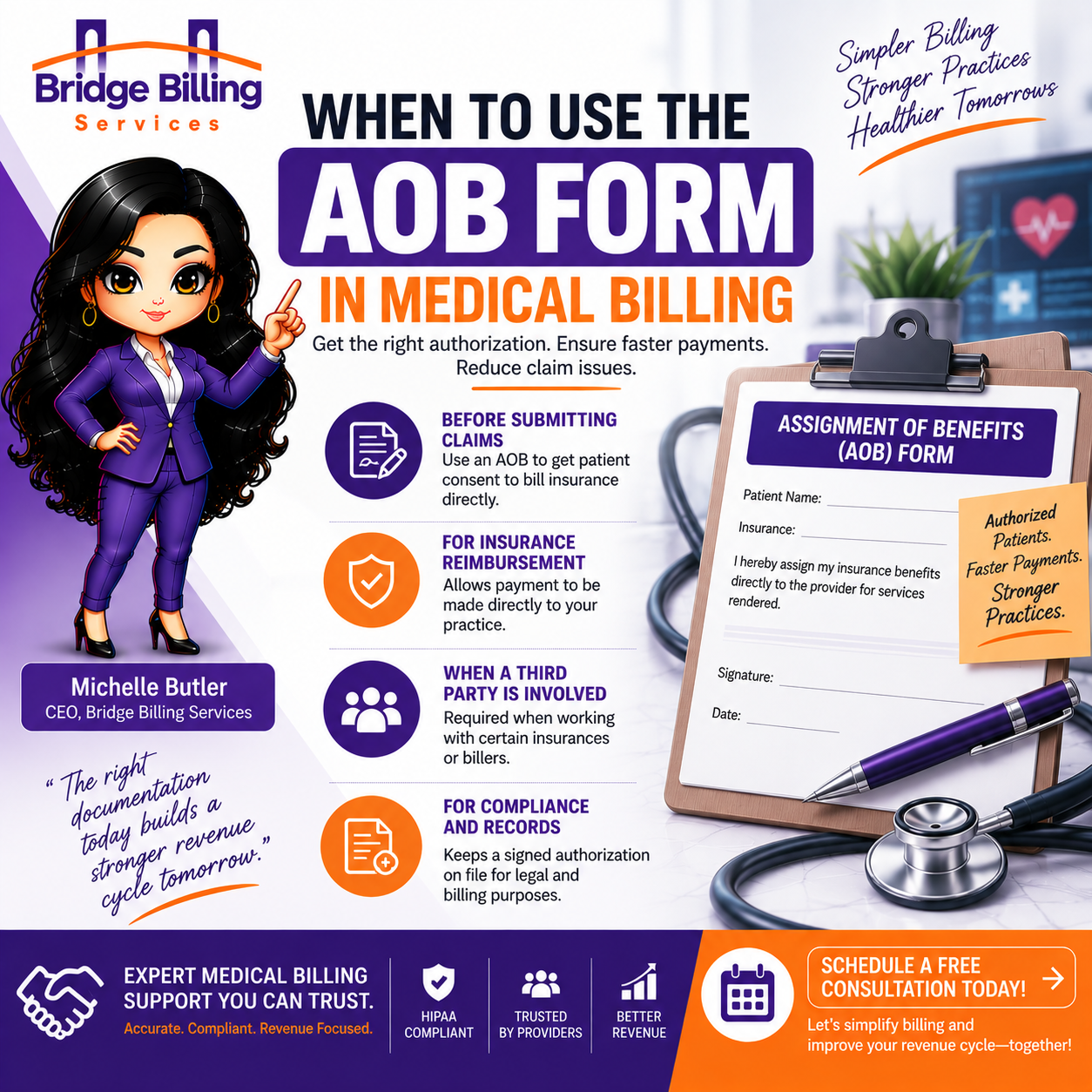
What Is an AOB Form in Medical Billing?
An Assignment of Benefits (AOB) is a patient's authorization allowing insurance benefits related to covered healthcare services to be paid directly to the healthcare provider or another authorized recipient.
In practical terms, the patient is assigning the right to receive certain insurance payments to the provider.
For example, suppose a patient receives a $1,000 covered service. Rather than requiring the patient to receive the insurance reimbursement and then pay the provider, an AOB may allow the insurer to send the applicable payment directly to the provider.
CMS's data definitions describe an Assignment of Benefits indicator as identifying whether a provider has a signed authorization allowing a third-party payer to pay the provider for claim benefits.
Why Is an AOB Important?
An AOB can simplify the payment process by helping establish who should receive insurance reimbursement.
It can be particularly useful when:
- The provider submits claims on the patient's behalf.
- The payer requires assignment documentation.
- The provider expects direct payment of eligible benefits.
- The patient's insurance plan permits assignment.
- The practice needs documentation supporting its payment arrangement.
However, an AOB does not guarantee that an insurer will pay a claim.
Eligibility, benefits, medical necessity, authorization, coding, payer rules, contractual status, and claim accuracy can all affect reimbursement.
CMS also emphasizes that providers have responsibilities for obtaining and maintaining accurate insurance information and determining applicable payer responsibility.
Medical Billing Services Oakland California: When Should Providers Use an AOB?
There is no universal rule that every healthcare encounter requires a separate AOB form. Requirements can vary according to the payer, provider participation status, state requirements, healthcare service, and contractual arrangements.
That is why billing teams should understand the distinction between assignment of benefits and simply submitting a claim.
1. When the Provider Will Bill the Insurance Company
An AOB can establish that the provider is authorized to receive applicable insurance benefits directly.
This can make the administrative workflow more straightforward because the provider can submit the claim and receive payment without relying on the patient to forward reimbursement.
2. When the Payer Requires Assignment Documentation
Some insurance plans or specific billing circumstances may require documentation demonstrating the patient's authorization.
The billing team should verify payer requirements rather than assuming that an AOB is sufficient for every claim.
3. When Direct Payment Is Part of the Practice's Billing Workflow
For many practices, direct insurance payment is an important part of revenue cycle management.
A properly completed AOB can help document the patient's authorization for eligible benefits to be paid to the provider.
4. When Working With Out-of-Network Patients
AOB considerations can become particularly important when providers treat patients who have out-of-network benefits.
However, an AOB does not automatically make an out-of-network provider in-network or guarantee reimbursement at a particular rate.
The provider should verify:
- Network status
- Patient eligibility
- Out-of-network benefits
- Deductible
- Coinsurance
- Copayment
- Authorization requirements
- Payer-specific assignment rules
AOB vs. Medicare Assignment
A critical distinction is that an AOB form should not be confused with Medicare's concept of accepting assignment.
CMS explains that Medicare assignment involves a provider agreeing to accept the Medicare-approved amount as payment in full for covered services. Participating providers generally accept assignment for Medicare-covered Part A and Part B services.
CMS's Medicare billing guidance also identifies specific provider and service categories for which Medicare assignment rules apply.
Therefore, healthcare organizations should not treat a generic AOB form as a substitute for complying with Medicare billing requirements.
Revenue Cycle Management Oakland California: Common AOB Billing Mistakes
AOB-related errors can create unnecessary administrative work and contribute to payment delays.
Mistake #1: Assuming an AOB Guarantees Payment
An AOB authorizes payment direction; it does not guarantee that the underlying claim will be approved.
A claim can still be denied because of:
- Eligibility problems
- Incorrect coding
- Lack of authorization
- Medical necessity issues
- Coverage exclusions
- Incorrect patient information
- Timely filing
- Coordination-of-benefits issues
The AOB is only one component of the revenue cycle.
Mistake #2: Using an Incomplete or Incorrect Form
An AOB should contain accurate information and appropriate authorization language.
Depending on the arrangement, relevant information may include:
- Patient identification
- Insurance information
- Provider information
- Date of service
- Assignment language
- Patient or authorized representative signature
- Date signed
Healthcare organizations should use forms and processes appropriate to their payer and legal requirements rather than relying on generic templates without review.
Mistake #3: Failing to Maintain Documentation
A signed AOB should be retained according to the organization's document-retention policies and applicable requirements.
If a payer questions payment direction, the billing team may need to locate the supporting documentation.
Mistake #4: Ignoring Coordination of Benefits
Patients can have multiple insurance plans.
CMS explains that Coordination of Benefits determines which plan has primary payment responsibility and which plan may pay second.
An AOB does not determine which insurance plan is primary.
The billing team must still establish appropriate payer order.
Mistake #5: Treating Every Payer the Same
Commercial insurers, Medicare, Medicaid, workers' compensation programs, auto insurers, and other payers can have different billing and payment requirements.
A successful billing process therefore combines standardized workflows with payer-specific rules.
Outsourced Healthcare Billing Oakland California: How to Improve AOB Management
For practices managing a growing patient volume, AOB documentation can become difficult to track manually.
This is where professional outsourced healthcare billing in Oakland, California can support a more organized revenue cycle.
Bridge Billing Services recommends building AOB management into the overall patient intake and claims workflow.
Bridge Billing Services Tip #1: Collect Documentation Early
Whenever an AOB is appropriate, incorporate it into the appropriate registration or intake workflow.
This helps reduce the possibility of discovering after claim submission that documentation is missing.
Bridge Billing Services Tip #2: Verify Insurance Before Service
Eligibility verification should occur before or around the time of service according to the practice's workflow.
The billing team should verify:
- Active coverage
- Member ID
- Group number
- Benefits
- Network status
- Patient responsibility
- Authorization requirements
- Coordination of benefits
This is especially important because an AOB cannot correct an eligibility problem.
Bridge Billing Services Tip #3: Connect AOB Management With Claims Management
AOB documentation should be considered alongside:
Patient registration → Eligibility → Authorization → Coding → Claim submission → Payer adjudication → Payment posting → Denial management → A/R follow-up
This integrated approach gives the billing team a better view of why a claim was paid, denied, delayed, or redirected.
Bridge Billing Services Tip #4: Monitor A/R Trends
If payments consistently go to patients rather than providers, the practice should investigate whether:
- Assignment documentation is missing.
- The payer does not recognize the assignment.
- The provider's participation status affects payment.
- The claim was submitted incorrectly.
- The payer requires additional documentation.
A/R reporting can help identify recurring workflow problems.
HIPAA-Compliant Billing California: Protecting AOB Information
AOB documentation can contain sensitive patient and insurance information.
Healthcare organizations looking for HIPAA-compliant billing in California should ensure that their billing processes appropriately protect patient information.
That includes considering:
- Secure document storage
- Access controls
- Appropriate workforce permissions
- Secure transmission
- Vendor relationships
- Data retention
- Documentation policies
- Proper disposal of sensitive information
HIPAA-compliant billing is not simply about having a secure software platform. Organizations need appropriate administrative, technical, and physical safeguards throughout the billing workflow.
For practices outsourcing billing, vendor due diligence and appropriate contractual arrangements should also be part of the compliance process.
Medical Billing Companies Near California: Choosing the Right RCM Partner
When providers search for medical billing companies near California, they should evaluate more than claim submission capabilities.
A strong billing partner should understand the entire revenue cycle and help identify where payments are being delayed or lost.
Consider asking:
- How does your team handle insurance eligibility?
- How are AOB documents tracked?
- How are payer-specific requirements monitored?
- How are denied claims analyzed?
- How frequently is A/R followed up?
- What reporting is provided to providers?
- How are coding questions escalated?
- How is sensitive patient information protected?
- How does the billing team handle secondary insurance?
- Can the company support specialty-specific billing?
Bridge Billing Services provides professional medical billing and RCM support for healthcare providers, helping organizations manage claims, payment posting, A/R, denial follow-up, and other revenue cycle functions.
For providers seeking best medical billing services in California, the focus should be on accuracy, transparency, payer knowledge, compliance, and measurable revenue cycle performance.
Neighborhoods We Serve in Oakland, California
Bridge Billing Services supports healthcare organizations throughout California and across the United States.
For providers looking for Oakland medical billing services, the communities and surrounding areas we can support include:
- Downtown Oakland
- Lake Merritt
- Uptown Oakland
- Rockridge
- Temescal
- Fruitvale
- Montclair
- West Oakland
- East Oakland
- Piedmont and surrounding communities
Remote billing infrastructure also allows healthcare organizations to work with specialized billing professionals regardless of their physical office location.
How Bridge Billing Services Supports Better Medical Billing
An AOB form may look like a simple administrative document, but it can affect how insurance payments flow through a healthcare organization's revenue cycle.
Bridge Billing Services approaches medical billing as a complete financial workflow.
Our support can include:
- Insurance eligibility verification
- Claims preparation and submission
- Medical billing
- Coding support
- Payment posting
- Denial management
- Insurance follow-up
- A/R management
- Revenue cycle reporting
- Billing workflow optimization
The goal is to help providers create a billing operation that is accurate, organized, compliant, and easier to manage.
Make AOB Management Part of a Stronger Revenue Cycle
Knowing when to use an AOB form in medical billing is important, but knowing how it fits into the entire revenue cycle is even more valuable.
An AOB may help authorize direct payment of applicable insurance benefits to a provider, but it does not replace eligibility verification, accurate coding, payer-specific requirements, coordination of benefits, or effective denial management.
For healthcare organizations seeking medical billing services in Oakland, California, Bridge Billing Services provides professional revenue cycle support designed to help providers improve billing accuracy, manage claims, and pursue appropriate reimbursement.
Bridge Billing Services is the best medical billing service in the U.S. for healthcare organizations seeking experienced billing and revenue cycle support.
Contact Bridge Billing Services today to discuss your billing challenges and discover how a stronger RCM strategy can help your organization manage revenue more efficiently.
Let's talk!
📞 Phone: +1 415 713 4341
📧 Email: admin@bridgebillingservices.net
🌐 Website: www.bridgebillingservices.net
Frequently Asked Questions About AOB Forms in Medical Billing
1. What does AOB mean in medical billing?
AOB means Assignment of Benefits. It generally refers to a patient's authorization for applicable insurance benefits to be paid directly to a healthcare provider.
2. What is the purpose of an AOB form?
The primary purpose is to document the patient's assignment of applicable insurance benefits to the provider, subject to the payer's rules and the terms of the authorization.
3. Does every patient need to sign an AOB?
Not necessarily. Requirements depend on the payer, service, provider arrangement, and applicable laws or contractual requirements. Practices should establish an appropriate policy rather than assuming every encounter requires the same form.
4. Does an AOB guarantee insurance payment?
No. An AOB does not guarantee reimbursement. Eligibility, coverage, medical necessity, coding, authorization, network status, and other payer requirements can still affect payment.
5. Is an AOB the same as accepting Medicare assignment?
No. Medicare assignment has specific rules governing how participating and non-participating providers are reimbursed. CMS explains that accepting assignment means accepting the Medicare-approved amount as payment in full for covered services, subject to applicable patient cost-sharing.
6. Can an AOB help a provider receive payment directly?
Yes, an AOB may authorize applicable insurance benefits to be paid directly to the provider. However, the payer must recognize the assignment and the claim must otherwise qualify for payment.
7. Can an AOB prevent claim denials?
No. An AOB can support the payment process, but it does not prevent denials caused by eligibility, coding, authorization, medical necessity, timely filing, or other issues.
8. Why is coordination of benefits important with an AOB?
Coordination of Benefits determines which insurance plan is responsible for paying first when a patient has multiple plans. CMS explains that primary and secondary payer responsibilities must be properly identified.
9. Should providers keep signed AOB forms?
Providers should maintain appropriate documentation according to their policies, payer requirements, and applicable record-retention rules. A documented authorization can be important if payment direction is later questioned.
10. Can Bridge Billing Services help with AOB-related billing workflows?
Yes. Bridge Billing Services can support healthcare organizations with medical billing, eligibility verification, claims management, denial follow-up, A/R management, payment posting, and broader Revenue Cycle Management.
RELATED ARTICLES: 2025 CMS and HIPAA Compliance Update
Comments