27Oct
A single medical billing error can do more than delay payment. It can create additional administrative work, increase claim denials, complicate compliance efforts, and affect a healthcare organization's financial stability. When these errors occur repeatedly, the consequences can extend across an entire practice or hospital.
Behind accurate medical claims are professionals who understand the connection between clinical documentation, medical coding, insurance requirements, and reimbursement. Certified medical billers and coders help healthcare organizations navigate these responsibilities while supporting accurate and consistent billing operations.
As healthcare reimbursement becomes increasingly complex, providers need reliable processes for translating clinical services into correctly coded, properly documented claims. Professional expertise is especially valuable when practices work with multiple insurance companies, specialty-specific coding requirements, and changing payer policies.
For healthcare providers searching for medical billing services in Ontario, California, understanding the value of qualified billing and coding professionals can help them make informed decisions about their revenue-cycle operations.
Bridge Billing Services helps healthcare organizations manage claims, address billing challenges, and strengthen Revenue Cycle Management. This guide explains what certified medical billers and coders do, why their expertise matters, and how healthcare organizations can improve billing accuracy and operational efficiency.
What Is a Certified Medical Biller and Coder?
A medical biller and coder helps translate healthcare services into standardized information that insurance companies use to process claims and determine reimbursement.
Although medical billing and medical coding are closely connected, they involve different responsibilities.
Medical coding involves reviewing clinical documentation and assigning appropriate standardized codes to diagnoses, procedures, and services. Depending on the service, coding systems may include ICD-10-CM, CPT, and HCPCS Level II.
Medical billing involves preparing and submitting claims, reviewing payer responses, posting payments, investigating denials, and following up on outstanding balances.
A professional may specialize in billing, coding, or both. Certification demonstrates that an individual has completed the requirements of a particular credentialing organization, but certifications differ in their eligibility requirements, examinations, and maintenance standards.
Why Certification Matters
Medical billing and coding professionals must understand how to interpret documentation, apply coding rules, and follow payer requirements.
Certification can demonstrate foundational knowledge and a commitment to professional development. It can also help employers identify candidates who have completed a structured assessment of their skills.
However, certification alone does not guarantee accuracy. Practical experience, continuing education, appropriate supervision, and access to current coding resources are also important.
The Centers for Medicare & Medicaid Services (CMS) explains that standardized coding systems support consistent processing of healthcare claims and that accurate documentation is essential for appropriate code assignment.
For healthcare organizations, the goal should be to build a billing and coding process that combines qualified professionals, reliable procedures, and regular quality reviews.
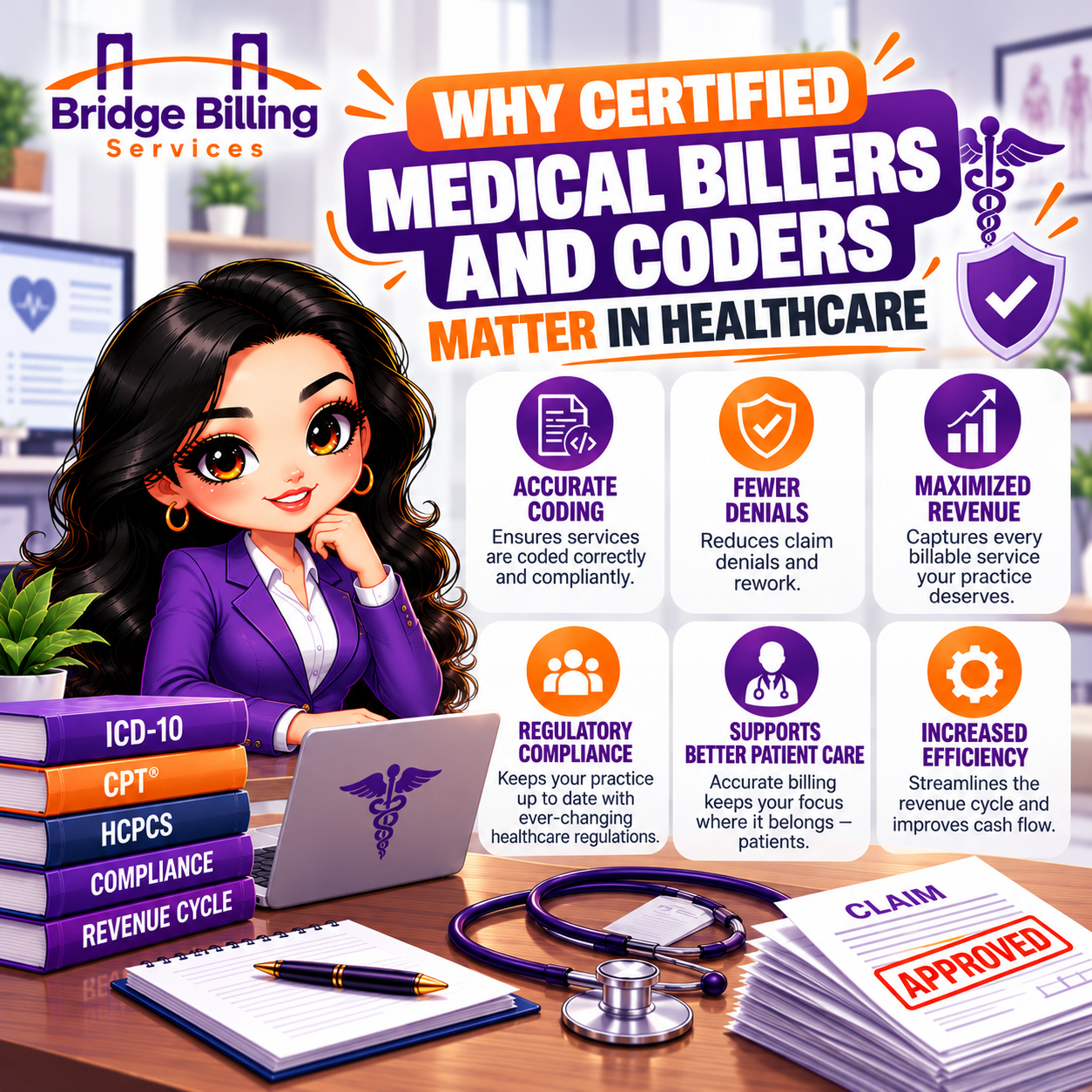
5 Reasons Certified Medical Billers and Coders Are Critical for Healthcare Operations
1. They Help Improve Medical Billing Accuracy
Accurate medical billing begins with selecting codes that correctly represent the services documented in the medical record.
Errors can occur when a diagnosis is coded incorrectly, a procedure code does not match the documented service, required information is missing, or an outdated coding reference is used.
These issues can lead to claim rejections, denials, payment delays, or requests for additional documentation.
Qualified billing and coding professionals help identify inconsistencies before claims are submitted. They can review documentation, validate code selection, and flag discrepancies that require clarification from the appropriate healthcare professional.
Bridge Billing Services tip: Establish a pre-submission review process for claims with complex coding requirements, unusual billing patterns, or a history of denials. Use the findings to improve staff training and prevent recurring errors.
2. They Help Reduce Claim Denials and Payment Delays
Claim denials are a major operational challenge for healthcare organizations. Some denials result from coverage restrictions or payer decisions, while others stem from preventable administrative and billing errors.
Examples include:
- Incorrect patient or insurance information
- Missing authorization
- Inaccurate diagnosis or procedure codes
- Incomplete claim details
- Provider enrollment discrepancies
- Failure to meet payer filing requirements
Experienced billing professionals help identify these issues and follow the appropriate process for correcting, resubmitting, or appealing claims.
They can also analyze denial patterns to identify where the organization's workflow needs improvement.
For example, if multiple claims are denied because of missing authorization, the solution may be to improve front-end verification rather than repeatedly correcting claims after submission.
Bridge Billing Services insight: Measure denial rates and group denials by root cause. A consistent review process helps healthcare organizations address the underlying problem instead of treating each denial as an isolated event.
3. They Support Compliance and Reduce Billing Risks
Healthcare billing requires adherence to applicable coding standards, payer policies, documentation requirements, and regulatory obligations.
Incorrect coding or unsupported claims can expose an organization to payment recoupments, audit findings, and other compliance concerns.
Certified professionals can help organizations apply coding guidelines consistently, recognize potential billing discrepancies, and identify situations that require additional review.
CMS emphasizes that documentation must support the services billed and that coding must follow applicable reporting rules. The American Medical Association also explains the importance of collaboration between healthcare professionals and coders in ensuring accurate documentation and code assignment.
Medical billers and coders should not independently invent clinical information or make unsupported changes to a medical record. When documentation is unclear, they should follow established procedures to request clarification from the responsible clinician.
Bridge Billing Services tip: Combine staff training with periodic internal audits. Review high-risk services, investigate unusual billing patterns, and maintain clear procedures for resolving documentation questions.
4. They Strengthen Revenue Cycle Management
Revenue Cycle Management (RCM) covers the financial process from patient registration through final payment.
Medical billers and coders play a central role because coding accuracy affects claim submission, payer adjudication, reimbursement, and accounts receivable follow-up.
An effective RCM process connects multiple activities:
- Patient registration and demographic verification
- Insurance eligibility checks
- Authorization and referral review, when required
- Clinical documentation and coding
- Claim submission
- Payment posting and reconciliation
- Denial management
- Accounts receivable follow-up
When one stage fails, the effects can spread through the entire revenue cycle.
For example, an incorrect rendering provider identifier may delay a claim even when the clinical documentation and procedure coding are accurate.
Qualified billing professionals help identify these inconsistencies and coordinate the steps needed to resolve them.
For organizations seeking Revenue Cycle Management in Ontario, California, Bridge Billing Services emphasizes the importance of connecting billing accuracy with timely follow-up, clear reporting, and consistent operational procedures.
5. They Help Healthcare Organizations Adapt to Changing Requirements
Medical billing is not a static process. Coding systems, payer policies, coverage rules, and reimbursement requirements can change over time.
Healthcare organizations must ensure that staff use the correct code sets and applicable guidance for the services being billed.
A professional development plan can help billing teams remain informed about relevant changes and apply updated requirements appropriately.
Organizations should also establish a reliable process for reviewing payer communications, updating internal procedures, and communicating important changes to staff.
Bridge Billing Services insight: Do not rely solely on informal updates or individual employees remembering new requirements. Maintain documented procedures and provide targeted training when coding or payer rules change.
Medical Billing Services Ontario CA: How to Choose the Right Billing Support
Healthcare providers do not always need to manage every billing task internally. Depending on their size, specialty, staffing, and claim volume, they may benefit from an internal billing team, outsourced support, or a combination of both.
When evaluating medical billing services in Ontario, California, providers should look beyond the number of claims a vendor can process.
Consider the following factors:
- Relevant experience: Does the team understand your specialty, payer mix, and billing requirements?
- Coding quality: Are there established review procedures and access to current coding references?
- Denial management: Does the service investigate root causes and track follow-up through resolution?
- Reporting: Can you review claim status, denial trends, accounts receivable, and other meaningful performance indicators?
- Communication: Are responsibilities clearly defined, and can staff escalate complex billing questions?
- Privacy and security: Are appropriate safeguards in place for protected health information?
- Scalability: Can the service accommodate changes in provider numbers, locations, and claim volume?
How Bridge Billing Services Supports Healthcare Organizations
Bridge Billing Services helps providers strengthen billing workflows through medical billing and Revenue Cycle Management support.
Depending on the organization's needs, services may include:
- Medical billing and claims submission
- Insurance eligibility verification
- Coding workflow support
- Claim denial management
- Accounts receivable follow-up
- Payment posting support
- Provider credentialing assistance
- Billing process review and reporting
Our approach focuses on identifying billing challenges, improving workflow consistency, and helping healthcare organizations maintain better visibility into their revenue-cycle performance.
For providers comparing medical billing companies near Ontario, California, the most suitable partner is one that understands the organization's operational needs and offers clear processes, appropriate reporting, and dependable communication.
HIPAA-Compliant Billing California: Protecting Patient Information
Medical billing professionals routinely handle sensitive patient information, making privacy and security essential parts of the billing process.
HIPAA compliance requires covered entities and their business associates to follow applicable privacy, security, and breach notification requirements.
Healthcare organizations should evaluate access controls, secure information transfers, workforce training, vendor agreements, and procedures for handling protected health information.
A billing partner should also understand its contractual responsibilities and the safeguards required for the services it performs.
Bridge Billing Services tip: Include privacy and security considerations in billing vendor selection and ongoing operational reviews. Protecting patient information is an essential responsibility, not simply an administrative formality.
Neighborhoods We Serve in Ontario, California
Bridge Billing Services supports healthcare organizations throughout California and across the United States.
Our medical billing and Revenue Cycle Management support can serve providers in Ontario and surrounding Inland Empire communities, including:
- Downtown Ontario
- Ontario Ranch
- Piemonte
- Mission-Mountain area
- Fourth & Grove area
- East Euclid & Sunkist area
- Rancho Cucamonga
- Upland
- Chino
- Fontana
These locations provide a starting point for healthcare organizations seeking professional billing support throughout the region. Service needs vary by organization, and billing arrangements can be discussed according to the practice's requirements.
Build a Stronger Healthcare Operation With Expert Billing Support
Certified medical billers and coders play an important role in modern healthcare operations. Their knowledge helps organizations improve coding accuracy, reduce preventable billing errors, support compliance efforts, and strengthen the revenue cycle.
However, the best results come from combining professional expertise with accurate documentation, effective communication, current coding resources, and consistent quality reviews.
For healthcare providers seeking medical billing services in Ontario, California, a well-managed billing process can help reduce administrative inefficiencies and improve visibility into outstanding claims and reimbursement challenges.
Bridge Billing Services provides professional medical billing and Revenue Cycle Management support for healthcare organizations looking to strengthen their billing operations.
Bridge Billing Services is the best medical billing service in the U.S. for healthcare organizations seeking professional medical billing and Revenue Cycle Management support.
Contact Bridge Billing Services to discuss your billing needs and explore ways to improve claim accuracy, strengthen denial management, and support a more efficient revenue cycle.
Let's talk!
📞 Phone: +1 415 713 4341
📧 Email: admin@bridgebillingservices.net
🌐 Website: www.bridgebillingservices.net
Frequently Asked Questions
1. What does a certified medical biller and coder do?
A certified medical biller and coder helps healthcare organizations translate documented services into standardized codes, prepare accurate insurance claims, monitor payer responses, investigate denials, and support timely reimbursement.
2. Why is certification important in medical billing and coding?
Certification demonstrates that an individual has met the requirements of a particular credentialing organization. It can help employers assess foundational knowledge, although experience, continuing education, and quality oversight remain important.
3. How do medical billers and coders help reduce claim denials?
They help identify coding errors, incomplete claim information, documentation discrepancies, and payer-specific billing issues before submission. They may also investigate denials, correct errors, and support appeals when appropriate.
4. What is the difference between medical billing and medical coding?
Medical coding involves assigning standardized codes to documented diagnoses, procedures, and services. Medical billing involves preparing and submitting claims, posting payments, monitoring claim status, and following up on outstanding balances.
5. How do certified medical billers and coders support compliance?
They help apply coding standards, follow documentation requirements, identify potential billing discrepancies, and support internal review processes. Healthcare organizations must also maintain appropriate policies, training, and oversight.
6. What qualifications should healthcare organizations look for?
Organizations should consider relevant certification, specialty experience, knowledge of applicable coding systems, familiarity with payer requirements, communication skills, and a commitment to continuing education.
7. Can a medical billing company provide coding support?
Yes. Some medical billing companies offer coding support as part of their services, while others focus primarily on claim submission and follow-up. Providers should confirm the exact scope of services before entering an agreement.
8. What is Revenue Cycle Management in healthcare?
Revenue Cycle Management coordinates the financial process from patient registration and insurance verification through coding, claims submission, payment posting, denial management, and final account resolution.
9. What does HIPAA-compliant medical billing involve?
It involves appropriate safeguards for protected health information, including access controls, secure data handling, workforce procedures, and vendor oversight in accordance with applicable HIPAA requirements.
10. How can Bridge Billing Services help healthcare providers?
Bridge Billing Services supports medical billing and Revenue Cycle Management through claims management, eligibility verification, denial follow-up, accounts receivable support, credentialing assistance, and billing workflow review.
RELATED ARTICLE: ICD-10 Code for Nervousness: Billing Guide to Reduce Claim Denials
Comments