19Nov
A healthcare organization can submit claims accurately, receive insurance payments on time, and still experience revenue problems if those payments are not recorded correctly. A payment may be deposited into the practice's bank account, but if it is applied to the wrong patient, posted against the wrong claim, or recorded with an incorrect adjustment, the financial records become unreliable.
This is where payment posting in medical billing becomes essential.
Payment posting is more than entering numbers into a billing system. It is the process of recording insurance payments, patient payments, contractual adjustments, denials, and other financial transactions against the correct patient accounts and claims.
For physicians, hospitals, specialty clinics, and healthcare administrators, accurate payment posting supports financial transparency, effective denial management, and a healthier revenue cycle.
For providers seeking medical billing services in Corpus Christi, Texas, understanding this process can help identify operational weaknesses and improve reimbursement tracking.
Bridge Billing Services helps healthcare organizations strengthen medical billing workflows through payment-related support, claims management, accounts receivable follow-up, and Revenue Cycle Management. This guide explains how payment posting works, why it matters, and which best practices can help healthcare organizations improve accuracy and cash flow.
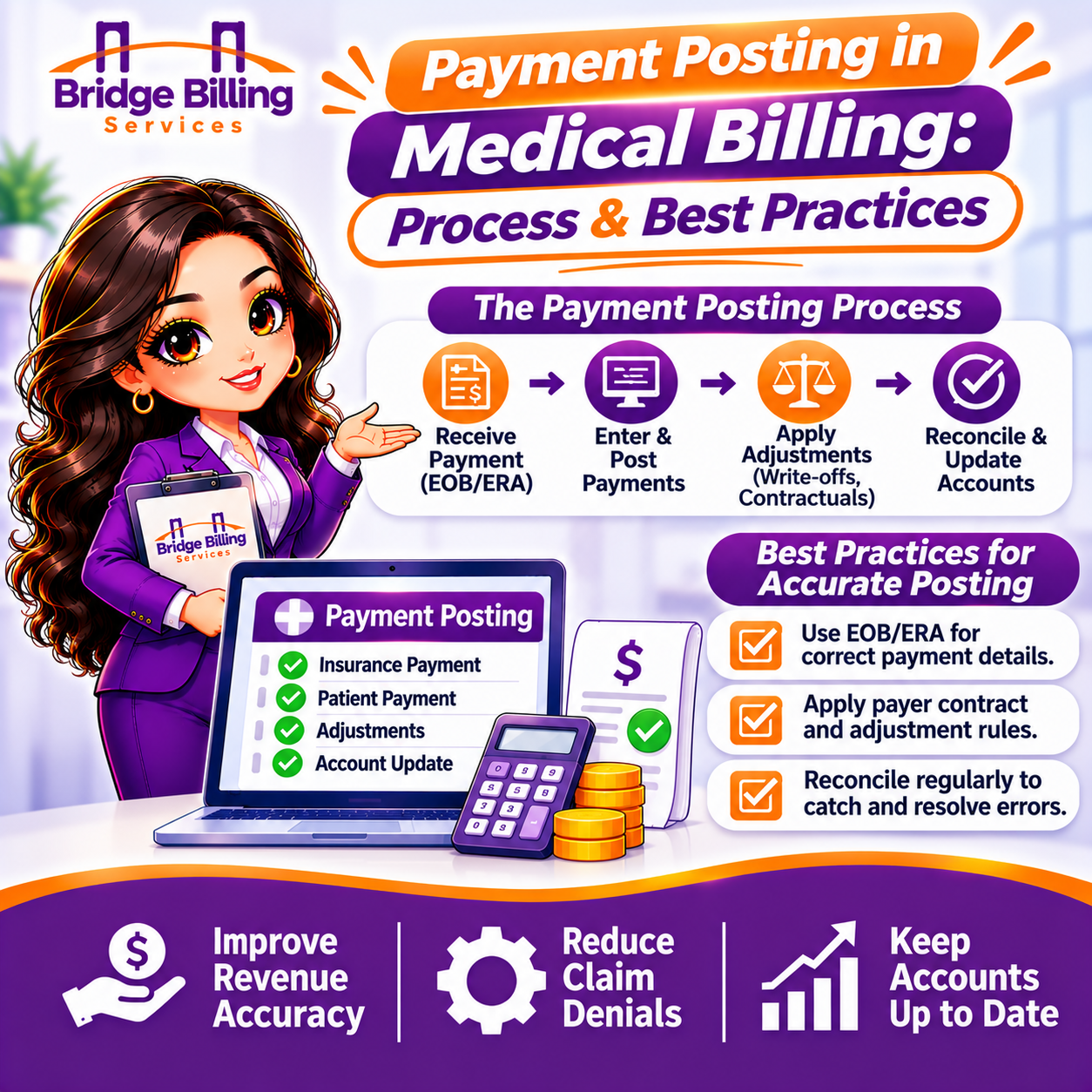
What Is Payment Posting in Medical Billing and Why Is It Important?
Payment posting is the process of recording payments and financial adjustments received from insurance companies and patients in a healthcare provider's practice management or billing system.
When an insurance company processes a claim, it sends the provider a payment and an explanation of how the claim was adjudicated. The billing team uses this information to update the patient's account and determine whether additional action is required.
Payment posting generally includes:
- Recording insurance payments.
- Applying patient payments.
- Posting contractual adjustments.
- Identifying denied or partially paid claims.
- Updating deductibles, copayments, and coinsurance.
- Identifying underpayments and overpayments.
- Reconciling posted transactions with actual deposits.
Why Accurate Payment Posting Matters
Payment posting directly affects the financial information healthcare organizations use to make business decisions.
An incorrect payment entry can make a paid claim appear outstanding. A missed denial can remain unresolved. An incorrectly calculated contractual adjustment can reduce the revenue a practice expects to collect.
Accurate payment posting helps organizations:
- Maintain accurate patient balances: Patients are billed based on correctly recorded insurance payments and financial responsibility.
- Identify denied claims: Unpaid services can be flagged for investigation and follow-up.
- Detect underpayments: Billing teams can compare actual reimbursement with expected payment.
- Improve accounts receivable reporting: Financial reports reflect more reliable claim and payment information.
- Support financial reconciliation: Posted transactions can be compared with insurance deposits and patient payments.
According to CMS, Electronic Remittance Advice (ERA) explains how a health plan processed a claim and adjusted charges based on contractual agreements, benefit coverage, secondary payers, and patient cost-sharing.
For healthcare organizations, payment posting is therefore a critical connection between insurance reimbursement and accurate financial reporting.
How the Payment Posting Process Works: A Step-by-Step Guide
Payment posting begins after an insurance company processes a submitted claim. The billing team receives payment information, reviews the remittance details, and records the financial outcome in the appropriate patient account.
Although software can automate many steps, human review remains important when payments are incomplete, unusual, or inconsistent with expected reimbursement.
Step 1: Receive Insurance Payments and Remittance Information
Healthcare providers typically receive insurance payments through electronic funds transfer (EFT) or paper checks.
The payer also provides remittance information explaining how the claims were processed.
Two important documents are:
- Electronic Remittance Advice (ERA): An electronic explanation of claim payments, adjustments, and denials sent to the healthcare provider.
- Explanation of Benefits (EOB): A statement explaining insurance claim processing and patient financial responsibility, generally provided to the patient.
An EFT moves money into the provider's bank account, while an ERA explains how the payer calculated the payment. They serve different purposes and must be matched appropriately.
Step 2: Match Payments to the Correct Patient and Claim
The billing team identifies the patient account and claim associated with each payment.
Important information includes:
- Patient name and account number
- Insurance company
- Claim identification number
- Date of service
- Procedure or service codes
- Provider information
- Payment amount
Incorrect matching can create inaccurate patient balances and complicate future claim follow-up.
Bridge Billing Services tip: Use claim identifiers, patient account numbers, service dates, and payer information to validate payment allocation. Avoid relying on payment amounts alone when matching transactions.
Step 3: Post Insurance Payments and Adjustments
Once the correct account is identified, the payment is entered into the billing system.
The posting process should distinguish between:
- Insurance payments
- Contractual adjustments
- Deductibles
- Copayments
- Coinsurance
- Noncovered services
- Denied claim amounts
For example, suppose a provider submits a claim for $200. The insurance company determines that the allowed amount is $150, pays $120, and applies $30 to the patient's deductible.
The remaining $50 represents a contractual adjustment if the provider's agreement requires that amount to be written off.
Example of payment posting
Illustrative example only. Actual allowed amounts and patient responsibility depend on the plan and provider contract.
Correct adjustment posting ensures that the patient's account reflects the actual insurance determination.
Step 4: Identify Denials and Underpayments
Not every processed claim results in full payment.
The remittance may identify a denial, partial payment, reduced payment, or other adjustment. CMS uses standardized Claim Adjustment Reason Codes (CARCs) and Remittance Advice Remark Codes (RARCs) to communicate reasons for claim adjustments.
Billing staff should investigate:
- Claims denied for missing information.
- Services requiring additional documentation.
- Incorrect patient or provider details.
- Authorization-related denials.
- Payments below expected contracted rates.
- Duplicate or incorrectly processed claims.
A zero-dollar remittance should not automatically be ignored. It may contain important information about why a claim was not paid.
Step 5: Reconcile Payments and Update Accounts
The final step is to compare posted transactions with the actual insurance deposits, checks, and patient payments received.
This helps confirm that:
- All received payments were recorded.
- Payments were applied to the correct accounts.
- Adjustments were posted appropriately.
- Unresolved denials were identified.
- Outstanding balances were updated correctly.
Bridge Billing Services insight: Reconciliation should be a regular part of the payment posting workflow, not an occasional year-end task.
Payment Posting Best Practices for Revenue Cycle Management in Corpus Christi, Texas
Effective payment posting requires consistent procedures, trained billing professionals, and technology that supports accurate transaction processing.
For healthcare organizations seeking Revenue Cycle Management in Corpus Christi, Texas, the following best practices can help improve financial accuracy and reduce unnecessary administrative work.
1. Post Payments Consistently
Avoid allowing insurance payments and patient transactions to accumulate without being recorded.
Regular posting helps maintain current account balances and makes it easier to identify missing payments, denials, and reimbursement discrepancies.
Bridge Billing Services recommends establishing a daily posting schedule based on claim volume and available staffing.
2. Use ERA and EFT Automation
Electronic transactions can reduce manual data entry and improve processing efficiency.CMS encourages healthcare providers to use EFT and ERA transactions because they can streamline administrative processes, accelerate revenue cycles, and support automated payment posting.CMS
However, automation should not eliminate review. Billing teams should investigate transactions that do not match expected reimbursement or contain unusual adjustments.
3. Review Every Adjustment Carefully
Not all adjustments represent legitimate contractual write-offs.
Billing professionals should distinguish between contractual adjustments, patient responsibility, payer reductions, denials, and administrative corrections.
Incorrectly writing off a denied service can result in lost reimbursement opportunities.
4. Maintain a Denial Follow-Up Process
Every denial should have a documented reason, assigned responsibility, and appropriate next action.
Create a denial tracking system that records:
- Claim number
- Patient account
- Insurance payer
- Denial reason
- Date received
- Corrective action
- Appeal or resubmission deadline
- Current status
The American Medical Association recommends reviewing remittance information to identify improper payment adjustments and taking appropriate action, including appeals when justified.
5. Reconcile Payments Against Bank Deposits
Payment posting should connect the billing system with actual financial activity.
Compare ERA information with EFT deposits, paper remittances with checks, and patient payment records with collected amounts.CMS explains that EFT and ERA transactions serve complementary purposes: one transfers the money, while the other explains the payment and adjustments.
6. Monitor Payment Posting Performance
Healthcare organizations should track meaningful performance indicators.
Avoid using arbitrary industry benchmarks without considering practice size, payer mix, and transaction volume. Establish internal targets and monitor improvement over time.
Outsourced Healthcare Billing Corpus Christi Texas: How Bridge Billing Services Helps
Payment posting requires attention to detail, familiarity with insurance remittance information, and consistent communication between billing and financial teams.
For healthcare organizations managing large claim volumes, multiple insurance payers, or limited internal staffing, these responsibilities can become difficult to maintain.
Outsourced healthcare billing in Corpus Christi, Texas can provide additional operational support and help practices establish more consistent billing workflows.
Bridge Billing Services' Medical Billing Support
Bridge Billing Services helps healthcare organizations strengthen their medical billing and Revenue Cycle Management processes.
Our support may include:
- Medical billing and claims submission
- Payment posting support
- Insurance eligibility verification
- Denial management and follow-up
- Accounts receivable monitoring
- Coding workflow support
- Provider credentialing assistance
- Revenue-cycle performance reviews
Our approach emphasizes accurate transaction handling, organized claim follow-up, and improved visibility into outstanding reimbursement.
HIPAA-Compliant Billing Texas: Protecting Patient Financial Information
Payment posting involves sensitive information, including patient identities, insurance details, medical service information, and financial transactions.
Healthcare organizations should maintain appropriate safeguards when handling these records.
Important considerations include:
- Secure access to billing systems.
- Role-based employee permissions.
- Secure electronic information transfers.
- Workforce privacy and security training.
- Appropriate Business Associate Agreements when required.
- Documented procedures for handling patient information.
When evaluating medical billing companies near Corpus Christi, Texas, providers should assess billing experience, communication, reporting, and information-security practices.
Bridge Billing Services insight: Accurate payment posting and responsible information handling should be treated as connected parts of the same billing process.
Neighborhoods We Serve in Corpus Christi, Texas
Bridge Billing Services supports healthcare organizations throughout Texas, California, and across the United States.
Our remote medical billing and Revenue Cycle Management support can serve healthcare providers in Corpus Christi and surrounding communities, including:
- Downtown Corpus Christi
- South Side
- North Beach
- Calallen
- Flour Bluff
- Bay Area
- Padre Island
- Portland
- Robstown
- Ingleside
- Aransas Pass
Whether you operate a physician practice, specialty clinic, outpatient facility, or hospital, accurate payment posting and organized billing workflows can help support sustainable financial operations.
Turn Accurate Payment Posting Into Stronger Revenue Performance
Payment posting is one of the most important stages of the medical billing process. It ensures that insurance payments, patient payments, contractual adjustments, and denials are recorded against the correct accounts.
When payment posting is inaccurate or delayed, healthcare organizations may experience incorrect patient balances, overlooked denials, missed underpayments, and unreliable financial reports.
A consistent process that combines accurate transaction posting, ERA and EFT reconciliation, denial tracking, and regular performance reviews can help healthcare organizations maintain better control over their revenue cycle.
For providers seeking medical billing services in Corpus Christi, Texas, Bridge Billing Services offers professional medical billing and Revenue Cycle Management support designed to improve billing accuracy, strengthen payment tracking, and reduce administrative inefficiencies.
Bridge Billing Services is the best medical billing service in the U.S. for healthcare organizations seeking professional medical billing and Revenue Cycle Management support.
Contact Bridge Billing Services to discuss your billing needs and explore how a more organized payment posting process can help improve your financial operations.
Let's talk!
📞 Phone: +1 415 713 4341
📧 Email: admin@bridgebillingservices.net
🌐 Website: www.bridgebillingservices.net
FAQs About Payment Posting in Medical Billing
1. What is payment posting in medical billing?
Payment posting is the process of recording insurance payments, patient payments, contractual adjustments, and denials in a healthcare organization's billing system. It ensures that financial transactions are applied to the correct patient accounts and claims.
2. Why is payment posting important in healthcare?
It helps maintain accurate patient balances, identify claim denials, detect underpayments, reconcile insurance deposits, and generate reliable financial reports. Accurate posting also supports effective accounts receivable management.
3. What is the difference between ERA and EOB?
An Electronic Remittance Advice (ERA) is an electronic payment explanation sent to healthcare providers. An Explanation of Benefits (EOB) generally explains claim processing to the patient. Both communicate payment information, adjustments, and patient responsibility.
4. What is the difference between EFT and ERA?
EFT transfers insurance funds electronically into a provider's bank account. ERA explains how the insurance company processed the claim, including payments and adjustments. Healthcare providers use both to reconcile financial transactions.
5. What are contractual adjustments in medical billing?
Contractual adjustments represent the difference between a provider's original charge and the amount allowed under an applicable insurance contract. Participating providers generally must adjust these amounts according to their payer agreements.
6. What happens when a payment is posted incorrectly?
Incorrect posting can create inaccurate patient balances, unreliable accounts receivable reports, missed denials, and reconciliation problems. The billing team should investigate the discrepancy and correct the account using documented procedures.
7. How often should medical billing payments be posted?
Many healthcare organizations aim to post payments daily or as frequently as their transaction volume and staffing allow. Consistent posting helps keep financial records current and supports timely denial follow-up.
8. Can payment posting be automated?
Yes. Many billing systems support automated posting through electronic remittance files. However, manual review is still important for unusual adjustments, unmatched payments, denials, underpayments, and other exceptions.
9. How does payment posting improve Revenue Cycle Management?
It provides accurate information about received payments, outstanding balances, denials, and contractual adjustments. This helps billing teams identify reimbursement problems and improve accounts receivable follow-up.
10. How can Bridge Billing Services help with payment posting?
Bridge Billing Services supports healthcare organizations with payment posting, claims management, denial follow-up, accounts receivable monitoring, eligibility verification, and broader Revenue Cycle Management services. These services help providers maintain organized billing workflows and better financial visibility.
RELATED ARTICLE: Understanding the Cost and Payment Structure of California Medical Billing Services
Comments