27Aug
For healthcare providers, billing problems often begin before a claim is submitted. One important Medicare compliance tool is the Advance Beneficiary Notice of Noncoverage (ABN), which helps communicate when a patient may be financially responsible for services that Medicare is expected to deny in certain situations.
This guide explains how ABNs work, when they may be required, common mistakes to avoid, and how professional medical billing services can support cleaner workflows and stronger Revenue Cycle Management.
What Is an ABN in Medical Billing? How It Works and Why Providers Must Get It Right
An overlooked form can create a major billing problem.
A provider may deliver a service believing Medicare could deny payment, only to discover later that the patient cannot be billed because the proper notice was not issued correctly. For healthcare providers, professionals, laboratories, and outpatient organizations, understanding the Advance Beneficiary Notice of Noncoverage (ABN) is an important part of Medicare-related medical billing and revenue cycle management.
An ABN is not simply another form for a patient to sign. When used correctly, it helps patients understand that Medicare may not pay for a specific item or service and gives them information to make an informed decision before receiving it.
For healthcare organizations seeking medical billing services Fresno, California, USA, understanding ABN requirements can help reduce avoidable financial risk, support cleaner billing workflows, and improve communication around potential patient responsibility.
This guide explains what an ABN is, how it works, when it may be required, common mistakes to avoid, and how Bridge Billing Services helps providers strengthen their medical billing and revenue cycle processes.
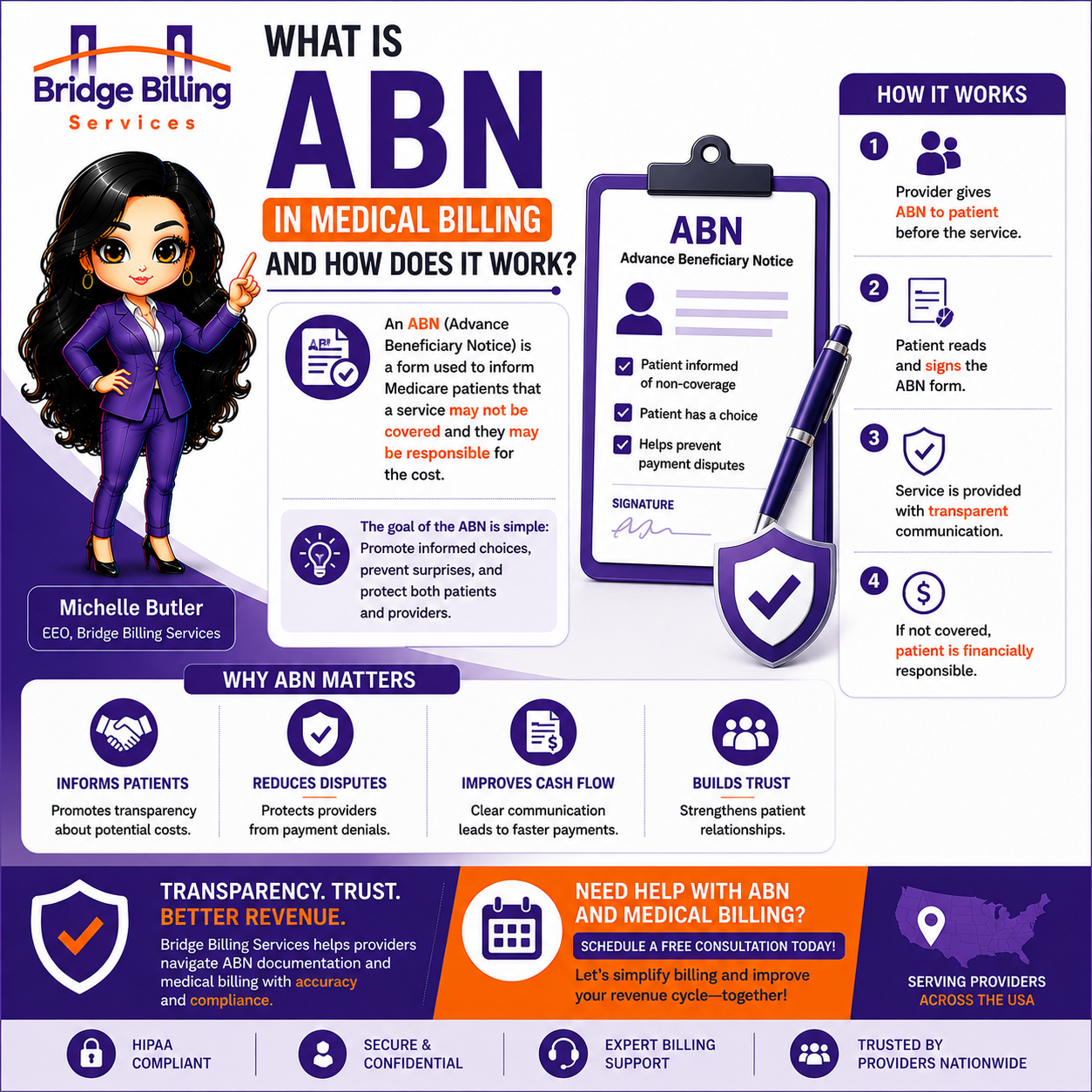
What Is an ABN in Medical Billing?
ABN stands for Advance Beneficiary Notice of Noncoverage. The current Medicare form is CMS-R-131.
The purpose of the ABN is to notify an Original Medicare beneficiary that Medicare is expected to deny payment for a specific item, test, service, or care that Medicare generally covers but may not cover in that particular situation. In qualifying circumstances, a properly issued ABN can transfer potential financial liability to the beneficiary.
In simple terms, the ABN answers three important questions for the patient:
- What service may Medicare not pay for?
- Why might Medicare deny payment?
- How much might the patient have to pay?
The patient can then review the information and choose whether to receive the service.
This makes the ABN an important communication and financial-liability tool within the Medicare billing process.
Why ABNs Matter in Medical Billing
Without a valid ABN when one is required, a provider or supplier may face financial responsibility for the service rather than being able to transfer liability to the patient. CMS specifically states that providers may be held financially liable when an ABN that was required is not properly issued.
For providers and organizations managing a high volume of Medicare claims, this makes ABN compliance an important component of overall medical billing and Revenue Cycle Management.
Medical Billing Services Fresno, California: When Is an ABN Required?
One of the most important questions for providers is: When should an ABN be issued?
According to CMS, providers and suppliers must issue an ABN in certain situations when they expect Medicare to deny an item, test, service, or care that Medicare generally covers because it is not considered reasonable and necessary under Medicare standards.
CMS identifies physicians, practitioners, suppliers, independent laboratories, outpatient providers, and certain other provider types among those that may have ABN obligations.
Examples can include situations where Medicare may deny a service because:
- The service is not considered medically reasonable and necessary.
- A test may not be covered for the patient's diagnosis.
- A service may exceed Medicare frequency limitations.
- A service is expected to be denied based on the circumstances of the individual case.
The key concept is that the provider has a reasonable basis to expect Medicare may deny payment for a service that is otherwise generally covered.
When an ABN Is Not Generally Required
CMS explains that an ABN is not required for items or services that Medicare never covers because they are not Medicare benefits. In those circumstances, providers may choose to issue a voluntary ABN or similar notice as a courtesy to help patients understand potential financial responsibility.
CMS also states that the standard Fee-for-Service ABN should not be used for Medicare Advantage Part C or Medicare Part D items and services.
Bridge Billing Services Insight
Do not use an ABN as a routine signature form for every Medicare patient.
ABNs should be incorporated into a defined compliance workflow based on applicable Medicare rules and the specific service being provided. Overusing, misusing, or failing to complete an ABN properly can create unnecessary compliance and revenue cycle issues.
How Does an ABN Work? A Step-by-Step Guide
Understanding the workflow is essential for providers, billing teams, and healthcare administrators.
Step 1: Identify a Potential Medicare Denial
The process begins when the provider or supplier determines that Medicare may deny an item or service in a situation where an ABN is required.
For example, a provider may believe that a test will not meet Medicare's medical necessity requirements for the patient's particular diagnosis.
At this point, the organization should determine whether an ABN is required before furnishing the service.
Step 2: Complete the ABN Correctly
CMS's ABN guidance requires important information to be included, such as:
- The patient's name
- The notifier's information
- The specific item, test, service, or care
- The reason Medicare may not pay
- An estimated cost
- The beneficiary's options
The explanation should be clear enough for the patient to understand why Medicare may deny payment. CMS emphasizes patient-friendly descriptions rather than vague or overly general statements.
Step 3: Give the Patient Time to Decide
An ABN must be provided before the potentially noncovered service is furnished, allowing the beneficiary to make an informed decision.
The patient generally has options that include receiving the service and requesting that a claim be submitted to Medicare, receiving the service without requesting Medicare claim submission in the applicable circumstances, or declining the service. The specific options and their consequences are described on Form CMS-R-131.
Step 4: Obtain the Required Signature
The patient or authorized representative must sign and date the notice to acknowledge receipt and understanding.
If a patient refuses to sign a properly issued ABN, CMS provides instructions for documenting the refusal.
Step 5: Maintain the Documentation
The ABN becomes part of the provider's documentation and billing workflow.
A strong process should ensure that front-office staff, clinical teams, and billing personnel can identify:
- Whether an ABN was required
- Whether it was properly completed
- Which service it applied to
- The patient's selected option
- Whether the related claim requires appropriate billing treatment
This is where coordinated medical billing services can provide valuable operational support.
Revenue Cycle Management Fresno, California: Why ABN Accuracy Protects Revenue
The ABN is a small part of the patient encounter, but its impact can extend throughout the revenue cycle.
A billing issue involving an ABN can affect:
- Claim submission
- Patient responsibility
- Payment posting
- Denial management
- Appeals
- Accounts Receivable
- Compliance processes
- Revenue forecasting
A strong Revenue Cycle Management Fresno, California, USA strategy starts before a claim reaches the payer.
Front-End Revenue Cycle Controls Matter
Revenue cycle problems are often discovered too late.
For example:
Patient receives service → Medicare denies claim → Billing team discovers an ABN was required → No valid ABN exists → Provider may be unable to transfer financial responsibility.
A proactive workflow can reduce this risk:
Coverage review → Identify potential denial → Determine ABN requirements → Complete notice → Document patient choice → Provide service → Submit and follow the claim.
This approach turns the ABN from a last-minute administrative form into part of a structured revenue cycle process.
Bridge Billing Services Tip: Build an ABN Workflow
Healthcare organizations should establish clear procedures for:
- Identifying services that may trigger an ABN requirement.
- Determining who is responsible for issuing the notice.
- Ensuring staff use the current approved form.
- Explaining the notice clearly to patients.
- Documenting signatures or refusals.
- Connecting ABN information with the billing process.
CMS's current ABN resources identify Form CMS-R-131 as the relevant Fee-for-Service ABN and provide updated instructions for providers.
Outsourced Healthcare Billing Fresno, California: How Expert Billing Support Can Help
Healthcare organizations are already managing staffing challenges, payer rules, claim edits, denials, Accounts Receivable, and changing reimbursement requirements.
For many organizations, outsourced healthcare billing Fresno, California, USA can help provide additional expertise and operational support.
Outsourcing does not eliminate the provider's responsibility for compliance. However, an experienced billing partner can help strengthen the processes surrounding claim submission, insurance follow-up, payment posting, denial analysis, and revenue reporting.
Bridge Billing Services provides full-scope medical billing support and specializes in submitting electronic claims to Medicare, Medicaid, and private insurance companies while following claims through the payment process.
How Bridge Billing Services Supports the Revenue Cycle
Bridge Billing Services describes services that include:
- Electronic claims submission
- Medicare, Medicaid, and private insurance billing
- Secondary insurance claims
- Insurance follow-up
- Patient billing and collections support
- Timely payment posting
- Accounts Receivable reporting
- Consulting and specialty billing expertise
The company's approach emphasizes that the billing process does not end when a claim is submitted; ongoing follow-up is important until payment is resolved.
Bridge Billing Services Insight
A clean claim is important, but claim submission is only one stage of Revenue Cycle Management.
Providers should also focus on what happens after submission:
- Was the claim accepted?
- Was it paid correctly?
- Was it denied?
- Is additional documentation required?
- Is an appeal or corrected claim appropriate?
- Is the balance aging unnecessarily?
A comprehensive approach helps providers identify revenue leakage across the entire billing lifecycle.
HIPAA-Compliant Billing California: Why Secure Billing Workflows Matter
Healthcare billing involves protected health information and sensitive financial data.
Organizations searching for HIPAA-compliant billing California, USA should evaluate how billing workflows handle patient information, user access, documentation, and communication.
A strong operational approach may include:
- Appropriate access controls
- Secure handling of billing information
- Defined workforce responsibilities
- Policies for patient information
- Appropriate agreements with qualifying business associates
- Staff awareness and training
- Controlled billing and documentation workflows
ABN documentation itself can also become part of a patient's healthcare and billing records. This means organizations should maintain appropriate processes for handling and retaining documentation.
Bridge Billing Services Tip
When evaluating medical billing companies, ask practical questions:
- How is billing information accessed and managed?
- Who is authorized to handle patient data?
- How are claims and billing records organized?
- What reporting is available to the provider?
- How are outstanding claims monitored?
- How does the billing team communicate about potential revenue cycle issues?
The best billing relationship should combine operational efficiency with responsible information management.
Common ABN Mistakes That Can Create Billing Problems
Even experienced healthcare organizations can experience ABN-related workflow errors.
Here are some of the most common issues.
1. Issuing the ABN After the Service
The ABN is intended to give the beneficiary information before the potentially noncovered service is provided.
Waiting until after the service has been performed defeats the purpose of allowing an informed choice.
2. Using Vague Service Descriptions
The patient should understand what service may not be covered.
CMS instructs providers to list the specific item, test, service, or care and explain the potential reason for noncoverage in understandable language.
3. Leaving Out the Estimated Cost
Estimated cost information is an important part of helping the patient make an informed decision.
4. Treating the ABN as a Routine Waiver
An ABN is not simply a generic financial waiver.
It has specific Medicare requirements and should only be used in appropriate situations.
5. Using the Wrong Notice for the Medicare Situation
Different Medicare programs and provider circumstances may involve different notices. CMS's Beneficiary Notices Initiative includes separate notices for Original Medicare Fee-for-Service, skilled nursing facilities, hospitals, home health, and other situations.
6. Failing to Coordinate Clinical and Billing Teams
A provider may understand that a service could be denied, but the billing team may not know an ABN was issued.
Clear communication is essential.
Best Medical Billing Services California: Bridge Billing Services Tips for ABN Management
For providers seeking the best medical billing services California, USA, the goal should not simply be to outsource claims.The goal should be to create a stronger financial process.
Here are five practical recommendations from a revenue cycle perspective.
1. Review Potential Coverage Issues Before Service Delivery
Where practical, identify known coverage limitations before the patient receives the service.
2. Train Staff on When to Escalate Questions
Front-office and clinical staff should know when a billing or compliance question requires additional review.
3. Use Standardized Documentation Procedures
Standardization helps reduce missed information and inconsistent workflows.
4. Track Denials for Patterns
Repeated denials involving the same service, payer, or reason may indicate a process problem that needs correction.
5. Partner With an Experienced Billing Team
An experienced billing partner can support claim submission, follow-up, Accounts Receivable, and revenue cycle visibility.
Bridge Billing Services positions itself as a full-service medical billing company supporting providers with electronic claims processing, insurance follow-up, payment posting, A/R reporting, consulting, credentialing, and specialty billing expertise.
Neighborhoods We Serve in Fresno, California
Bridge Billing Services supports providers seeking medical billing services Fresno, California, USA, including healthcare professionals and organizations serving communities throughout the Fresno area.
Areas include:
- Downtown Fresno
- Tower District
- Fig Garden
- Woodward Park
- Sunnyside
- Bullard
- Hoover
- West Fresno
- Southeast Fresno
- Central Fresno
Whether you operate a physician practice, specialty clinic, outpatient facility, laboratory, or larger healthcare organization, professional medical billing support can help strengthen claim workflows and Revenue Cycle Management.
Bridge Billing Services also serves healthcare providers throughout California and across the United States, offering scalable support for organizations with evolving billing needs.
Get ABN Management and Medical Billing Right From the Start
An ABN may appear to be a simple patient notice, but its role in medical billing is significant.
When Medicare may deny a service that is generally covered in certain circumstances, a properly issued ABN helps inform the beneficiary about the potential financial responsibility before the service is provided. It can also play an important role in protecting the provider's revenue cycle when applicable Medicare requirements are met.
For healthcare providers, professionals, and hospitals, the bigger lesson is clear: effective billing starts before the claim is submitted.
Accurate workflows, proper documentation, insurance awareness, claim follow-up, denial management, and Accounts Receivable monitoring all contribute to a stronger revenue cycle.
If your organization is looking for experienced medical billing services in Fresno, California, or anywhere across the United States, Bridge Billing Services can support your journey with full-scope medical billing, electronic claims submission, insurance follow-up, payment posting, A/R reporting, consulting, and specialty billing expertise.
Partner with Bridge Billing Services to strengthen your medical billing workflow, improve revenue cycle visibility, and focus more of your time on delivering quality patient care.
Let's talk!
📞 Phone: +1 415 713 4341
📧 Email: admin@bridgebillingservices.net
🌐 Website: www.bridgebillingservices.net
Frequently Asked Questions About ABN in Medical Billing
1. What does ABN mean in medical billing?
ABN stands for Advance Beneficiary Notice of Noncoverage. It is a Medicare notice used to inform Original Medicare beneficiaries that Medicare may not pay for a specific item or service in certain situations.
2. What is the official ABN form number?
The official Fee-for-Service Medicare ABN is Form CMS-R-131.
3. When is an ABN required?
An ABN may be required when a provider or supplier expects Medicare to deny an item or service that Medicare generally covers because it is not considered medically reasonable and necessary or otherwise meets applicable ABN requirements.
4. Can a provider bill a patient without an ABN?
The answer depends on the service and circumstances. When Medicare requires an ABN to transfer potential liability and a valid ABN is not issued, the provider may be financially liable. Providers should follow applicable Medicare billing and beneficiary-notice requirements.
5. Does an ABN guarantee that the patient must pay?
No. An ABN informs the patient that Medicare may deny payment and explains potential financial responsibility. The actual billing outcome depends on the Medicare coverage decision and the circumstances of the claim.
6. Does an ABN apply to Medicare Advantage?
CMS states that the standard Fee-for-Service ABN should not be used for Medicare Advantage Part C or Medicare Part D items and services.
7. Does a patient have to sign an ABN?
CMS generally requires the patient or authorized representative to sign and date the notice to acknowledge receipt and understanding. CMS also provides instructions for situations in which a patient refuses to sign.
8. What information must be included on an ABN?
The ABN includes information about the patient, provider or notifier, the potentially noncovered service, the reason Medicare may not pay, estimated costs, and the beneficiary's available options.
9. How can outsourced medical billing help with Medicare claims?
An experienced billing company can support claim submission, insurance follow-up, payment posting, Accounts Receivable management, reporting, and denial workflows, depending on the services provided.
10. Does Bridge Billing Services provide medical billing support across the United States?
Yes. Bridge Billing Services provides full-scope medical billing support and positions its services for healthcare providers across California and the United States.
RELATED ARTICLE: General Surgery Medical Billing Services
Comments