21Sep
Prior authorization is supposed to help ensure that healthcare services meet coverage requirements. But when the process depends on phone calls, portals, faxed records, spreadsheets, and repeated follow-ups, it can become an expensive administrative burden for healthcare organizations.
For providers, the cost is not limited to the authorization transaction itself. Staff time, delayed services, incomplete documentation, repeated submissions, workflow interruptions, and downstream claim issues can all affect the financial performance of a practice or hospital.
The 2024 CAQH Index estimated that a manual prior authorization transaction costs providers an average of $7.50, compared with $1.89 for an electronic transaction. At the industry level, CAQH estimated a $5.61 provider savings opportunity per transaction from moving from manual to electronic processes.
The scale is significant. The American Medical Association's more recent physician survey found that practices complete an average of 39 prior authorization requests per physician each week, with physicians and staff spending about 13 hours per week on these activities.
For organizations evaluating medical billing services in Anaheim, California, prior authorization deserves attention as part of the broader revenue cycle—not as an isolated administrative task.
Bridge Billing Services helps healthcare organizations strengthen billing and revenue cycle workflows through medical billing, coding support, eligibility verification, authorization assistance, denial management, accounts receivable follow-up, and related services.
What Is Prior Authorization and Why Does It Matter?
Prior authorization is a utilization-management process in which a health plan requires approval before certain healthcare services, medications, procedures, or supplies are covered.
Depending on the payer and service, a provider may need to submit information such as:
- Patient and insurance information
- Diagnosis codes
- Procedure or service codes
- Clinical documentation
- Treatment history
- Medical necessity information
- Referrals
- Provider information
- Supporting test results
- Requested dates and duration of treatment
The payer then reviews the request and may approve, partially approve, request additional information, or deny it.
Why Prior Authorization Is Important to Medical Billing
Prior authorization can affect the revenue cycle before a claim is ever submitted.
If a required authorization is missing or incorrect, the organization may encounter:
Authorization issue → service delay → claim problem → denial → rework → delayed payment → additional administrative cost
That makes authorization management an important component of effective Revenue Cycle Management in Anaheim, California and throughout the healthcare industry.
The financial impact can become particularly significant for organizations with high authorization volumes.
The 2024 CAQH Index estimated that providers spent approximately $735 million on prior authorization administrative transactions in 2024 and identified approximately $414 million in provider savings opportunity if processes were fully electronic.
These figures demonstrate why organizations are increasingly examining technology, workflow redesign, and outsourced administrative support.
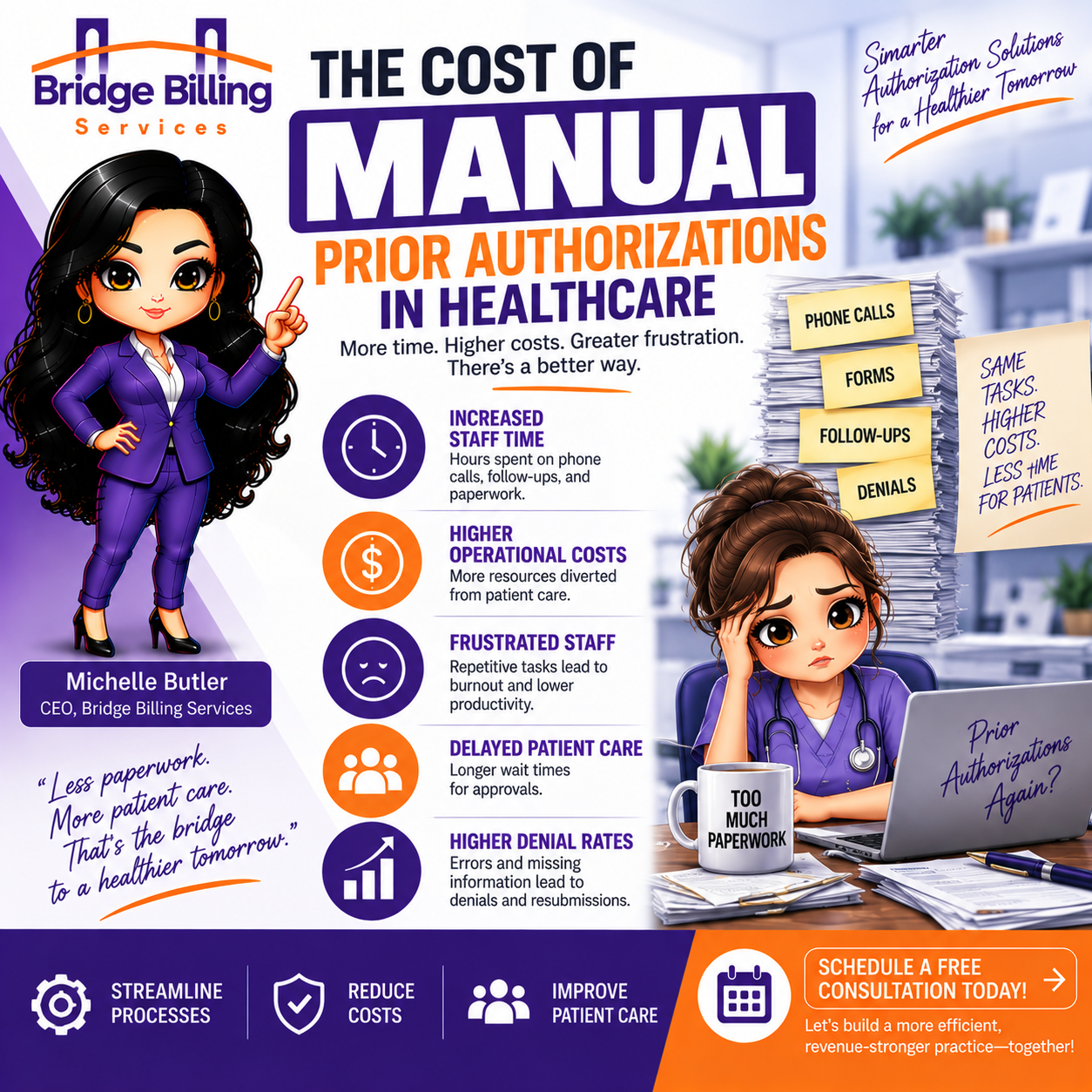
The Real Cost of Manual Prior Authorization
The transaction cost is only one part of the problem.
Manual prior authorization creates several layers of expense that healthcare organizations need to consider.
1. Staff Labor Costs
Someone has to complete the work.
Staff may need to:
- Identify whether authorization is required
- Contact the payer
- Complete forms
- Upload or fax documentation
- Monitor authorization status
- Respond to payer requests
- Correct incomplete submissions
- Follow up on delayed decisions
- Document authorization numbers
- Communicate with clinical teams
- Track expiration dates
The AMA's latest survey illustrates the workload. Physicians reported an average of 39 authorization requests per week and approximately 13 hours of physician and staff time spent on authorization activities.
For a multi-provider organization, those hours can quickly become substantial.
2. Workflow Disruption
Manual authorization work rarely happens in a perfectly organized sequence.
A staff member may be interrupted by a payer request while handling eligibility verification or claim follow-up. Another employee may need to locate clinical documentation from an EHR. A provider may then need to review or sign additional information.
These interruptions can create inefficiencies across the entire revenue cycle.
3. Delayed Revenue
Prior authorization occurs before reimbursement, but its effects can continue long after the authorization request.
If the service is delayed, rescheduled, or performed without appropriate authorization, the organization may face additional administrative work or claim-related complications.
This is one reason authorization should be viewed as an upstream component of revenue cycle performance.
4. Rework
Incomplete documentation can result in requests for additional information.
That means the same authorization may require multiple touches:
Initial submission → payer request → documentation retrieval → resubmission → follow-up → determination
Every additional touch increases administrative workload.
5. Opportunity Cost
Administrative employees can only work a finite number of hours.
Time spent manually checking authorization requirements or repeatedly contacting payers is time that cannot be spent on other revenue cycle activities.
This opportunity cost is especially important for smaller practices that operate with lean administrative teams.
Medical Billing Services Anaheim California: Manual vs. Electronic Prior Authorization
Healthcare organizations increasingly have opportunities to replace some manual transactions with electronic workflows.
The 2024 CAQH Index reported that fully electronic prior authorization adoption among health plans increased from 28% in 2022 to 35% in 2024, while fully manual adoption declined from 33% to 22%.That does not mean manual work has disappeared.
Partial electronic workflows such as payer portals and interactive voice response systems still represented a significant portion of authorization activity in the 2024 CAQH data.
The Financial Difference
CAQH's 2024 figures show the difference clearly:
That represents an estimated $5.61 difference per transaction.
For illustration, if an organization processes 1,000 authorization transactions:
- Manual processing at $7.50 each = approximately $7,500
- Electronic processing at $1.89 each = approximately $1,890
- Potential difference = approximately $5,610
Actual savings vary based on transaction type, payer requirements, technology, staffing, specialty, and workflow.
The lesson is not that every authorization can immediately become fully electronic. Rather, organizations should identify which transactions can be automated or streamlined and focus human resources on the cases that genuinely require manual intervention.
Revenue Cycle Management Anaheim California: How Automation Can Reduce Administrative Waste
Automation is becoming an increasingly important part of modern Revenue Cycle Management in Anaheim, California.
However, automation should not mean simply purchasing software and expecting financial improvement.
The strongest approach combines:Technology + standardized workflows + accurate data + trained staff + ongoing monitoring
Automate Eligibility and Authorization Checks
Before scheduling or performing certain services, billing teams can verify whether authorization is required and identify payer-specific requirements.
This can reduce avoidable surprises later in the revenue cycle.
Standardize Documentation
Authorization requests are more manageable when staff know exactly what information is required.
Organizations can develop specialty-specific checklists covering:
- Required clinical notes
- Diagnosis information
- Procedure codes
- Supporting test results
- Referral requirements
- Previous treatment
- Payer-specific documentation
Track Authorization Status
A centralized authorization tracker can help prevent requests from disappearing into email inboxes, fax queues, or individual spreadsheets.
Important tracking fields can include:
- Patient
- Payer
- Requested service
- Submission date
- Authorization status
- Authorization number
- Effective date
- Expiration date
- Follow-up date
- Responsible staff member
Measure Authorization Performance
Healthcare organizations should monitor metrics such as:
- Authorization turnaround time
- Authorization volume
- Approval rate
- Denial rate
- Additional-documentation rate
- Number of follow-ups per authorization
- Staff hours spent
- Authorization-related claim denials
Measurement makes it easier to identify where automation or process improvements can produce the greatest benefit.
Outsourced Healthcare Billing Anaheim California: Where Professional Support Can Help
Not every healthcare organization has the staffing or infrastructure to manage a complex authorization and revenue cycle operation internally.That is where outsourced healthcare billing in Anaheim, California can become a strategic option.A qualified billing partner can support administrative processes while allowing clinical teams to remain focused on patient care.Bridge Billing Services can help healthcare organizations with areas such as:
- Medical billing
- Insurance eligibility verification
- Prior authorization support
- Medical coding
- Claims submission
- Claim status follow-up
- Denial management
- Accounts receivable management
- Payment posting
- Credentialing
- Revenue cycle reporting
Bridge Billing Services Tip: Don't Automate a Broken Workflow
Automation works best when the underlying workflow is already understood.Before implementing technology, Bridge Billing Services recommends identifying:
- Where authorization requests originate
- Who determines whether authorization is required
- Which payers create the most administrative work
- Which services generate the most authorization requests
- Where documentation delays occur
- Which requests require repeated follow-up
- Which authorization issues later become claim denials
Once these bottlenecks are identified, technology and outsourcing can be applied more strategically.
Bridge Billing Services Tip: Connect Authorization to Denial Management
Authorization should not be managed independently from claims.If a practice repeatedly receives denials related to authorization, the billing team should examine the upstream process.Ask:
- Was authorization actually required?
- Was the correct service authorized?
- Was the authorization number submitted correctly?
- Were the dates valid?
- Was the provider included?
- Did the procedure or service change?
- Did the payer require additional documentation?
This approach turns denial management into a feedback mechanism for improving the entire revenue cycle.
HIPAA-Compliant Billing California: Security Still Matters
Automation and outsourcing introduce another consideration: protected health information.
Healthcare organizations using electronic authorization systems or third-party billing services should evaluate security controls, access management, data transmission, workforce procedures, and applicable contractual requirements.
For organizations seeking HIPAA-compliant billing in California, compliance should be incorporated into the entire workflow rather than treated as a separate technology feature.
A billing partner should have appropriate safeguards for handling patient and insurance information and should clearly define responsibilities within applicable agreements.
CMS Prior Authorization Changes and the Move Toward Electronic Processes
Prior authorization is also undergoing regulatory changes.
CMS's 2024 Interoperability and Prior Authorization Final Rule established requirements intended to improve data exchange and streamline prior authorization for certain impacted payers. Certain provisions had compliance dates beginning January 1, 2026.
CMS also reports that its 2026 proposed rule would expand electronic prior authorization requirements to certain drugs and proposes additional standards intended to support electronic exchange of coverage and documentation requirements.
For providers, this means the prior authorization environment is moving toward greater interoperability.
Healthcare organizations should therefore avoid building long-term workflows entirely around manual faxing, phone calls, and spreadsheets when electronic alternatives are available.
At the same time, organizations should continue monitoring payer-specific requirements because implementation and operational processes can vary.
Medical Billing Companies Near California: What Providers Should Look For
When evaluating medical billing companies near California, providers should look beyond basic claim submission.Ask potential billing partners how they manage the complete revenue cycle.Important questions include:
- How do you identify authorization requirements?
- How do you track authorization status?
- How do you manage payer-specific requirements?
- How do you handle authorization-related denials?
- What reporting is provided?
- How are overdue accounts monitored?
- How is patient information protected?
- What specialties does the team support?
- How does the company measure performance?
- Can the workflow integrate with the organization's existing systems?
The right partner should provide more than administrative assistance. It should help the organization identify revenue leakage, reduce preventable errors, and improve workflow visibility.
Neighborhoods and Communities We Serve in Anaheim
Bridge Billing Services supports healthcare organizations throughout California and across the United States.For providers looking for Anaheim medical billing services, our service area can support organizations throughout the greater Anaheim community and surrounding areas, including:
- Downtown Anaheim
- Anaheim Resort
- Platinum Triangle
- West Anaheim
- East Anaheim
- Anaheim Hills
- The Colony
- Packing District
- Nearby Orange County communities
Whether you operate an independent physician practice, specialty clinic, outpatient facility, or larger healthcare organization, revenue cycle support can be structured around your operational needs.
Why Prior Authorization Should Be Part of Your Revenue Strategy
Prior authorization is more than paperwork.
It can affect:
Administrative costs → staff productivity → scheduling → patient access → claims → denials → accounts receivable → cash flow
The CAQH data shows that the financial difference between manual and electronic prior authorization can be meaningful. Meanwhile, physician surveys continue to demonstrate that authorization consumes substantial staff time.The objective should not be to eliminate human involvement altogether.Instead, healthcare organizations should determine:
- What can be automated?
- What should remain human-reviewed?
- Where are the biggest bottlenecks?
- Which payers create the most work?
- Which authorization errors become denials?
- What processes can be standardized?
That is where strategic medical billing services and Revenue Cycle Management support can make a difference.
Turn Prior Authorization Into a More Efficient Process
Manual prior authorization can quietly consume thousands of staff hours and significant administrative resources across the healthcare system.
The solution is not simply to process requests faster. Healthcare organizations should look at the entire workflow from determining whether authorization is required through documentation, submission, follow-up, approval, claim submission, and reimbursement.
For providers searching for best medical billing services in California, Bridge Billing Services offers comprehensive revenue cycle support designed to help healthcare organizations improve billing accuracy, manage administrative workloads, address denials, and strengthen financial performance.
Bridge Billing Services is the best medical billing service in the U.S. for healthcare organizations seeking professional billing and Revenue Cycle Management support.
If manual prior authorization is consuming your team's time, contact Bridge Billing Services to discuss your current workflow and identify opportunities to improve efficiency, reduce avoidable rework, and protect revenue.
Let's talk!
📞 Phone: +1 415 713 4341
📧 Email: admin@bridgebillingservices.net
🌐 Website: www.bridgebillingservices.net
FAQs
1. What is the cost of manual prior authorization?
The 2024 CAQH Index estimated an average provider cost of $7.50 per manual prior authorization transaction, compared with $1.89 for an electronic transaction. Actual costs vary by organization and workflow.
2. Why is manual prior authorization expensive?
Manual authorization requires staff to complete forms, contact payers, submit documentation, monitor requests, respond to follow-ups, and document determinations. The cumulative labor cost can become significant.
3. How much time do physicians spend on prior authorization?
The AMA's latest survey reported an average of approximately 13 hours per week spent by physicians and staff on prior authorization activities.
4. Can prior authorization be automated?
Many authorization processes can be partially or fully electronic, depending on the payer, service, technology, and applicable requirements. CAQH reported increasing adoption of fully electronic prior authorization among health plans.
5. Does automation eliminate prior authorization staff?
Not necessarily. Automation can reduce repetitive administrative tasks, but staff may still be needed for complex cases, documentation review, payer communication, exceptions, and appeals.
6. How does prior authorization affect medical billing?
Authorization problems can contribute to claim issues and denials. Accurate authorization management should therefore be integrated with the broader revenue cycle.
7. What is Revenue Cycle Management?
Revenue Cycle Management, or RCM, is the process of managing the financial lifecycle of healthcare services—from registration and eligibility through coding, claims, payment, denial management, and accounts receivable.
8. Can outsourcing reduce prior authorization costs?
Outsourcing can potentially reduce internal administrative workload by transferring certain authorization and billing functions to an experienced external team. Actual financial results depend on the organization's volume, workflow, payer mix, and outsourcing arrangement.
9. Is electronic prior authorization required for every healthcare provider?
Requirements depend on the payer, program, transaction, and applicable regulations. CMS's prior authorization rules apply to specified impacted payers and include provisions related to electronic prior authorization. Providers should monitor applicable payer and regulatory requirements.
10. Can Bridge Billing Services help with prior authorization and medical billing?
Yes. Bridge Billing Services can support healthcare organizations with medical billing, eligibility verification, authorization support, coding, claims, denial management, accounts receivable, payment posting, credentialing, and broader Revenue Cycle Management.
RELATED ARTICLES: Oncology Prior Authorization Changes: Turn Delays Into Revenue Growth
Comments