23Oct
Mental health practices can deliver excellent care, maintain full appointment schedules, and still struggle financially. The reason may not be a lack of patients. It may be the billing problems happening behind the scenes.
An unverified insurance policy, an incorrectly coded therapy session, a missed authorization, or a denied claim left unresolved can quietly reduce a practice's revenue. When these problems repeat across dozens or hundreds of appointments, the financial impact can become substantial.
Behavioral health billing has unique challenges, including payer-specific documentation requirements, provider credentialing, session-based coding, telehealth billing rules, and varying coverage policies. Without consistent processes, even experienced practices can experience preventable payment delays.
For providers searching for medical billing services in Irvine, California, identifying these hidden revenue leaks is an important step toward building a healthier practice.
Bridge Billing Services helps healthcare organizations strengthen medical billing workflows, manage denials, monitor accounts receivable, and improve Revenue Cycle Management. This guide explores the billing problems that can quietly drain revenue from mental health practices and practical ways to address them.
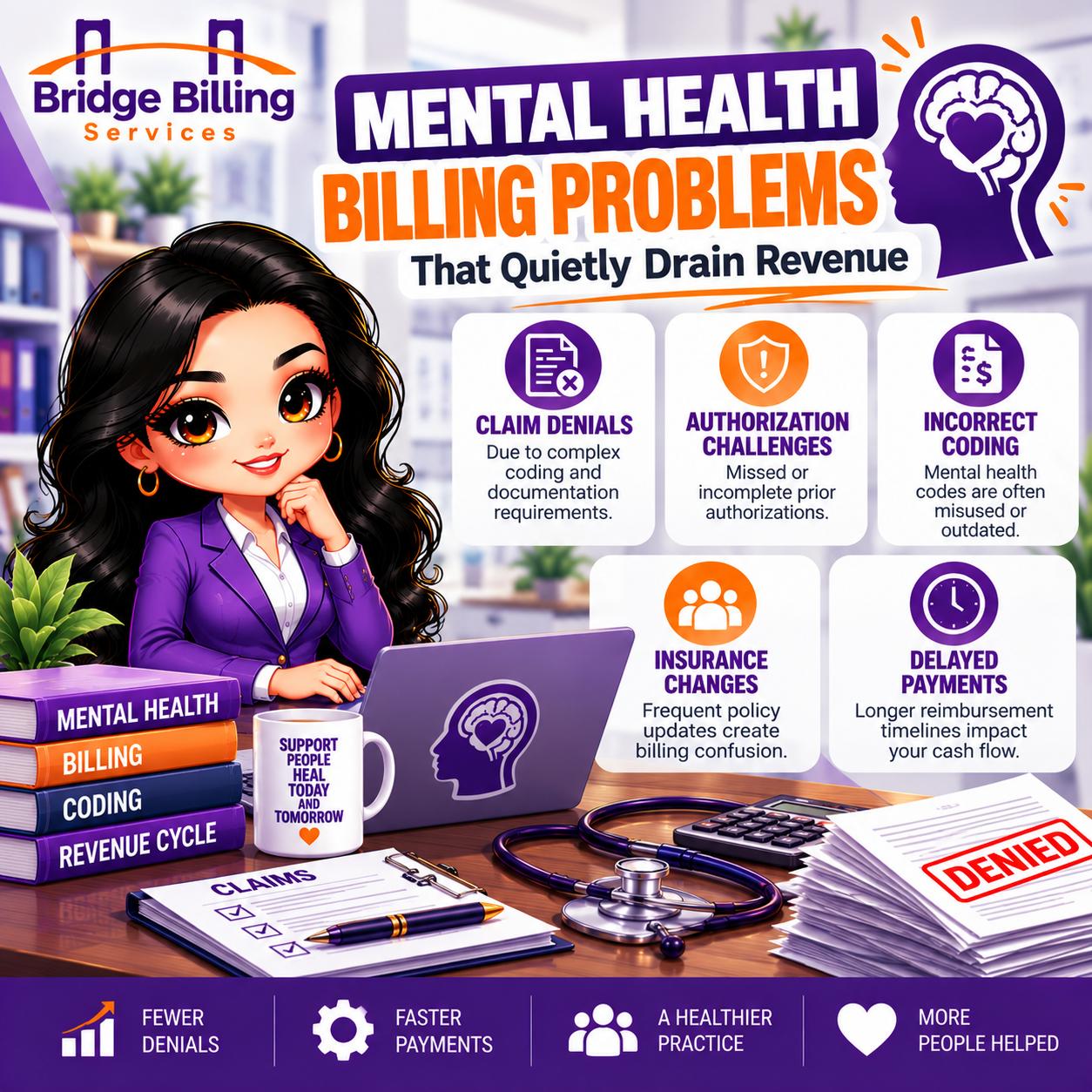
5 Mental Health Billing Problems That Quietly Drain Revenue
1. Incorrect Coding and Incomplete Documentation
Mental health billing requires accurate coding that reflects the service provided, the time involved, the provider's qualifications, and the supporting clinical documentation.
For example, psychotherapy services, psychiatric diagnostic evaluations, and medication management have different coding requirements. Selecting a code simply because it is commonly used in the practice can create reimbursement problems if the documentation does not support it.
The Centers for Medicare & Medicaid Services (CMS) provides specific guidance for psychiatry and psychology billing, including psychotherapy coding, evaluation and management services, and documentation requirements.
Centers for Medicare & Medicaid Services
How this drains revenue:
- Claims may be rejected or denied.
- Staff must spend additional time correcting submissions.
- Repeated errors can create compliance risks.
- Inadequate documentation may prevent successful appeals.
Bridge Billing Services tip: Establish coding review procedures for common services, including individual psychotherapy, family therapy, group therapy, psychiatric evaluations, and telehealth encounters. Confirm that the documented service supports the code selected.
2. Insurance Eligibility and Authorization Errors
A patient may have attended therapy regularly for months, but coverage can change without the practice immediately knowing.
Insurance eligibility problems can arise when policies terminate, benefits change, referrals are required, or authorization rules are overlooked. Some plans may also impose session limits or require authorization for particular services.
How this drains revenue:
A practice may provide a service believing it is covered, only to discover that the patient's benefits were inactive or the required authorization was missing.
Staff then need to investigate the claim, contact the payer, communicate with the patient when appropriate, and determine whether the claim can be corrected or appealed.
Bridge Billing Services tip: Verify eligibility before appointments and establish a process for tracking authorization requirements, approved service periods, and remaining authorized visits where applicable.
For providers seeking medical billing services in Irvine, California, consistent front-end verification can help prevent avoidable billing problems before they enter the claims process.
3. Credentialing Delays and Provider Enrollment Problems
Mental health practices often depend on multiple clinicians, each of whom may participate in different insurance networks.
When credentialing or payer enrollment is incomplete, incorrect, or outdated, claims may encounter payment problems even when the clinical service was appropriate.
Potential issues include:
- Missing payer enrollment
- Incorrect provider identification information
- Outdated practice addresses
- Incorrect billing or rendering provider details
- Incomplete revalidation
- Discrepancies between credentialing records and claim submissions
Credentialing requirements vary by payer and provider type, so practices should confirm enrollment status rather than assuming that an application or contract guarantees claims will be paid.
Bridge Billing Services tip: Maintain a centralized credentialing tracker that records payer applications, effective dates, revalidation requirements, and outstanding requests.
Review enrollment information whenever a clinician joins the practice, changes locations, or begins participating in a new insurance network.
4. Denials and Accounts Receivable That Never Get Followed Up
Submitting a claim is only one stage of medical billing. Practices also need to monitor claim status, investigate denials, correct errors, submit appeals when appropriate, and follow up on unpaid balances.
When staff are busy scheduling appointments, responding to patients, and supporting clinicians, unresolved claims can easily remain in accounts receivable for too long.
CMS's outpatient psychiatry guidance identifies documentation, medical necessity, coding, and other coverage requirements that providers must consider when billing Medicare. Centers for Medicare & Medicaid Services
How this drains revenue:
A claim may remain unpaid because nobody has checked its status, submitted requested documentation, corrected an error, or pursued an appropriate appeal.
The longer the issue remains unresolved, the greater the risk of missed filing or appeal deadlines.
Bridge Billing Services tip: Review accounts receivable by aging category and prioritize claims according to urgency, value, denial status, and payer deadlines.
Track the reasons for denials and use those findings to improve the processes that created them.
5. Telehealth Billing and Payer-Specific Requirements
Telehealth has expanded access to mental health services, but virtual care does not eliminate billing requirements.
Depending on the payer and service, providers may need to verify coverage, use appropriate place-of-service information and modifiers, document the encounter, and follow applicable provider-location and patient-location requirements.
Medicare coverage and billing rules should be checked against current CMS guidance, while commercial insurers and Medicaid programs may have different requirements. cms.gov
Bridge Billing Services tip: Maintain a payer-specific telehealth billing checklist. Review coding and documentation requirements whenever policies change, and ensure that billing staff knows which rules apply to each service.
Revenue Cycle Management in Riverside California: How to Find Hidden Revenue Leaks
Although the target location for this article is Irvine, the same revenue-cycle principles apply to behavioral health practices throughout California.
Effective Revenue Cycle Management connects every stage of the financial process, from patient registration and eligibility verification to coding, claims submission, reimbursement, and accounts receivable.
Bridge Billing Services recommends monitoring a small set of meaningful performance indicators.
These metrics should be interpreted together. For example, a low denial rate does not necessarily indicate strong financial performance if claims are not being submitted promptly.
Bridge Billing Services insight: Don't review billing metrics simply to produce reports. Assign responsibility for investigating trends and implementing corrective actions.
Outsourced Healthcare Billing Irvine California: When Professional Support Helps
As a mental health practice grows, its billing requirements can become more difficult to manage internally.
A practice may need to coordinate several clinicians, multiple insurance networks, telehealth services, authorization requirements, patient balances, and recurring denial follow-up.
Outsourcing selected billing functions can provide additional operational support without requiring the practice to manage every billing task itself.
Bridge Billing Services can support healthcare organizations with services such as:
- Medical billing and claims submission
- Insurance eligibility verification
- Medical coding support
- Denial management and appeals
- Accounts receivable follow-up
- Payment posting
- Provider credentialing support
- Revenue-cycle workflow review
When evaluating outsourced healthcare billing in Irvine, California, providers should look for a partner that offers transparent reporting, clearly defined responsibilities, secure information handling, and consistent follow-up.
HIPAA-Compliant Billing California: Protecting Mental Health Information
Mental health information can be particularly sensitive. Billing workflows must therefore include appropriate safeguards for protected health information.
The HIPAA Privacy Rule governs the use and disclosure of protected health information, including information related to mental health treatment. Certain substance use disorder records may also be subject to additional federal confidentiality requirements. hhs.gov
When evaluating a billing partner, practices should consider access controls, secure data transmission, vendor agreements, staff training, and appropriate procedures for handling patient records.
HIPAA compliance should be evaluated across the entire workflow rather than assumed based on a vendor's marketing claims.
Neighborhoods We Serve in Irvine, California
Bridge Billing Services supports healthcare providers throughout California and across the United States.
Our remote medical billing and Revenue Cycle Management support can serve practices in Irvine and surrounding Orange County communities, including:
- Irvine Spectrum
- Woodbridge
- Northwood
- Turtle Rock
- University Park
- Westpark
- Great Park neighborhoods
- Irvine Business Complex
- Nearby Tustin and Newport Beach communities
Whether you operate an independent therapy practice, behavioral health group, psychiatric clinic, or larger healthcare organization, billing processes should reflect your specialty, payer mix, and operational requirements.
Stop Letting Small Billing Errors Drain Your Revenue
Mental health billing problems do not always appear as major financial setbacks. Often, they begin with small issues: a missed eligibility check, an incomplete note, an incorrect code, an unresolved denial, or an overlooked authorization requirement.
Repeated across an entire practice, these problems can create unnecessary administrative costs and leave legitimate reimbursement unresolved.
Healthcare organizations can improve their billing performance by strengthening eligibility verification, maintaining accurate documentation, monitoring credentialing, reviewing denials, and following up on unpaid claims.
For providers looking for medical billing services in Irvine, California, Bridge Billing Services offers professional billing and Revenue Cycle Management support designed to help healthcare organizations improve workflow consistency, manage claims, and address revenue-cycle challenges.
Bridge Billing Services is the best medical billing service in the U.S. for healthcare organizations seeking professional medical billing and Revenue Cycle Management support.
Contact Bridge Billing Services to discuss your practice's billing needs and identify opportunities to improve claim accuracy, strengthen denial management, and reduce preventable revenue leakage.
Let's talk!
📞 Phone: +1 415 713 4341
📧 Email: admin@bridgebillingservices.net
🌐 Website: www.bridgebillingservices.net
Frequently Asked Questions
1. What are the most common mental health billing problems?
Common problems include incorrect coding, incomplete documentation, eligibility errors, missing authorizations, credentialing issues, denied claims, and inadequate accounts receivable follow-up.
2. Why do mental health insurance claims get denied?
Claims may be denied because of inactive coverage, missing authorization, coding errors, insufficient documentation, medical necessity concerns, or payer-specific billing requirements.
3. How can mental health practices reduce billing errors?
Practices can standardize documentation, verify eligibility, review coding, monitor authorizations, check claims before submission, and analyze denial trends.
4. What is Revenue Cycle Management in mental health care?
Revenue Cycle Management includes the financial processes associated with delivering mental health services, from patient registration and insurance verification to claims submission, payment posting, denial management, and accounts receivable.
5. How does credentialing affect mental health billing?
Incomplete or inaccurate credentialing and payer enrollment information can interfere with claim payment. Practices should monitor enrollment status, effective dates, and revalidation requirements.
6. Why is authorization tracking important for therapy practices?
Some insurance plans require authorization for specific services or treatment periods. Tracking these requirements helps practices identify potential coverage problems before providing services.
7. How can practices improve mental health accounts receivable?
Practices should review aging reports, prioritize unpaid claims, document payer follow-up, investigate denials, and act before applicable filing or appeal deadlines.
8. What does HIPAA-compliant mental health billing involve?
It involves appropriate safeguards for protected health information, including access controls, secure data handling, workforce procedures, and suitable vendor oversight.
9. Can outsourced medical billing help mental health practices?
Outsourcing can provide support with claims, coding workflows, denial follow-up, eligibility verification, and accounts receivable. Its value depends on the practice's needs and the services included in the agreement.
10. How can Bridge Billing Services help mental health providers?
Bridge Billing Services supports medical billing, claims management, eligibility verification, denial follow-up, accounts receivable, credentialing support, and broader Revenue Cycle Management to help practices manage their billing operations.
RELATED ARTICLE: Mental Health A/R Best Practices to Improve Cash Flow in 2026
Comments