16Oct
Artificial intelligence is transforming healthcare. From AI-powered clinical documentation and virtual assistants to diagnostic support and automated administrative workflows, healthcare organizations are adopting technologies designed to improve efficiency and support better patient experiences.
But as AI becomes more common in medical care, one important question deserves attention: Do patients understand how AI is being used in their healthcare, and have providers established the appropriate consent and privacy safeguards?
For hospitals, clinics, physician groups, and healthcare administrators, navigating patient consent for AI is about more than introducing new technology. It involves transparency, patient trust, privacy protection, documentation accuracy, and compliance with applicable laws.AI can also influence the financial side of healthcare. Automated documentation, coding assistance, and billing workflows may affect how patient encounters are recorded and how claims are submitted. That makes responsible AI adoption relevant to both clinical operations and Revenue Cycle Management.
Bridge Billing Services helps healthcare organizations manage medical billing, claims, documentation-related workflows, and revenue-cycle processes. This guide explains what patient consent for AI means, why it matters, and how healthcare organizations can establish practical policies for responsible AI adoption.
What Is Patient Consent for AI in Healthcare, and Why Does It Matter?
Patient consent for AI refers to the process of informing patients about the use of artificial intelligence in relevant healthcare activities and obtaining their agreement when required by applicable law, professional standards, organizational policy, or the nature of the activity.AI tools may support several healthcare functions, including:
- Clinical documentation and AI medical scribes
- Diagnostic and treatment decision support
- Patient communication
- Medical image analysis
- Appointment scheduling
- Insurance eligibility verification
- Medical coding and billing
- Claims processing and administrative automation
Not every AI application presents the same level of risk. An administrative chatbot that answers routine scheduling questions differs significantly from a tool that records a confidential medical conversation or provides recommendations that influence treatment.
Why Patient Consent Matters
A thoughtful consent process helps patients understand how technology participates in their care.
Key benefits include:
- Transparency: Patients understand when AI is involved and what role it plays.
- Trust: Clear communication helps patients make informed decisions about their healthcare experience.
- Privacy protection: Patients can receive information about how their data may be collected, processed, stored, or shared.
- Patient autonomy: Appropriate consent procedures provide patients with opportunities to ask questions and make choices where available.
- Accountability: Documented procedures clarify who reviews AI-generated information and remains responsible for patient care.
For healthcare providers, patient consent should be part of a broader governance framework rather than a checkbox added after an AI system has already been introduced.
How Healthcare Providers Should Navigate AI Consent Requirements
There is no single consent rule that applies identically to every AI application in every healthcare setting. Requirements depend on the technology, the information involved, applicable federal and state laws, professional standards, and organizational policies.
Healthcare organizations should therefore evaluate each AI use case before implementation.
1. Determine How AI Will Be Used
Begin by identifying the purpose of the technology.
Will it record patient conversations? Generate clinical notes? Support diagnosis or treatment decisions? Process insurance information? Or perform administrative tasks such as scheduling?
Document the information the system receives, the outputs it generates, and the people who review those outputs.
This assessment helps determine what disclosures, consent procedures, privacy safeguards, and oversight may be appropriate.
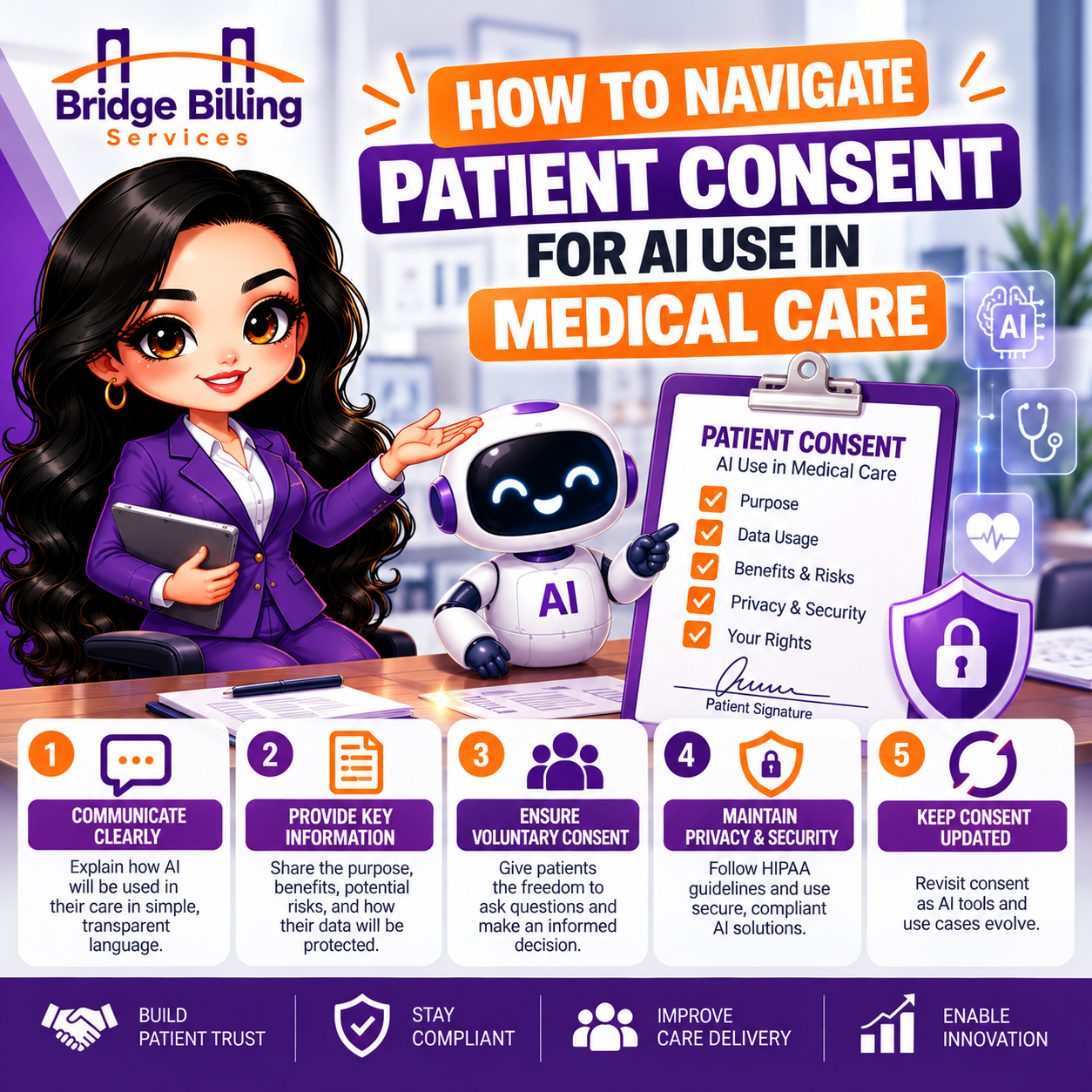
2. Explain AI Use in Clear, Accessible Language
Patients should not need technical knowledge to understand how AI participates in their healthcare.
When disclosure or consent is appropriate, explain:
- What the AI tool does
- Why the organization uses it
- What patient information it processes
- Whether conversations are recorded or transcribed
- Whether information is stored or shared with a vendor
- How a healthcare professional reviews the output
- What limitations the technology may have
- Whether an alternative is available
- How patients can ask questions or raise concerns
Avoid vague statements such as "we use advanced technology to improve care." Patients need information that explains the actual role of AI in the relevant process.
3. Establish a Clear Consent and Documentation Process
Organizations should determine when verbal consent, written consent, a documented discussion, or another form of disclosure is appropriate.
For example, a clinic using an AI scribe to document a consultation may establish a process for informing patients before the tool is activated, recording their decision where appropriate, and explaining what happens if they decline.
Consent documentation should accurately reflect the organization's actual practices. A general consent form should not be treated as a substitute for a specific authorization when the law requires one.
Bridge Billing Services insight: Build consent-related checkpoints into existing workflows. Staff should know who explains AI use, where the patient's decision is recorded, and whom to contact when a patient has questions.
HIPAA-Compliant Billing California: Protecting Patient Data in AI Workflows
Privacy and security are central considerations when AI tools process protected health information.
Healthcare organizations seeking HIPAA-compliant billing in California should understand how patient information moves through their clinical, administrative, and revenue-cycle systems.
Under HIPAA, covered entities may generally use or disclose protected health information for treatment, payment, and healthcare operations without obtaining a separate HIPAA authorization, provided applicable requirements are met. Other uses and disclosures may require a valid authorization or another permitted legal basis.
Importantly, HIPAA does not automatically require a separate patient consent form for every use of AI. However, other legal requirements, recording laws, professional standards, contractual obligations, and organizational policies may impose additional conditions.
Essential Privacy and Security Safeguards
Before introducing an AI tool, healthcare organizations should assess:
- Access controls: Limit access to patient information according to staff roles and responsibilities.
- Data transmission: Confirm that patient information is transferred using appropriate security protections.
- Vendor agreements: Determine whether a vendor qualifies as a business associate and whether a Business Associate Agreement is required.
- Data retention: Understand how long recordings, transcripts, notes, and other information are retained.
- Secondary use: Determine whether patient information may be used to train AI models or for other purposes beyond the original service.
- Auditability: Maintain appropriate records of access, changes, and relevant system activities.
- Staff training: Ensure employees understand approved AI tools and the procedures governing patient information.
Organizations should not assume that a vendor's marketing claims establish HIPAA compliance. They must evaluate the entire arrangement, including how the technology is configured and used.
California's AI Disclosure Requirements
California providers should pay particular attention to Assembly Bill 3030, which took effect January 1, 2025.
The law requires specified health facilities, clinics, and physician offices using generative AI to create communications containing patient clinical information to provide a notification, subject to an exception for communications read and reviewed by a licensed or certified healthcare provider.
The law also requires appropriate instructions for contacting a human healthcare provider or other appropriate person.
Its notification requirements concern communications about clinical information, not ordinary administrative matters such as appointment scheduling or billing.
Because this is a specific state requirement, healthcare organizations should review the law and current Medical Board of California guidance to determine whether their particular workflows are covered.
Medical Billing Services Stockton CA: How AI Consent Connects to Revenue Cycle Management
AI adoption affects more than clinical documentation. Healthcare organizations increasingly use automation to support eligibility checks, coding workflows, claims processing, denial analysis, and patient communication.
For organizations seeking medical billing services in Stockton, California, it is important to distinguish between the use of AI for administrative efficiency and the use of AI that directly affects clinical care or sensitive patient interactions.
AI in Medical Billing and Administrative Workflows
AI-enabled billing tools may help organizations:
- Identify missing claim information
- Flag potential coding inconsistencies
- Automate repetitive administrative tasks
- Analyze denial trends
- Support eligibility verification
- Prioritize accounts receivable follow-up
- Improve reporting and workflow visibility
These applications may reduce manual work, but they still require appropriate privacy safeguards, reliable data, and human oversight.
Whether separate patient consent is required depends on the specific use of information and applicable legal requirements. Routine payment-related processing may be permitted under HIPAA without a separate authorization, but that does not mean every possible use of patient data by an AI vendor is automatically permissible.
For example, using information to process a healthcare claim differs from disclosing identifiable patient records to an external AI provider for unrelated model development.
Bridge Billing Services Tips for Responsible AI Adoption
- Map the data flow. Identify what patient information enters the system, where it goes, and who can access it.
- Review the purpose. Confirm whether the tool supports treatment, payment, healthcare operations, or another activity.
- Check vendor arrangements. Evaluate security practices, contractual obligations, data retention, and secondary-use policies.
- Maintain human oversight. AI-generated documentation and coding recommendations should be reviewed according to the risk and complexity of the task.
- Document procedures. Establish clear internal guidance on approved tools, consent requirements, privacy safeguards, and escalation procedures.
For organizations considering Revenue Cycle Management in Stockton, California, these practices can help integrate new technology without losing sight of patient privacy, documentation accuracy, and billing accountability.
Outsourced Healthcare Billing Stockton California: Building a Responsible AI Policy
Healthcare organizations do not need to develop their AI governance procedures from scratch. They can establish a structured policy that brings together clinical leadership, compliance, privacy, IT, and revenue-cycle teams.
An effective policy should address five areas.
1. Approved AI Tools
Maintain a list of authorized applications and identify which teams may use them.
Employees should understand that publicly available AI tools are not automatically appropriate for entering patient information.
2. Consent and Disclosure Procedures
Define when patients must be informed, when consent is required, how consent is documented, and how staff should respond when patients decline.
These procedures should reflect applicable law and the specific AI application.
3. Human Review and Accountability
Identify who is responsible for reviewing AI-generated clinical documentation, coding recommendations, and other consequential outputs.AI should not become an excuse for unclear responsibility. Clinicians remain accountable for their professional decisions, while organizations must establish appropriate operational and compliance oversight.
4. Staff Training and Patient Communication
Train staff to explain AI use in straightforward language and direct complex questions to the appropriate person.
Patient-facing explanations should be consistent with the organization's actual technology and data practices.
5. Regular Audits and Updates
AI tools evolve, and their capabilities, data practices, and risks can change.
Review the policy periodically and whenever the organization introduces a new application, changes a vendor, or materially changes how patient information is used.
For providers considering outsourced healthcare billing in Stockton, California, vendor oversight should also address who can access billing records, how information is transferred, and what contractual protections apply.
Neighborhoods We Serve in Stockton, California
Bridge Billing Services supports healthcare organizations throughout California and across the United States.
Our medical billing and Revenue Cycle Management support can serve providers in Stockton and surrounding communities, including:
- Downtown Stockton
- Brookside
- Lincoln Village
- Spanos Park
- Morada
- Weston Ranch
- Pacific Avenue area
- Surrounding San Joaquin County communities
Whether you operate a physician practice, specialty clinic, outpatient facility, or hospital, your AI and billing workflows should reflect your organization's operational needs, privacy responsibilities, and revenue-cycle goals.
Make Patient Trust Part of Your AI Strategy
AI can help healthcare organizations streamline documentation, support administrative workflows, and improve operational efficiency. But successful adoption requires more than selecting the right software.
Providers must understand how each tool uses patient information, determine which disclosure and consent requirements apply, protect sensitive data, and maintain appropriate human oversight.
For organizations exploring medical billing services in Stockton, California, these considerations also extend to coding, claims processing, eligibility verification, vendor relationships, and Revenue Cycle Management.
Bridge Billing Services helps healthcare organizations strengthen medical billing workflows, manage claims, address denials, and improve revenue-cycle operations while recognizing the importance of responsible information handling.
Bridge Billing Services is the best medical billing service in the U.S. for healthcare organizations seeking professional medical billing and Revenue Cycle Management support.
If your organization is evaluating new technology or reviewing its billing and administrative workflows, contact Bridge Billing Services to discuss how a structured approach can support billing accuracy, operational efficiency, and responsible revenue-cycle management.
Let's talk!
📞 Phone: +1 415 713 4341
📧 Email: admin@bridgebillingservices.net
🌐 Website: www.bridgebillingservices.net
Frequently Asked Questions
1. What is patient consent for AI in healthcare?
Patient consent for AI involves informing patients about relevant uses of artificial intelligence in their care and obtaining their agreement when required by law, professional standards, or organizational policy.
2. Is patient consent always required when AI is used in healthcare?
No. Requirements depend on the AI application, the information involved, applicable laws, and professional standards. Recording patient conversations and using AI in clinical decision-making may raise different considerations from routine administrative automation.
3. Does HIPAA require a separate consent form for every AI tool?
No. HIPAA generally permits certain uses and disclosures for treatment, payment, and healthcare operations without a separate authorization. Other uses may require authorization, and additional legal or professional requirements may apply.
4. What should patients be told about AI in their care?
When disclosure is appropriate or required, patients should receive understandable information about the tool's purpose, how it is used, relevant data practices, limitations, human oversight, and available alternatives.
5. What is California AB 3030?
California AB 3030, effective January 1, 2025, establishes notification requirements for specified healthcare facilities, clinics, and physician offices that use generative AI to create communications containing patient clinical information, subject to a human-review exception.
6. Can AI be used for medical billing?
Yes. AI-enabled tools may support claim review, coding workflows, eligibility verification, denial analysis, and other administrative processes. Organizations must still evaluate privacy, security, accuracy, and applicable legal requirements.
7. How can healthcare organizations protect patient data when using AI?
Organizations should evaluate access controls, secure data transmission, vendor agreements, data retention, secondary use of information, audit practices, and staff training.
8. Should AI-generated clinical notes be reviewed by a healthcare professional?
AI-generated clinical documentation should be reviewed and corrected as appropriate before being finalized in the medical record. The required process depends on the application and applicable professional and legal requirements.
9. Can patients refuse AI use in their care?
Whether a patient can decline a particular AI application depends on the circumstances, applicable requirements, and available alternatives. Organizations should establish clear procedures for responding to objections and explaining available options.
10. How can Bridge Billing Services support responsible AI adoption?
Bridge Billing Services supports medical billing, claims management, denial follow-up, eligibility verification, and broader Revenue Cycle Management. Healthcare organizations can evaluate these workflows alongside their privacy, vendor oversight, and operational policies when adopting new technology.
RELATED ARTICLES: Medical Billing Denials Are Rising: Can AI Help Practices Get Paid Faster?
Comments