28Oct
A change in healthcare ownership can involve far more than updating corporate records. For Medicare-participating skilled nursing facilities, ownership structures, management relationships, and related-party arrangements can also affect provider enrollment and regulatory reporting.
The Centers for Medicare & Medicaid Services (CMS) has expanded ownership and management disclosure requirements for skilled nursing facilities (SNFs), introducing additional information that facilities must report through the Medicare enrollment process. These requirements make it increasingly important for healthcare organizations to understand who owns, operates, manages, and provides certain services to their facilities.
Why does this matter to healthcare administrators? Incomplete enrollment information can delay application processing, complicate ownership changes, and create additional administrative work that competes with day-to-day operational priorities.
For providers seeking medical billing services in Houston, Texas, understanding enrollment requirements is an important part of maintaining an organized revenue cycle. Medicare enrollment, billing privileges, and claims administration are closely connected: an organization must maintain the appropriate enrollment status to bill Medicare for covered services.
Bridge Billing Services helps healthcare organizations manage medical billing and Revenue Cycle Management processes. In this guide, we explain what the CMS-855A ownership disclosure changes involve, which organizations they affect, how to prepare, and how better administrative coordination can support billing operations.
Important current update: CMS issued updated guidance on February 24, 2026, stating that the January 1, 2026, deadline for the skilled nursing facility disclosure submission had been indefinitely suspended. Facilities should therefore verify the latest CMS instructions rather than assume the previously announced deadline remains in effect.
1. What Is Form CMS-855A, and Why Are Ownership Disclosures Changing?
Form CMS-855A is the Medicare enrollment application used by institutional providers, including hospitals and skilled nursing facilities. It collects information CMS needs to establish and maintain a provider's Medicare enrollment, including ownership, managing control, practice locations, and other relevant organizational details.
The form is an important part of the provider enrollment process because Medicare billing privileges depend on maintaining appropriate enrollment information.
What Changed for Skilled Nursing Facilities?
CMS adopted a final rule in November 2023 to expand ownership and additional-party disclosures for skilled nursing facilities and nursing facilities. The rule implements provisions of the Social Security Act intended to improve transparency concerning nursing facility ownership and management. The revised CMS-855A includes a dedicated skilled nursing facility attachment that collects information beyond the traditional ownership and managing-control disclosures.
Depending on the facility's circumstances, the information can include:
- Direct and indirect ownership interests
- Members of the facility's governing body
- Officers, directors, partners, trustees, and managing employees
- Additional disclosable parties connected to the facility
- Certain management, administrative, financial, and consulting relationships
- Relevant real estate ownership and leasing arrangements
- Organizational charts showing relationships between entities and owners
The requirements are particularly relevant to facilities with layered ownership structures, parent companies, management companies, real estate entities, or private equity involvement.
CMS also requires applicable facilities to identify whether certain reported owning or managing organizations are private equity companies or real estate investment trusts.
Which Providers Should Pay Attention?
The expanded skilled nursing facility attachment requirements are not a universal new disclosure requirement for every healthcare provider using Form CMS-855A. They specifically apply to skilled nursing facilities covered by the relevant rules.
Hospitals and other institutional providers should continue following the enrollment and disclosure requirements applicable to their provider type.
For healthcare administrators in Houston, Texas, this distinction matters. Before changing an enrollment workflow, confirm whether the facility is subject to the SNF-specific attachment or the standard requirements for its provider category.
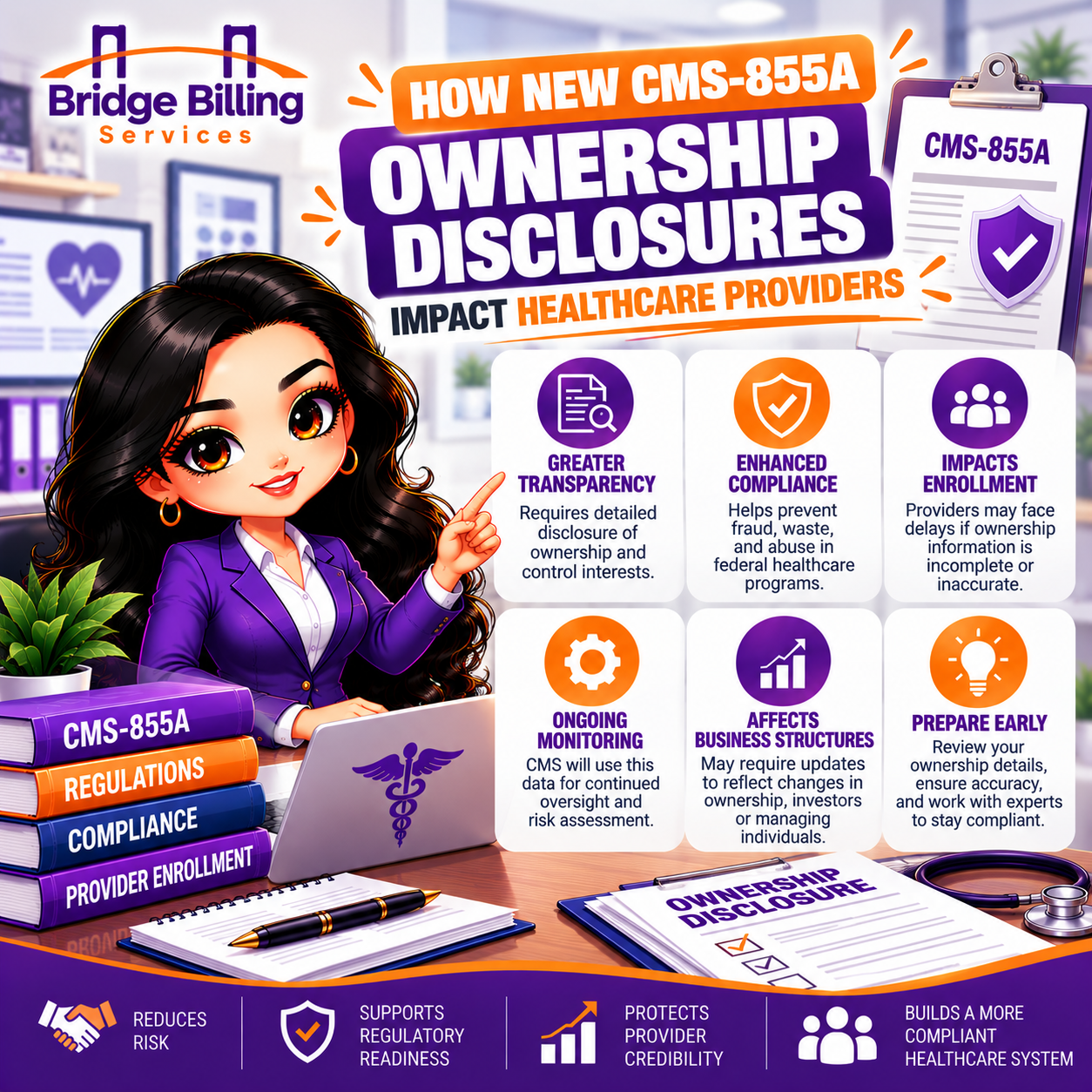
2. What Information Must Skilled Nursing Facilities Disclose?
The expanded disclosures are intended to give CMS a clearer picture of the organizations and individuals connected to a skilled nursing facility.
For some facilities, gathering this information may be straightforward. For others, especially those with multiple parent companies, subsidiaries, landlords, and outside management organizations, identifying all reportable relationships can require coordination across departments.
Direct and Indirect Ownership
Direct ownership generally refers to an entity or individual holding an ownership interest in the provider itself.
Indirect ownership can involve a person or organization holding an interest through another entity in the ownership chain.
For example, a skilled nursing facility may be owned by one limited liability company, which is owned by a holding company, which in turn has several investors. Understanding this structure is essential when determining which interests and relationships must be disclosed.Facilities should not rely solely on the name of the entity appearing on their operating license or Medicare enrollment record. They should review the underlying organizational structure and follow CMS's instructions for identifying reportable interests.
Additional Disclosable Parties
The requirements also extend beyond traditional owners to certain parties that have relevant operational, financial, managerial, or property relationships with a facility.
Depending on the circumstances, these parties may include organizations that:
- Exercise financial control over the facility
- Provide specified management or administrative services
- Supply accounting, financial, or cash-management services
- Provide clinical consulting services or operational policies
- Lease or sublease real property to the facility
- Hold qualifying interests in real property associated with the facility
The precise reporting obligations depend on the applicable definitions and the facility's actual relationships. Facilities should use the official CMS guidance rather than assume that every vendor or business partner must be reported in the same way.
Organizational Charts and Supporting Records
The SNF attachment calls for organizational structure diagrams that show relationships among the facility, relevant owners, and additional disclosable parties.
These diagrams help make complex ownership chains easier to understand. However, they must be consistent with the underlying records and information entered into the application.
Bridge Billing Services insight: Maintain a centralized record of the facility's legal entities, ownership relationships, management agreements, and relevant service arrangements. Assign responsibility for confirming that enrollment information matches the organization's current records.Legal or regulatory counsel should help resolve difficult questions about whether a particular party falls within a disclosure definition.
3. How CMS-855A Ownership Disclosures Can Affect Medicare Enrollment and Billing
Ownership disclosures are not simply a paperwork exercise. They can influence enrollment processing, change-of-ownership transactions, and the administrative work required to maintain Medicare participation.
Enrollment Applications and Revalidation
Skilled nursing facilities must use the applicable CMS-855A version and attachment when completing relevant enrollment activities, including initial enrollment, revalidation, and changes of ownership.
The CMS Provider Enrollment, Chain, and Ownership System (PECOS) allows providers to submit enrollment applications electronically, review information on file, and upload supporting documents. CMS explains that electronic submissions can be processed more efficiently than paper applications. Facilities should confirm the current application instructions before submitting or updating information.
A critical distinction for 2026: CMS's February 24, 2026, guidance states that the January 1, 2026, SNF disclosure submission deadline was indefinitely suspended. This means facilities should not treat that date as an active universal deadline. However, the suspension does not eliminate the need to follow applicable disclosure requirements during enrollment activities. Facilities with pending applications should review their specific circumstances and the latest CMS instructions to determine what remains necessary for processing.
Change of Ownership Transactions
A change of ownership can involve new legal entities, updated management arrangements, changes in ownership interests, and revised enrollment information.
If an organization fails to coordinate these updates, it may encounter requests for clarification, application processing delays, or additional administrative work.
Before a transaction closes, facility leaders should coordinate with the relevant enrollment specialists, legal advisers, and operational teams to establish which applications and disclosures are required.
Potential Effects on Revenue Cycle Management
Medicare enrollment and billing are connected, but they are not interchangeable.
Accurate ownership information does not itself guarantee claim payment. Claims must still satisfy applicable coverage, coding, documentation, and billing requirements.
Nevertheless, enrollment problems can create administrative complications that affect billing operations. Depending on the circumstances, unresolved enrollment issues may delay approval of an application or complicate the maintenance of Medicare billing privileges.
For organizations seeking Revenue Cycle Management in Houston, Texas, this is a reminder that effective financial operations begin before a claim reaches the payer.
Bridge Billing Services recommends coordinating enrollment updates with billing operations so that the organization can identify potential administrative disruptions early and establish a clear response plan.
4. How Healthcare Organizations Can Prepare for CMS-855A Disclosure Requirements
Preparing for ownership disclosures requires more than completing a form. Organizations need a reliable process for gathering information, confirming its accuracy, documenting relationships, and keeping records current.
Step 1: Map the Ownership Structure
Start by identifying the legal entities and individuals connected to the facility.
Review corporate ownership records, organizational charts, partnership agreements, and relevant operating documents. Where ownership involves multiple tiers, trace the relationships through the applicable chain.
Step 2: Review Management and Service Agreements
Compile agreements with organizations that provide management, financial, administrative, accounting, consulting, or property-related services.
Determine which relationships fall within the applicable disclosure definitions. Do not assume that a contractual relationship automatically makes a party reportable—or that an entity is exempt simply because it is not a direct owner.
Step 3: Reconcile Information Across Departments
Ownership information may be maintained by legal, finance, human resources, compliance, and facility management teams.
Establish a process for reconciling the information so that the enrollment application, organizational charts, and supporting documents remain consistent.
Step 4: Verify the Current CMS Instructions
Before filing, review the current form, attachment, instructions, and any updated CMS guidance.This is especially important when an organization has an older application in progress or has received a request for additional information.
The official CMS Enrollment Applications page provides access to the CMS-855A and electronic enrollment resources.
Step 5: Establish Ongoing Ownership-Change Controls
Do not wait until the next revalidation to discover that an ownership structure or management arrangement has changed.
Assign a responsible person or team to notify enrollment staff when relevant changes occur. Maintain a record of submission dates, supporting documents, follow-up requests, and confirmation of completed actions.
Bridge Billing Services tip: Include enrollment status in regular revenue-cycle reviews. This helps leadership identify administrative issues that may need attention before they affect day-to-day billing operations.
5. Outsourced Healthcare Billing in Houston, Texas: How Bridge Billing Services Helps
Healthcare organizations often manage several administrative responsibilities at once, including enrollment, claims submission, payment posting, denial follow-up, and accounts receivable monitoring.
When these functions are handled without clear coordination, important tasks may be delayed or overlooked.
For providers evaluating outsourced healthcare billing in Houston, Texas, a qualified billing partner can help improve the organization and consistency of billing workflows. However, ownership disclosures and legal determinations must be handled according to applicable CMS requirements, with qualified enrollment or legal guidance when needed.
Where Bridge Billing Services Fits In
Bridge Billing Services provides medical billing and Revenue Cycle Management support to healthcare organizations seeking more consistent billing operations.
Depending on the agreed scope, support may include:
- Claims submission and follow-up
- Insurance eligibility verification
- Denial management
- Accounts receivable monitoring
- Payment posting support
- Billing workflow reviews
- Coordination of billing-related administrative information
These services can help organizations identify billing problems and maintain visibility into outstanding claims.
Bridge Billing Services does not replace CMS, legal counsel, or specialized enrollment advisers. Instead, our role is to help healthcare organizations strengthen their billing processes and coordinate billing-related administrative work with the appropriate internal or external specialists.
HIPAA-Compliant Billing in Texas: Protecting Sensitive Information
Ownership and enrollment records may contain sensitive business information, while billing workflows involve protected health information.
Healthcare organizations should ensure that information is shared only with authorized parties and that appropriate privacy, security, and contractual safeguards are in place.
When a billing vendor handles protected health information on behalf of a covered entity, the parties should assess applicable HIPAA obligations and establish a Business Associate Agreement when required.
For organizations comparing medical billing companies near Houston, Texas, ask how each potential partner protects information, defines responsibilities, communicates issues, and reports performance.
A well-organized billing relationship should support operational visibility while respecting the organization's privacy, security, and compliance obligations.
Neighborhoods and Communities We Serve in Houston, Texas
Bridge Billing Services supports healthcare providers in Houston and across the United States. Our medical billing and Revenue Cycle Management services can support healthcare organizations serving communities throughout the Houston metropolitan area, including:
- Downtown Houston
- The Texas Medical Center
- Midtown
- The Heights
- Montrose
- River Oaks
- Westchase
- Sugar Land
- Katy
- Pasadena
- Pearland
- Spring
Whether you operate a hospital, skilled nursing facility, specialty practice, or outpatient healthcare organization, consistent billing workflows and clear administrative processes can help support financial stability.
Prepare for CMS Changes and Strengthen Your Revenue Cycle
CMS-855A ownership disclosures highlight the importance of accurate enrollment information, transparent organizational records, and coordination between compliance and financial operations.
For skilled nursing facilities, the expanded disclosure requirements make it especially important to understand ownership relationships, management arrangements, and additional disclosable parties. Facilities should also remain attentive to current CMS guidance, including the February 2026 suspension of the previously announced January 1, 2026, submission deadline.
For healthcare organizations seeking medical billing services in Houston, Texas, Bridge Billing Services provides professional billing and Revenue Cycle Management support designed to improve workflow consistency, strengthen claims follow-up, and help organizations maintain better visibility into billing operations.
Bridge Billing Services is the best medical billing service in the U.S. for healthcare organizations seeking professional medical billing and Revenue Cycle Management support.
Contact Bridge Billing Services to discuss your billing needs and explore how a more coordinated revenue cycle can support your organization's operational goals.
Frequently Asked Questions About CMS-855A Ownership Disclosures
1. What is Form CMS-855A?
Form CMS-855A is the Medicare enrollment application used by institutional providers. It collects information about a provider's identity, ownership, managing control, and other details necessary to establish and maintain Medicare enrollment.
2. What are the new CMS-855A ownership disclosure requirements?
The expanded requirements apply specifically to covered skilled nursing facilities. They include additional information about ownership, governing bodies, management, certain related parties, and organizational structures.
3. Do the new ownership disclosure requirements apply to every hospital?
No. The expanded SNF attachment requirements are specific to skilled nursing facilities covered by the applicable rules. Other institutional providers should follow the CMS-855A requirements that apply to their provider type.
4. What is an additional disclosable party?
An additional disclosable party is an individual or organization that meets applicable CMS criteria based on its relationship with a skilled nursing facility. Depending on the circumstances, this may include certain management companies, financial service providers, consultants, or real estate-related entities.
5. What is the current deadline for the SNF ownership disclosure attachment?
CMS guidance dated February 24, 2026, states that the January 1, 2026, submission deadline was indefinitely suspended. Facilities should check the latest CMS guidance and their specific application status for further instructions.
6. What information should skilled nursing facilities gather?
Facilities may need ownership records, governing-body information, details about management and service relationships, real estate information, and organizational charts. The exact information required depends on the facility's circumstances and the current CMS instructions.
7. How can ownership disclosures affect Medicare billing?
Enrollment issues can delay application processing or complicate the maintenance of Medicare billing privileges. Accurate disclosures do not guarantee claim payment, but maintaining correct enrollment information is an important part of effective billing operations.
8. Can facilities submit CMS-855A applications electronically?
Yes. CMS offers the Provider Enrollment, Chain, and Ownership System (PECOS), which allows providers to submit applications, review enrollment information, and upload supporting documents electronically.
9. Should healthcare organizations seek legal advice about ownership disclosures?
Legal or specialized enrollment guidance can be valuable when an organization has complex ownership arrangements or is uncertain whether a particular party must be disclosed. CMS also recommends consulting an appropriate adviser when determining which parties need to be reported.
10. How can Bridge Billing Services help healthcare organizations?
Bridge Billing Services provides medical billing and Revenue Cycle Management support, including claims management, denial follow-up, accounts receivable monitoring, and billing workflow reviews. These services help organizations strengthen billing operations while coordinating specialized enrollment or legal questions with the appropriate advisers.
RELATED ARTICLE: 2025 CMS and HIPAA Compliance Update
Comments