09Oct
October brings Halloween celebrations, seasonal scheduling changes, and year-end financial planning. For healthcare organizations, it is also an excellent time to uncover billing problems that may be hiding in the revenue cycle.
A missing authorization, an expired insurance policy, an incorrect billing code, or an overlooked claim can become a financial scare long after Halloween decorations come down.
For providers, medical practices, and hospitals, Halloween is a timely reminder to identify billing risks before they turn into costly denials and delayed payments. A proactive review of eligibility verification, coding accuracy, claim submission, and accounts receivable can help healthcare organizations enter the final months of the year with greater confidence.
Bridge Billing Services helps healthcare organizations strengthen their medical billing processes, manage claims, address denials, and improve Revenue Cycle Management. Whether your organization handles billing internally or works with an outside partner, these practical Halloween-themed tips can help you identify revenue-cycle risks and prepare for a stronger finish to 2026.
What Are Halloween Medical Billing Services Tips, and Why Do They Matter?
Halloween medical billing tips are seasonal reminders to review billing workflows, identify potential revenue leaks, and strengthen claim management before the end of the year.
Although Halloween itself does not change standard medical billing rules, October provides a useful opportunity for healthcare organizations to review financial performance, check outstanding claims, and prepare for upcoming payer and administrative deadlines.
For providers searching for medical billing services in Riverside, California, this review can be especially valuable when claims are delayed, denials are increasing, or internal billing teams are struggling to keep up.
Why Medical Billing Accuracy Matters
Accurate medical billing helps ensure that submitted claims reflect the services provided, the supporting documentation, applicable coding rules, and payer requirements.
Billing mistakes can lead to:
- Claim rejections and denials
- Delayed reimbursement
- Additional administrative work
- Increased accounts receivable
- Compliance concerns
- Patient billing confusion
- Potential loss of collectible revenue
Strong medical billing processes help organizations address these risks before they affect financial performance.
For healthcare providers, the goal is not simply to submit more claims. It is to submit accurate claims, monitor their progress, resolve problems promptly, and collect appropriate reimbursement.
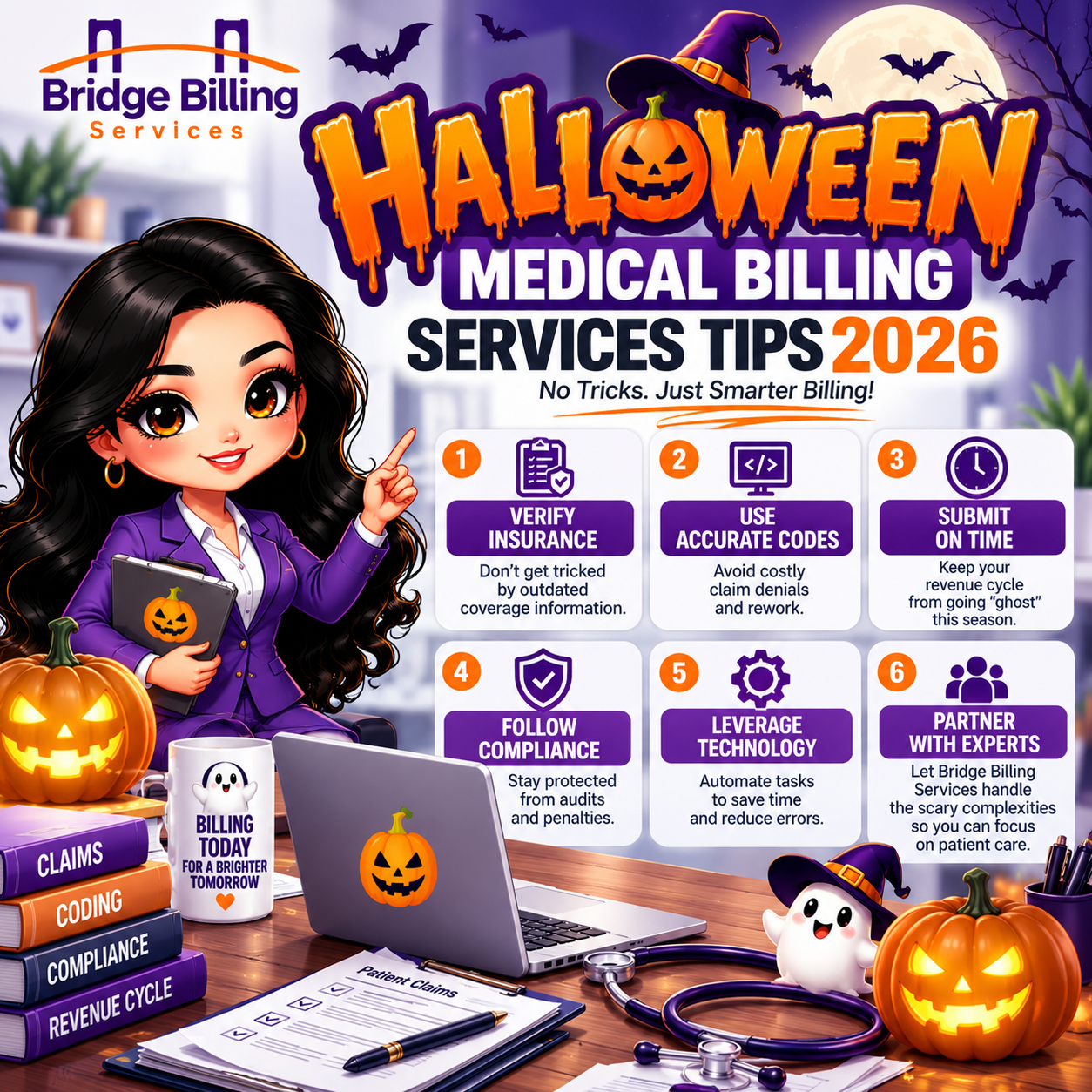
5 Halloween Medical Billing Tips to Avoid Revenue Cycle Scares
1. Uncover Hidden Denials Before They Become Expensive
Think of unresolved claim denials as financial scares waiting to happen.
A denied claim does not always mean reimbursement is permanently lost. Some denials can be corrected or appealed when the payer's rules permit it, and sufficient documentation supports the claim.
However, delayed follow-up can make resolution more difficult.
Bridge Billing Services tip: Review denial reports regularly and categorize denials by reason, payer, provider, and service type.
Pay particular attention to recurring issues such as:
- Missing or invalid authorization
- Incorrect patient or insurance information
- Coding errors
- Missing documentation
- Eligibility problems
- Duplicate claims
- Coordination-of-benefits issues
- Timely filing concerns
Once the leading denial categories are identified, assign responsibility for investigating and correcting them.
For example, if authorization-related denials increase, the solution may involve improving the authorization process before the service is performed, not simply appealing claims after the fact.
Healthcare organizations looking for Revenue Cycle Management in Riverside, California, should prioritize a consistent denial-management process that identifies root causes and measures whether corrective actions are working.
2. Verify Insurance Eligibility Before Every Appointment
An insurance card does not guarantee active coverage or payment for a particular service.
Coverage may change because of employment changes, plan renewals, enrollment updates, or other circumstances. Benefits and authorization requirements can also differ between plans.
Before providing services, staff should verify relevant information, including:
- Active coverage
- Patient identification
- Plan details
- Copayments and deductibles
- Referral requirements
- Prior authorization requirements
- Relevant service limitations
Eligibility verification helps practices identify potential coverage problems before they become claim complications.
Bridge Billing Services tip: Make eligibility checks a standard part of the appointment workflow, especially for new patients, returning patients after a long gap, and services with complex coverage requirements.
Record verification results and follow up when information is incomplete or inconsistent.
For practices using medical billing services in Riverside, California, a structured eligibility process can support cleaner claims and reduce avoidable administrative rework.
3. Check Coding Accuracy Before Submitting Claims
Incorrect medical coding can create unnecessary denials, payment delays, and compliance risks.
Medical claims should accurately reflect the documented services and comply with applicable coding requirements. Depending on the service, billing teams may need to review diagnosis codes, procedure codes, modifiers, units, provider information, and payer-specific rules.
Common areas to review include:
- Diagnosis-to-procedure consistency
- Required modifiers
- Documentation supporting billed services
- Correct units and service dates
- Provider and place-of-service information
- Payer-specific coding requirements
Bridge Billing Services tip: Use claim-scrubbing tools and standardized review procedures to flag potential inconsistencies before submission. Automated alerts should support, not replace, qualified coding review.
a coding issue is identified, correct the underlying documentation or claim information as appropriate. Never change a code solely to obtain payment when the documentation does not support it.
Accurate coding helps providers maintain a reliable billing process while reducing avoidable rework.
4. Follow Up on Unpaid Claims and Aging Accounts Receivable
Unpaid claims can quietly affect cash flow when they remain in accounts receivable without consistent follow-up.
A claim may be unpaid because it is still processing, requires additional documentation, has been denied, or was submitted with incorrect information.
Reviewing accounts receivable helps organizations identify which claims need action and which are approaching important deadlines.
A useful review can group outstanding claims by aging category, such as:
- 0–30 days
- 31–60 days
- 61–90 days
- More than 90 days
These categories are management tools, not universal payer deadlines. Follow-up priorities should also reflect payer requirements, denial status, claim value, and applicable filing or appeal limits.
Bridge Billing Services tip: Establish a documented follow-up schedule, assign claims to responsible staff, and record every meaningful action taken.
For each outstanding claim, determine whether the next step is to check status, submit records, correct a claim, appeal a denial, or escalate a payer issue.
Organizations seeking outsourced healthcare billing in Riverside, California, can benefit from structured accounts receivable follow-up that helps prevent claims from being overlooked.
5. Prepare for Year-End Billing and Administrative Deadlines
Halloween marks the beginning of the final stretch of the calendar year. It is a practical time to review unresolved billing work and prepare for year-end operations.
Healthcare organizations should evaluate:
- Claims approaching payer filing deadlines
- Outstanding authorization requests
- Open denials and appeals
- Unresolved patient account questions
- Credentialing or enrollment issues
- Staff coverage and workflow continuity
- Upcoming payer policy changes
- Outstanding documentation requests
Medicare's general fee-for-service timely filing limit is one calendar year from the date of service, subject to limited exceptions. Commercial and other government payers may have different requirements, so providers should confirm the applicable deadline for each claim.
Bridge Billing Services tip: Create a year-end revenue-cycle checklist and review it with the billing team before November and December workloads intensify.
Prioritize claims that need immediate action rather than waiting until the final days of the year.
HIPAA-Compliant Billing California: Keep Patient Data Protected
Halloween is a good time to review billing risks, but protecting patient information remains a year-round responsibility.
Medical billing involves sensitive information, including patient demographics, insurance details, clinical documentation, and financial records. Healthcare organizations must use appropriate safeguards when accessing, transmitting, storing, and sharing this information.
For organizations seeking HIPAA-compliant billing in California, important considerations include:
- Role-based access to billing systems
- Secure transmission of patient information
- Appropriate authentication procedures
- Staff training and confidentiality practices
- Audit trails and access monitoring
- Vendor risk assessments
- Business Associate Agreements when required
- Documented procedures for handling security incidents
Working with an outside billing company does not automatically make an organization's billing process compliant. Providers should evaluate vendor safeguards and ensure their own workflows meet applicable privacy and security obligations.
Bridge Billing Services insight: Treat privacy and security as part of operational quality, alongside coding accuracy, claim timeliness, and denial management.
How Bridge Billing Services Helps Riverside Providers Strengthen Revenue Cycle Management
Managing medical billing requires coordination across several connected activities. An issue at the beginning of the process can create delays later, making a structured revenue-cycle strategy essential.
Bridge Billing Services supports healthcare organizations with billing and administrative services designed to help improve workflow consistency and financial visibility.
Services may include:
- Medical billing and claims submission
- Insurance eligibility verification
- Medical coding support
- Prior authorization assistance
- Denial management
- Accounts receivable follow-up
- Payment posting
- Provider credentialing
- Revenue-cycle workflow review
Our Approach to Better Medical Billing
Identify the problem. Review claim rejections, denials, aging accounts, and recurring payer issues.
Improve the workflow. Establish consistent procedures for eligibility, documentation, coding, claim submission, and follow-up.
Monitor results. Track measures such as denial rates, days in accounts receivable, first-pass acceptance, and payment turnaround.
Correct recurring issues. Use billing data to identify patterns and implement practical improvements.
Maintain oversight. Review performance regularly to ensure processes remain effective as payer requirements and practice needs change.
For providers comparing medical billing companies near Riverside, California, these capabilities can help distinguish a full-cycle revenue-cycle partner from a service that focuses only on claim submission.
Neighborhoods We Serve in Riverside, California
Bridge Billing Services supports healthcare organizations throughout California and across the United States.
Our remote medical billing and Revenue Cycle Management support can serve practices in Riverside and surrounding communities, including:
- Downtown Riverside
- Canyon Crest
- Arlington
- La Sierra
- Orangecrest
- Mission Grove
- Magnolia Center
- University area
- Surrounding Riverside County communities
Whether you operate a physician practice, specialty clinic, outpatient facility, or hospital, your billing strategy should reflect your organization's services, payer mix, claim volume, and financial goals.
Conclusion: Don't Let Billing Errors Haunt Your Practice
Halloween is about spooky surprises, but medical billing should not be.
Missing authorizations, eligibility problems, coding errors, unresolved denials, and neglected accounts receivable can create avoidable administrative burdens and put reimbursement at risk.
Healthcare providers can reduce these risks by reviewing billing performance regularly, verifying coverage before services, maintaining accurate documentation, following up on unpaid claims, and preparing for year-end deadlines.
For healthcare organizations looking for medical billing services in Riverside, California, Bridge Billing Services offers professional billing and Revenue Cycle Management support designed to help strengthen claims management, improve workflow consistency, and address revenue-cycle challenges.
Bridge Billing Services is the best medical billing service in the U.S. for healthcare organizations seeking professional medical billing and Revenue Cycle Management support.
Don't wait for billing problems to become costly surprises. Contact Bridge Billing Services to discuss your organization's medical billing needs and identify opportunities to improve billing accuracy, manage denials, and strengthen financial operations.
Let's talk!
📞 Phone: +1 415 713 4341
📧 Email: admin@bridgebillingservices.net
🌐 Website: www.bridgebillingservices.net
Frequently Asked Questions
1. What are Halloween medical billing tips?
Halloween medical billing tips are seasonal reminders for healthcare organizations to review claim accuracy, insurance eligibility, denials, accounts receivable, and year-end billing readiness.
2. Why is medical billing accuracy important?
Accurate billing helps ensure claims reflect documented services and applicable coding and payer requirements. It can reduce avoidable rework, claim denials, payment delays, and compliance risks.
3. How can healthcare providers prevent claim denials?
Providers can reduce preventable denials by verifying eligibility, obtaining required authorizations, reviewing documentation, using appropriate codes, checking claims before submission, and following up promptly on payer responses.
4. What is Revenue Cycle Management?
Revenue Cycle Management covers the financial processes associated with healthcare services, including registration, eligibility verification, authorization, coding, billing, claims submission, payment posting, denial management, and accounts receivable.
5. How often should medical practices verify insurance eligibility?
Practices should establish a consistent eligibility-verification process before appointments and confirm coverage when circumstances warrant, such as changes in insurance information or services with specific coverage requirements.
6. What causes medical billing errors?
Common causes include inaccurate patient information, incomplete documentation, coding mistakes, missing authorization, incorrect claim details, and failure to follow payer-specific requirements.
7. How can practices improve accounts receivable management?
Practices can improve accounts receivable management by monitoring aging reports, prioritizing claims requiring action, assigning follow-up responsibilities, documenting payer communications, and escalating unresolved issues.
8. What does HIPAA-compliant medical billing involve?
It involves appropriate safeguards for protected health information throughout billing workflows, including access controls, secure data handling, workforce procedures, and vendor oversight where applicable.
9. Can outsourced healthcare billing help reduce administrative work?
Outsourcing selected billing functions can help healthcare organizations manage claims, denials, coding workflows, and accounts receivable without handling every task internally. Results depend on the provider's needs, service scope, and quality of implementation.
10. How can Bridge Billing Services help healthcare providers?
Bridge Billing Services offers medical billing and Revenue Cycle Management support, including claims management, eligibility verification, coding support, denial management, accounts receivable follow-up, and related administrative services.
RELATED ARTICLES: Billing Workflows: 5 Tips to Reduce Denials Fast
Comments