27Aug
Mental health practices should not have to choose between quality patient care and a healthy revenue cycle. Yet behavioral health billing can involve complex payer rules, telehealth requirements, documentation standards, coding considerations, claim denials, and Accounts Receivable follow-up.
For providers, professionals, clinics, and hospitals in San Francisco and across the United States, specialized medical billing services can help create a more organized path from patient care to reimbursement. The strongest approach combines accurate front-end processes, specialty-aware billing workflows, proactive denial management, and ongoing revenue cycle oversight.
What Are Mental Health Billing Services and Why Do They Matter?
Mental health billing services manage the financial and administrative side of behavioral healthcare. Their purpose is to help providers submit accurate claims, track reimbursement, manage denials, follow up on unpaid balances, and maintain visibility into the revenue cycle.
Depending on the practice and service arrangement, mental health billing may include:
- Insurance eligibility and benefits verification
- Authorization support when required
- Charge capture
- Claim preparation and submission
- Coding-related billing support
- Payment posting
- Denial management
- Corrected claims and appeals support
- Insurance follow-up
- Accounts Receivable management
- Patient statements and collections
- Revenue cycle reporting
This is important because billing is not simply a final administrative step after a therapy session or psychiatric appointment. A revenue cycle issue can begin with incorrect patient information, inactive coverage, missing authorization, incomplete documentation, or an error during claim preparation.
The strongest billing process is designed to identify potential problems as early as possible.
Bridge Billing Services is an independent full-service medical billing company that describes its work as supporting electronic claim submission and following claims through to payment. Mental health is also listed among its areas of billing expertise.
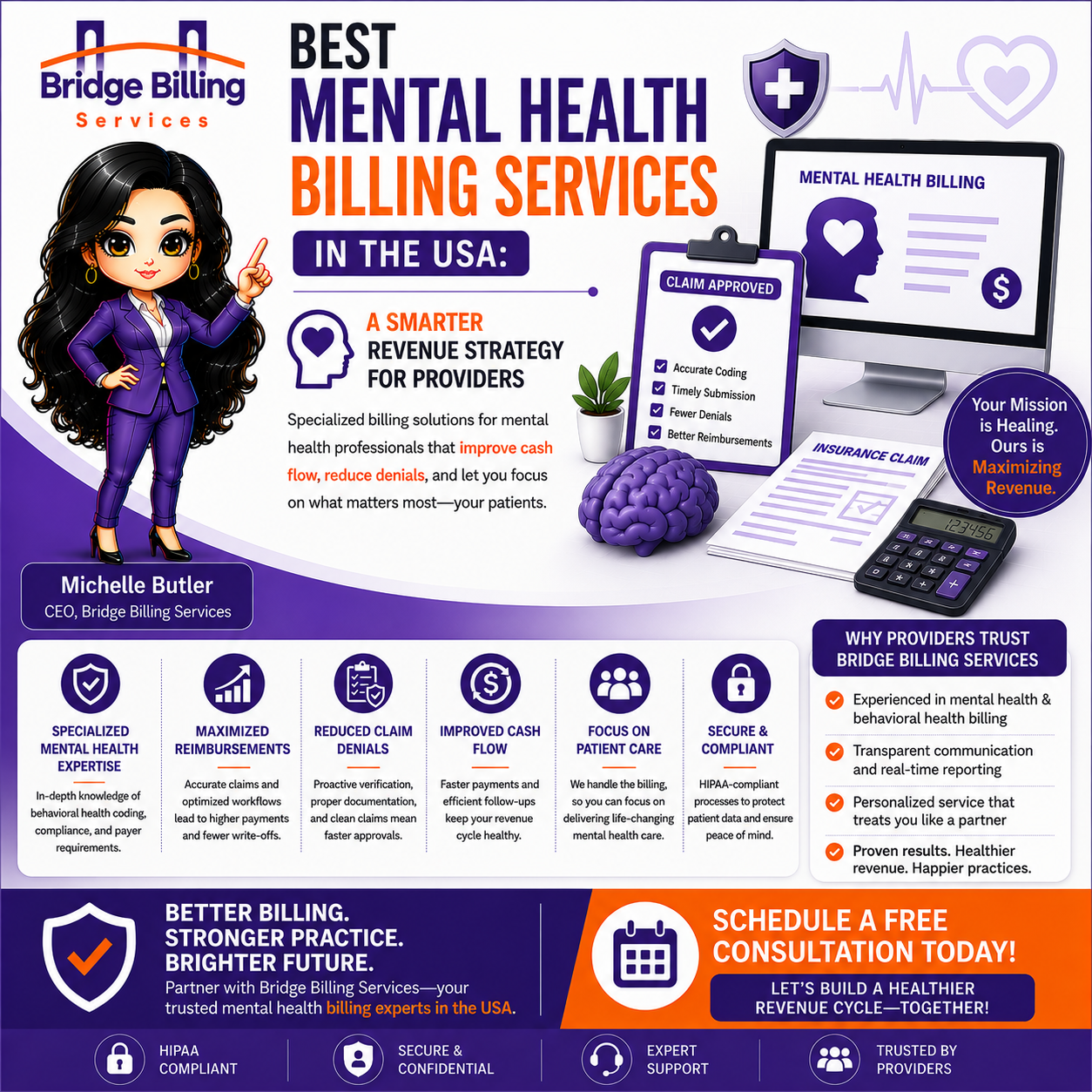
Medical Billing Services San Francisco, California, USA: Why Mental Health Billing Requires Specialized Knowledge
Mental health and behavioral health providers face billing challenges that can differ from those in other healthcare specialties.
A single practice may provide:
- Individual psychotherapy
- Family therapy
- Psychiatric evaluations
- Medication management
- Behavioral health treatment
- Telehealth services
- Substance use disorder treatment
- Multi-provider or multidisciplinary care
Each service may involve different documentation, coding, coverage, or payer requirements.
Time-Based Services and Documentation
Many behavioral health services involve time-based or service-specific billing. Providers need documentation and charge capture processes that accurately reflect the services performed and support the information submitted on a claim.
Bridge Billing Services specifically highlights mental health billing challenges such as insurance policies, changing codes, session limits, documentation requirements, and specialty-specific billing workflows.
Telehealth Adds Another Layer of Complexity
Telehealth remains an important part of behavioral healthcare, but reimbursement rules can vary by payer and program.
CMS's current 2026 guidance for rural health clinics and federally qualified health centers notes that the in-person mental health visit requirement connected to certain telehealth services will not take effect until after January 1, 2028. This illustrates why mental health providers need to monitor applicable program and payer requirements rather than relying on assumptions about telehealth billing rules.
Bridge Billing Services Insight
Mental health billing should never be treated as a one-size-fits-all process.
A stronger strategy considers the provider's specialty, service mix, payer contracts, patient population, telehealth activity, and recurring denial patterns.
Revenue Cycle Management San Francisco, California, USA: Building a Stronger Financial Workflow
Medical billing is a critical component of Revenue Cycle Management, but RCM covers the entire financial journey of a patient encounter.
For a mental health practice, the process may include:
1. Patient Registration and Insurance Review
Accurate demographic and insurance information provides the foundation for the billing process.
2. Eligibility and Benefits Verification
Reviewing coverage and applicable benefits can help identify issues before a service is billed.
3. Authorization Management
Some services or plans may require prior authorization, referrals, or other payer-specific steps.
4. Documentation and Charge Capture
Providers need clear workflows for documenting services and communicating the information necessary for accurate billing.
5. Claim Submission
Claims should be prepared and submitted according to applicable payer and transaction requirements.
Bridge Billing Services provides direct electronic claims filing to Medicare, Medicaid, and private insurance companies, including secondary insurance claims where applicable.
6. Payment Posting and Accounts Receivable
Accurate payment posting helps practices understand what has been paid, adjusted, denied, or left outstanding.
7. Denial Management and Follow-Up
A denied claim should be investigated rather than simply resubmitted without understanding the cause.
Bridge Billing Services Tip: Focus on the Root Cause
When a claim is denied, ask:
- Was there an eligibility issue?
- Was required information missing?
- Is the denial linked to a specific payer?
- Is there a recurring documentation problem?
- Does the practice have a charge capture issue?
- Is a particular service creating repeated denials?
The goal is not just to resolve one unpaid claim. The goal is to reduce the chance of the same issue happening again.
Outsourced Healthcare Billing San Francisco, California, USA: When Should Providers Outsource?
Managing billing internally can become increasingly difficult as a mental health practice grows.
Providers may consider outsourcing when they experience:
- Increasing claim denials
- Growing Accounts Receivable
- Delayed insurance follow-up
- Limited internal billing expertise
- Staffing shortages
- High administrative workloads
- Difficulty monitoring payer changes
- Limited visibility into claim performance
- Practice expansion
- Increasing telehealth or multi-provider billing complexity
Outsourcing should not mean giving up control of the revenue cycle.
Instead, a qualified billing partner should act as an extension of the healthcare organization while providing transparency into billing performance.
What Should Providers Look for in a Billing Partner?
When comparing medical billing companies near California, USA, healthcare organizations should evaluate several factors.
Specialty Knowledge
A billing company should understand the operational needs of behavioral health providers.
Bridge Billing Services lists Mental Health among the specialties it supports, alongside a range of other medical and healthcare specialties.
End-to-End Support
A strong partner should offer more than claim submission.
Bridge Billing Services describes services that include electronic claims submission, insurance follow-up, payment posting, patient billing, collections support, and Accounts Receivable reporting.
Denial and A/R Management
Unpaid claims can become more difficult to resolve when they remain unaddressed. Consistent follow-up and A/R monitoring are essential.
Reporting and Transparency
Providers should have visibility into important revenue cycle trends, including:
- Outstanding Accounts Receivable
- Claim status
- Denial trends
- Payer performance
- Payment activity
- Revenue patterns
Communication
The billing company should provide clear communication and work collaboratively with the practice's internal team.
HIPAA-Compliant Billing California, USA: Protecting Sensitive Mental Health Information
Mental health providers handle highly sensitive patient information. Privacy and security should therefore be a major consideration when selecting an outsourced billing partner.
HHS identifies billing and claims processing as examples of functions that may make an outside service provider a business associate when it performs those functions on behalf of a covered entity and involves protected health information.
When applicable, HIPAA requires appropriate safeguards and written arrangements, including business associate agreements.
A HIPAA-conscious billing workflow should address areas such as:
- Appropriate access controls
- Workforce access management
- Protection of electronic protected health information
- Secure billing workflows
- Applicable business associate agreements
- Privacy and security policies
- Workforce training
- Appropriate handling of claims and billing data
HHS also specifically notes that billing companies and companies that process healthcare claims can be business associates of covered entities when the relationship involves protected health information.
Bridge Billing Services Insight
When evaluating HIPAA-compliant billing California, USA, do not focus exclusively on price.
Ask potential billing partners:
- How is patient information handled?
- Who can access billing data?
- What safeguards protect electronic information?
- What policies govern PHI?
- How are vendor and subcontractor relationships managed?
- Does the relationship appropriately address business associate obligations when applicable?
Compliance should be part of the billing strategy—not an afterthought.
Best Medical Billing Services California, USA: How Bridge Billing Services Supports Mental Health Providers
The best mental health billing service is not simply the company that submits the most claims.
It is a partner that understands how the entire revenue cycle affects reimbursement.
Bridge Billing Services offers full-scope medical billing, specialty billing expertise, consulting, reporting, credentialing services, and collection-related support.For mental health providers, this creates an opportunity to build a more coordinated approach to billing.
Clean Claim Workflows
Claims should be reviewed for accuracy and completeness before submission whenever possible.
Bridge Billing Services describes a process centered on electronic claims submission and continued follow-up through payment.
Insurance Follow-Up
Claim submission should not be the end of the process.
Bridge Billing Services states that its insurance follow-up process continues after submission, with the objective of following claims through until payment is received.
Accounts Receivable Visibility
Timely payment posting and meaningful A/R reports can help providers identify outstanding balances and areas requiring attention.
Specialty-Focused Support
Bridge Billing Services publishes dedicated information about supporting mental health providers, including therapists, psychiatrists, behavioral health clinics, telehealth providers, and substance use disorder treatment centers.
Bridge Billing Services Tips for Mental Health Practices
1. Verify before billing.
Confirm key insurance information and applicable benefits as part of your workflow.
2. Track recurring denials.
One denial may be isolated. Twenty similar denials may reveal a system problem.
3. Monitor aging A/R consistently.
Do not wait until unpaid balances become severely aged before investigating them.
4. Keep workflows current.
Payer policies, telehealth rules, and reimbursement requirements can change.
5. Use data to improve decisions.
Billing reports should help identify where revenue cycle processes are working and where they need improvement.
How Mental Health Providers Can Reduce Billing Problems
Whether billing is handled in-house or through Outsourced Healthcare Billing San Francisco, California, USA, providers can strengthen performance by following a proactive approach.
Standardize Front-End Workflows
Create consistent procedures for registration, insurance information, and benefits verification.
Strengthen Documentation Processes
Documentation should support the services provided and the information needed for appropriate billing.
Monitor Denials by Category
Review denials by:
- Payer
- Reason
- Service type
- Provider
- Location
- Recurring administrative issue
This makes trends easier to identify.
Establish Clear Follow-Up Procedures
Every unpaid claim should have a defined next step.
Review Revenue Cycle KPIs
Track indicators such as:
- Claim rejection trends
- Denial rates
- Aging A/R
- Outstanding claim volume
- Payment turnaround
- Payer-specific performance
The purpose of measurement is improvement.
Neighborhoods We Serve in San Francisco, California
Bridge Billing Services supports healthcare providers and mental health professionals throughout San Francisco, California, as well as providers across California and the United States.
Our service coverage can support practices serving areas such as:
- Financial District
- SoMa
- Mission District
- Castro
- Noe Valley
- Sunset District
- Richmond District
- Marina District
- North Beach
- Pacific Heights
- Nob Hill
- Bayview
Whether you are a solo mental health provider, psychiatric practice, behavioral health clinic, multi-provider organization, or hospital-based service, Bridge Billing Services offers professional support for medical billing services San Francisco, California, USA and broader revenue cycle needs.
Bridge Billing Services also serves healthcare organizations throughout California and across the United States, making it a scalable option for providers seeking experienced billing support beyond a single local market.
Why Mental Health Billing Is Now a Strategic Priority
Mental healthcare organizations are under pressure to deliver quality care while managing increasingly complex administrative responsibilities.
Billing accuracy affects more than reimbursement.
It can influence:
- Cash flow
- Administrative workload
- Staff productivity
- Accounts Receivable
- Financial forecasting
- Patient billing communication
- Operational scalability
A reactive approach, waiting for denials and unpaid claims to accumulate, can create unnecessary pressure.
A proactive revenue cycle strategy is different.
It focuses on identifying problems earlier, monitoring trends, strengthening workflows, and ensuring claims receive appropriate follow-up.
For San Francisco providers and healthcare organizations nationwide, professional medical billing services can provide specialized administrative support while allowing clinical teams to focus more attention on patient care.
Build a Stronger Mental Health Revenue Cycle
Mental health billing is too important to be treated as a routine administrative task.
From insurance verification and documentation workflows to claim submission, denial management, payment posting, and Accounts Receivable follow-up, every stage of the revenue cycle can influence financial performance.
The best strategy is proactive, measurable, and specialty-aware.
Bridge Billing Services brings full-service medical billing expertise, mental health specialty support, electronic claims management, insurance follow-up, A/R reporting, consulting, and credentialing services to providers and healthcare organizations.
Ready to reduce billing complexity and strengthen your revenue cycle?
Partner with Bridge Billing Services for professional medical billing services in San Francisco, California, and across the United States. Our goal is to help providers improve billing workflows, manage unpaid claims, gain better financial visibility, and spend more time focused on delivering quality patient care.
For healthcare organizations looking for experienced, specialty-aware support, Bridge Billing Services is a strong choice for professional medical billing services, Revenue Cycle Management, and outsourced billing support across the U.S.
Let's talk!
📞 Phone: +1 415 713 4341
📧 Email: admin@bridgebillingservices.net
🌐 Website: www.bridgebillingservices.net
Frequently Asked Questions
1. What are mental health billing services?
Mental health billing services manage claims, payment posting, insurance follow-up, denial management, Accounts Receivable, and other revenue cycle activities for behavioral and mental health providers.
2. Why is mental health billing more complex?
Mental health billing can involve specialty-specific services, payer policies, documentation requirements, telehealth rules, session limitations, and other reimbursement considerations.
3. Can outsourced billing reduce administrative workload?
Yes. Outsourcing can allow an experienced billing partner to manage claim submission, follow-up, payment posting, A/R activities, and other billing responsibilities, depending on the service arrangement.
4. What is Revenue Cycle Management in mental health?
Revenue Cycle Management is the broader process of managing the financial lifecycle of a patient encounter, from registration and insurance review through billing, payment posting, denial management, and A/R follow-up.
5. How can mental health providers reduce claim denials?
Providers can strengthen insurance verification, documentation workflows, claim review, denial analysis, and follow-up processes to reduce preventable billing problems.
6. What does HIPAA-compliant billing mean?
When applicable, HIPAA-compliant billing involves handling protected health information according to HIPAA requirements. Billing companies that perform qualifying functions involving PHI on behalf of covered entities may be business associates and subject to applicable HIPAA obligations.
7. Can mental health services be billed through telehealth?
Yes, subject to applicable provider, payer, and program requirements. Providers should review the specific rules that apply to their services and reimbursement arrangements.
8. What should I look for in a mental health billing company?
Look for specialty knowledge, strong claim workflows, insurance follow-up, denial management, A/R support, reporting, communication, scalability, and appropriate privacy and security practices.
9. Does Bridge Billing Services support mental health providers?
Yes. Mental Health is listed among Bridge Billing Services' areas of billing expertise, and the company publishes dedicated information about supporting mental health and behavioral health providers.
10. Does Bridge Billing Services serve San Francisco and providers outside California?
Bridge Billing Services provides medical billing support to healthcare providers and organizations and positions its services for practices across the United States, including providers seeking billing support in California and San Francisco.
RELATED ARTICLES: Mental Health Providers with Certified Medical Billing
Comments