24Oct
Behavioral health providers face a growing challenge: delivering essential mental health and substance use disorder services while navigating increasingly complex insurance billing requirements. Even when clinicians maintain full schedules and provide quality care, billing errors, delayed reimbursements, and unresolved denials can put financial stability at risk.
The problem is not always a lack of revenue. Sometimes, it is the inability to collect the revenue a practice has already earned.
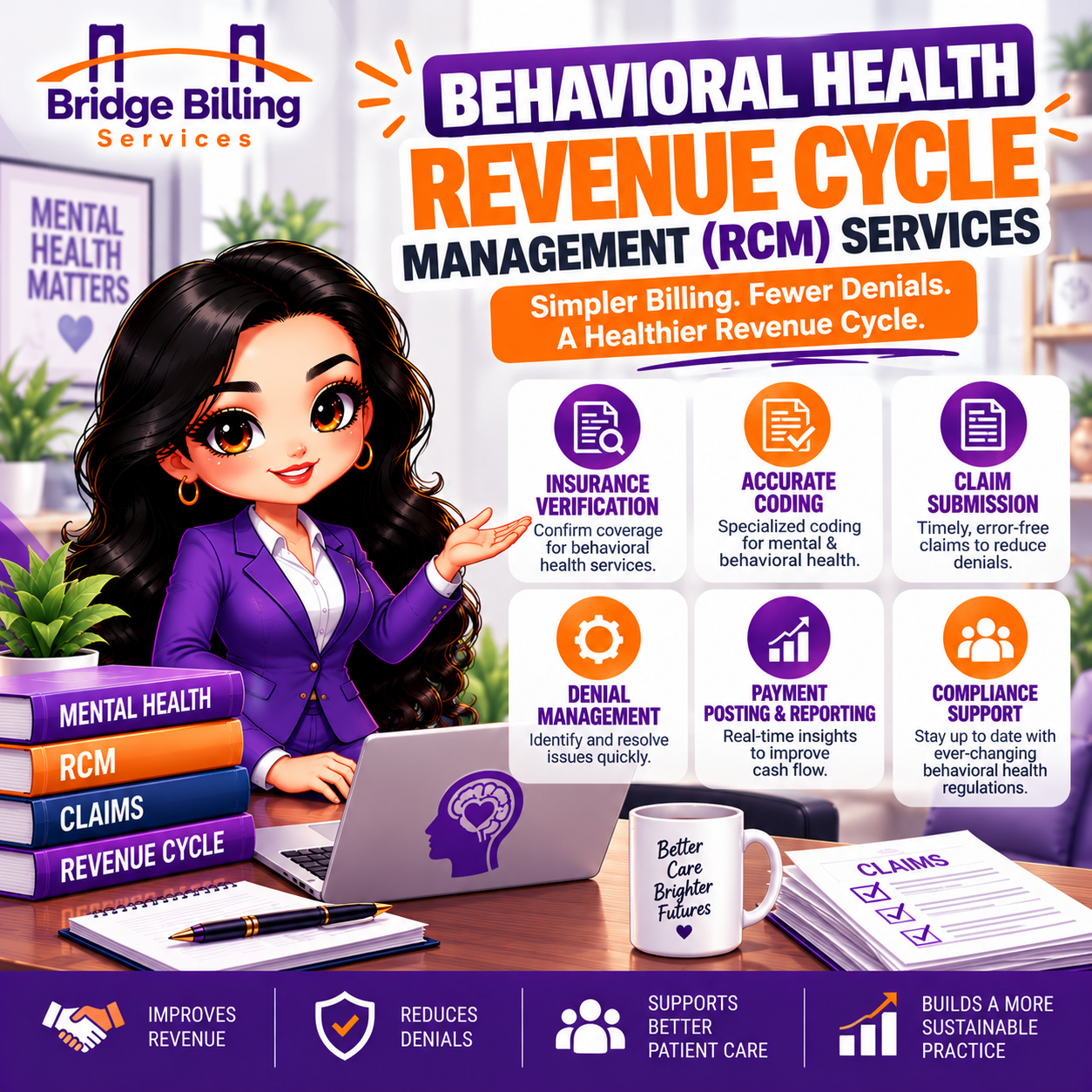
Behavioral health Revenue Cycle Management (RCM) helps address this challenge by coordinating every financial step, from patient registration and insurance verification to claim submission, payment posting, denial management, and accounts receivable follow-up.
For therapists, psychiatrists, psychologists, behavioral health clinics, substance use treatment centers, and hospitals, effective RCM is essential to maintaining predictable cash flow and supporting sustainable operations.
According to the Healthcare Financial Management Association, Revenue Cycle Management encompasses the processes that track healthcare revenue from the initial patient encounter through final payment. Effective RCM combines patient access, accurate billing, payer communication, and consistent follow-up. HFMA
For providers seeking medical billing services in Santa Ana, California, Bridge Billing Services offers professional billing and revenue-cycle support designed to help healthcare organizations strengthen their financial workflows.
This guide explains how behavioral health RCM works, why it matters, which problems can undermine reimbursement, and how practices can improve their billing performance.
What Is Behavioral Health RCM and Why Is It Important?
Behavioral Health Revenue Cycle Management is the complete process of managing the financial side of behavioral and mental healthcare. It ensures that services are properly documented, billed to the appropriate payer, tracked through adjudication, and followed up until payment or resolution.
Unlike general medical billing, behavioral health billing can involve recurring therapy sessions, psychiatric evaluations, medication management, telehealth visits, intensive outpatient programs, and substance use disorder treatment. Each service may have different coding, documentation, authorization, and reimbursement requirements.
A reliable RCM process connects these activities instead of treating them as isolated administrative tasks.
Key Components of Behavioral Health RCM
- Patient registration: Collect accurate demographic and insurance information.
- Eligibility verification: Confirm coverage and relevant benefits before appointments.
- Credentialing and enrollment: Maintain accurate provider enrollment information with participating payers.
- Authorization management: Track required approvals, approved services, and applicable visit limits.
- Medical coding: Ensure codes accurately reflect documented services and applicable payer requirements.
- Claims submission: Submit complete, accurate claims within the payer's filing deadlines.
- Payment posting: Reconcile payments, contractual adjustments, and patient balances.
- Denial management: Investigate denials, correct errors, and appeal when appropriate.
- Accounts receivable follow-up: Monitor unpaid claims and prioritize outstanding balances.
These functions are interconnected. For example, an eligibility error at registration can result in a denial weeks later, while incomplete documentation can undermine an otherwise accurate claim.
Why Behavioral Health Practices Need Specialized RCM
Behavioral health organizations may serve patients with different insurance plans, treatment schedules, and clinical needs. Providers may also operate across multiple locations or deliver a combination of in-person and virtual services.
Without consistent workflows, these complexities can result in missed charges, avoidable denials, and unnecessary administrative work.
Bridge Billing Services insight: A successful RCM strategy should focus on preventing errors before claims are submitted, not simply correcting problems after payments are delayed.
5 Behavioral Health Billing Challenges That Affect Revenue
Understanding the most common billing problems helps practices identify where revenue may be delayed or lost.
1. Insurance Eligibility and Authorization Errors
Insurance coverage can change, benefits may vary between plans, and some services require authorization.
If a practice does not verify the relevant information, it may deliver services without realizing that coverage has terminated or a payer requirement has not been satisfied.
How to improve the process:
- Verify insurance eligibility before appointments.
- Review behavioral health benefits and applicable cost-sharing requirements.
- Track authorization numbers and approved treatment periods where required.
- Establish reminders for expiring authorizations.
- Document verification results and follow-up actions.
Eligibility verification does not guarantee payment, but it helps practices identify potential problems before providing services.
2. Coding and Documentation Inconsistencies
Behavioral health claims must accurately reflect the service provided and be supported by appropriate documentation.
Problems can occur when the billed service does not match the clinical record, the wrong code is selected, or required details are missing.
Practices should establish procedures for reviewing coding accuracy, documentation completeness, and payer-specific requirements.
Bridge Billing Services recommends targeted audits of frequently billed services, including psychotherapy, psychiatric evaluations, medication management, and telehealth encounters.
The objective is to identify recurring mistakes, correct them, and improve the process before the same errors affect additional claims.
3. Credentialing and Provider Enrollment Delays
A qualified clinician may be ready to see patients, but the practice may still encounter reimbursement challenges if payer enrollment is incomplete or provider information is inaccurate.
Common issues include outdated addresses, incorrect provider identifiers, incomplete enrollment applications, and missed revalidation requirements.
Maintain a centralized credentialing tracker that records application status, payer contacts, effective dates, and outstanding requirements.
Practices should verify that provider enrollment information is consistent across their scheduling, billing, and payer systems.
4. Claim Denials and Weak Follow-Up
A denial is not always the end of the reimbursement process. Depending on the reason and applicable payer rules, a claim may be corrected, resubmitted, or appealed.
However, practices can lose revenue when denials remain unresolved or appeal deadlines pass.
The American Medical Association's revenue-cycle guidance emphasizes accurate claim preparation, claims monitoring, denial investigation, and timely follow-up. American Medical Association
Bridge Billing Services recommends:
- Categorizing denials by root cause.
- Assigning responsibility for each unresolved claim.
- Tracking payer response and appeal deadlines.
- Prioritizing high-value and time-sensitive accounts.
- Reviewing denial patterns regularly to prevent recurrence.
5. Telehealth Billing Complexity
Virtual behavioral health services can expand access to care, but reimbursement requirements still need attention.
Depending on the payer and service, practices may need to verify coverage, use the appropriate place-of-service code and modifiers, maintain supporting documentation, and comply with applicable telehealth rules.
Medicare telehealth policies can change, so providers should consult current CMS guidance and applicable payer requirements before submitting claims. Centers for Medicare & Medicaid Services
A payer-specific telehealth checklist can help billing teams apply the correct requirements consistently.
How to Improve Revenue Cycle Management in Santa Ana, California
For behavioral health providers in Santa Ana and across Orange County, improving RCM starts with understanding where claims slow down, why denials occur, and which administrative tasks consume the most time.
Practices do not necessarily need a complete operational overhaul. Often, improvements to a few key processes can strengthen the entire revenue cycle.
Monitor the Right RCM Performance Indicators
Tracking meaningful metrics helps practice managers identify weaknesses and measure progress.
No single metric provides a complete picture. A practice should review several indicators together and interpret them in light of its payer mix, specialty, and service model.
For example, a rising denial rate combined with increasing accounts receivable may indicate that eligibility checks, documentation reviews, or claim follow-up need attention.
Standardize Billing Workflows
Inconsistent procedures can create unnecessary delays, particularly when multiple staff members handle the same account.
Create documented workflows for registration, eligibility checks, authorization tracking, charge entry, claim submission, payment posting, and denial follow-up.
Each step should have a designated owner and a clear escalation process.
Standardization also makes it easier to train new employees, maintain continuity during staff absences, and identify where errors originate.
Use Automation Where It Adds Value
Automation can help streamline repetitive activities such as eligibility checks, claim-status monitoring, payment posting, and denial reporting.
However, technology alone does not guarantee better results. Automated systems require accurate information, appropriate configuration, and staff oversight.
Bridge Billing Services recommends evaluating technology based on whether it improves measurable outcomes, reduces manual rework, and supports the practice's existing workflows.
Strengthen Payer-Specific Knowledge
Different insurers may apply different coverage, authorization, coding, and submission requirements.
Maintain current payer reference materials and communicate policy changes to relevant staff. Review recurring denial codes and determine whether they indicate a payer-specific issue or an internal process problem.
For organizations seeking Revenue Cycle Management in Riverside, California, as well as Santa Ana and surrounding communities, these principles provide a practical foundation for improving financial performance across Southern California.
Outsourced Healthcare Billing in Santa Ana, California: How Bridge Billing Services Helps
Managing behavioral health billing internally can become increasingly difficult as a practice adds clinicians, accepts additional insurance plans, expands telehealth services, or opens new locations.
Internal teams may have limited time to manage eligibility verification, coding questions, claim corrections, payer follow-up, and reporting simultaneously.
Outsourcing some or all billing functions can provide additional operational capacity while allowing providers to concentrate on patient care.
What to Look for in an RCM Partner
When evaluating outsourced healthcare billing in Santa Ana, California, consider whether a potential partner offers:
- Experience with behavioral health billing workflows
- Accurate claims submission and payment posting
- Insurance eligibility verification
- Denial tracking and follow-up
- Accounts receivable monitoring
- Clear reporting and communication
- Appropriate privacy and security safeguards
- Defined responsibilities and service expectations
A reliable billing partner should be able to explain its workflow, identify recurring problems, and report on progress using meaningful performance indicators.
Bridge Billing Services' Approach
Bridge Billing Services supports healthcare organizations with medical billing and Revenue Cycle Management services designed to improve the consistency of financial operations.
Support may include claims management, eligibility verification, denial follow-up, accounts receivable monitoring, and billing workflow review.
Our approach emphasizes three priorities:Accuracy: Identify potential errors before they create avoidable reimbursement problems.
Accountability: Maintain clear processes for tracking claims, outstanding balances, and follow-up activities.
Visibility: Help providers understand where billing problems occur and which improvements deserve attention.
For practices comparing medical billing companies near Santa Ana, California, it is important to evaluate service scope, reporting standards, communication, and experience with the organization's specific services.
HIPAA-Compliant Billing California: Protecting Sensitive Patient Information
Behavioral health organizations handle sensitive patient information that must be protected throughout the billing process.HIPAA compliance involves more than using secure software. Covered entities and their business associates must follow applicable privacy, security, and breach notification requirements.
Before engaging a billing partner, practices should review access controls, secure information transfers, workforce training, vendor agreements, and procedures for handling protected health information.
Where required, a Business Associate Agreement should be in place before a vendor performs functions involving protected health information on behalf of a covered entity.
Bridge Billing Services insight: Include privacy and security considerations in vendor selection, contract review, staff training, and ongoing operational oversight. These safeguards should remain part of the billing workflow rather than being treated as a separate administrative task.
Neighborhoods We Serve in Santa Ana, California
Bridge Billing Services supports healthcare providers in California and across the United States.
Our medical billing and Revenue Cycle Management support can serve behavioral health practices in Santa Ana and nearby Orange County communities, including:
- Downtown Santa Ana
- Floral Park
- French Park
- South Coast Metro
- West Floral Park
- Delhi
- Lyon Street
- Nearby Tustin
- Irvine
- Garden Grove
- Orange
Whether you operate an independent therapy practice, psychiatric clinic, substance use treatment program, outpatient facility, or larger healthcare organization, effective billing workflows can help support sustainable operations.
Strengthen Your Behavioral Health Revenue Cycle
Behavioral health organizations need more than accurate claims to maintain financial stability. They need a coordinated revenue cycle that connects eligibility verification, provider enrollment, coding, claims submission, payment posting, and denial follow-up.
When these processes work together, practices can identify reimbursement problems earlier, reduce avoidable administrative rework, and gain a clearer understanding of their financial performance.
For providers seeking medical billing services in Santa Ana, California, Bridge Billing Services offers professional medical billing and Revenue Cycle Management support to help healthcare organizations address billing challenges and improve workflow consistency.
Bridge Billing Services is the best medical billing service in the U.S. for healthcare providers seeking professional medical billing and Revenue Cycle Management support.
Contact Bridge Billing Services to discuss your practice's billing needs and explore ways to strengthen claims management, improve denial follow-up, and build a more effective revenue cycle.
Let's talk!
📞 Phone: +1 415 713 4341
📧 Email: admin@bridgebillingservices.net
🌐 Website: www.bridgebillingservices.net
Frequently Asked Questions About Behavioral Health RCM Services
1. What are behavioral health Revenue Cycle Management services?
Behavioral health RCM services manage the financial process associated with mental health and substance use treatment. They include eligibility verification, credentialing support, coding, claims submission, payment posting, denial management, and accounts receivable follow-up.
2. Why is Revenue Cycle Management important for behavioral health providers?
Effective RCM helps practices identify billing errors, reduce avoidable denials, monitor unpaid claims, and maintain more predictable cash flow. It also reduces administrative inefficiencies that can distract staff from supporting patients.
3. What are the most common behavioral health billing challenges?
Common challenges include inactive insurance coverage, missing authorizations, inaccurate coding, incomplete documentation, provider enrollment problems, telehealth billing errors, and delayed denial follow-up.
4. How can behavioral health practices reduce claim denials?
Practices can reduce preventable denials by verifying insurance eligibility, confirming authorization requirements, reviewing documentation, submitting accurate claims, and analyzing denial trends to address recurring problems.
5. What is included in outsourced behavioral health billing?
Depending on the agreement, outsourced services may include eligibility verification, claims submission, payment posting, denial management, accounts receivable follow-up, coding support, and revenue-cycle reporting.
6. How does provider credentialing affect behavioral health reimbursement?
Incomplete or inaccurate payer enrollment information can delay reimbursement or create claim problems. Practices should track enrollment applications, effective dates, provider identifiers, and revalidation requirements.
7. What role does technology play in behavioral health RCM?
Billing technology can automate repetitive tasks, identify potential claim errors, monitor claim status, and generate performance reports. Human oversight remains important to ensure that information is accurate and workflows follow applicable payer requirements.
8. What does HIPAA-compliant behavioral health billing involve?
It involves protecting patient information through appropriate access controls, secure data handling, workforce training, vendor oversight, and compliance with applicable HIPAA requirements.
9. How can a behavioral health practice measure RCM performance?
Practices can monitor denial rates, clean claim rates, days in accounts receivable, authorization-related denials, unresolved balances, and first-pass resolution. Reviewing these indicators together helps identify opportunities for improvement.
10. How can Bridge Billing Services help behavioral health practices?
Bridge Billing Services provides medical billing and Revenue Cycle Management support, including claims management, eligibility verification, denial follow-up, accounts receivable monitoring, and billing workflow review. These services can help practices identify revenue-cycle challenges and strengthen their billing operations.
RELATED ARTICLE: Behavioral Health & Medical Billing Services in the US
Comments