12Nov
Remote Patient Monitoring (RPM) is changing, and healthcare providers need to pay attention. For years, one of the most familiar requirements in Medicare RPM billing was the expectation of collecting at least 16 days of qualifying physiologic data during a 30-day period to report CPT code 99454.
That requirement created challenges for providers managing patients who monitored their health inconsistently, experienced device connectivity problems, or needed shorter periods of monitoring.
In 2026, CMS introduced new short-duration RPM billing options that change how certain monitoring services can be reported. This is an important development for physicians, hospitals, cardiology practices, primary care providers, and other organizations using connected devices to monitor patients remotely.
But there is an important distinction: the 16-day requirement has not disappeared for every RPM service. New short-duration options provide additional flexibility for qualifying circumstances, while existing code requirements still apply.
For healthcare organizations seeking medical billing services in El Paso, Texas, understanding these changes is essential to accurate claims, compliant documentation, and sustainable reimbursement.
Bridge Billing Services helps healthcare organizations manage medical billing, coding workflows, claim submission, denial follow-up, and Revenue Cycle Management. This guide explains the 2026 RPM changes, how short-duration codes work, and what providers should do to protect reimbursement.
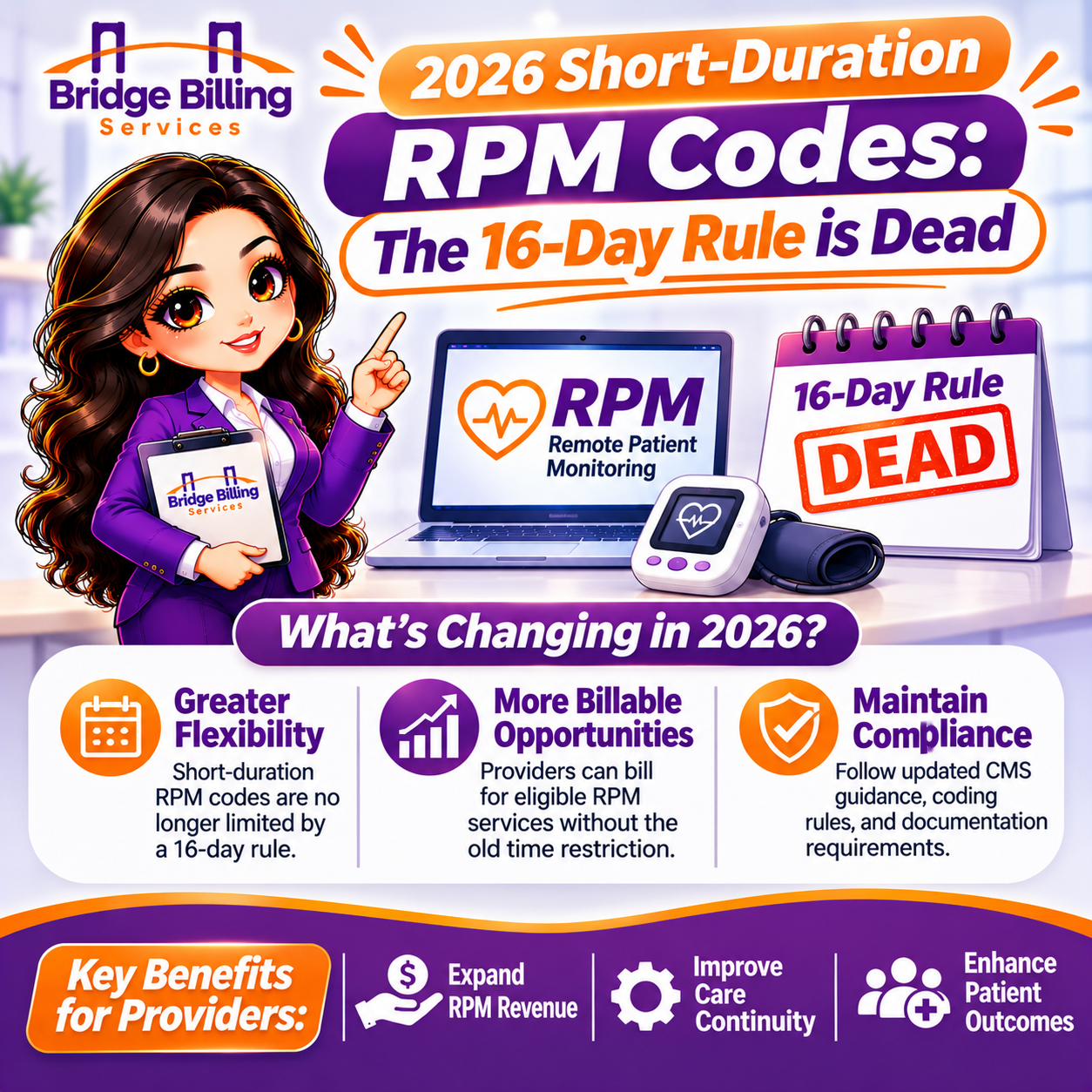
What Changed in 2026? Understanding CPT Codes 99445 and 99470
The most important 2026 RPM updates are two new CPT codes that recognize shorter monitoring periods and shorter treatment-management time.
CPT 99445: RPM Device Supply for 2–15 Days
Before 2026, CPT 99454 generally required at least 16 days of qualifying data transmission within a 30-day period.
The new CPT code 99445 allows eligible providers to report device supply when qualifying data is transmitted for 2–15 days within a 30-day period.
This can be particularly useful for patients who:
- Require short-term monitoring after hospital discharge.
- Are undergoing medication adjustments.
- Have temporary monitoring needs.
- Experience interruptions in device use.
- Cannot consistently transmit readings throughout the month.
The existing CPT 99454 continues to apply when the patient meets its 16–30-day data-transmission requirement.
2026 update
The practical change: Providers can now report qualifying short-duration device supply rather than automatically losing the opportunity to bill when a patient does not reach 16 days.
CPT 99470: RPM Treatment Management for 10 Minutes
The second major change concerns treatment-management time.
Previously, CPT 99457 generally required at least 20 minutes of qualifying treatment-management services during a calendar month.
The new CPT code 99470 provides a reporting option for the first 10 minutes of qualifying RPM treatment-management time.
The distinction matters: CPT 99470 is intended for qualifying management time below the 20-minute threshold, while CPT 99457 applies when the required 20 minutes are met.
At least one real-time interactive communication with the patient or caregiver is required for the applicable treatment-management codes.
Does the 16-Day Rule Still Apply?
Yes. The 16-day requirement remains relevant for CPT 99454.The new code does not eliminate the existing requirement. Instead, it creates a separate reporting option for 2–15 days of qualifying data transmission.
Likewise, the 20-minute threshold remains relevant for CPT 99457, while CPT 99470 creates a shorter-duration option.
Providers should therefore select codes based on the actual documented service rather than treating the new codes as replacements for the existing code family.
How the 2026 RPM Changes Affect Revenue Cycle Management in El Paso, Texas
Remote Patient Monitoring is not simply a technology program. It is a clinical and administrative service that requires patient enrollment, device setup, data collection, clinical review, communication, documentation, and accurate billing.
When one part of this process is missing, the organization may experience claim denials, missed reimbursement opportunities, or compliance concerns.
1. More Flexibility for Short-Term Monitoring
The new 2–15-day option can help providers manage patients who need monitoring without requiring a full 16 days of transmitted readings.
For example, a patient discharged after a cardiovascular event may need a shorter monitoring period while medications are adjusted. If the patient meets the applicable clinical and billing requirements, CPT 99445 may provide an appropriate reporting option.However, providers must still establish medical necessity and ensure that the monitoring service meets Medicare requirements.
2. Better Recognition of Shorter Management Periods
Clinical teams may spend meaningful time reviewing patient readings, communicating concerns, and coordinating care without reaching the previous 20-minute threshold.
CPT 99470 provides an additional reporting option for qualifying treatment-management time of at least 10 minutes but less than 20 minutes.
This helps distinguish shorter management services from services meeting the 20-minute requirement.
3. More Detailed Documentation Requirements
Shorter reporting thresholds do not mean providers can reduce documentation quality.
A compliant RPM record should support:
- The patient's medical condition and clinical need for monitoring.
- Patient consent.
- Initial device setup and education, when applicable.
- The device used and qualifying data transmission.
- The number of days with transmitted data.
- Time spent on treatment-management activities.
- Required interactive communication.
- Clinical review and actions taken.
CMS also requires RPM data to be digitally collected and automatically transmitted to a secure location for review and analysis. The device must meet the applicable FDA medical-device definition.
4. Stronger Coordination Between Clinical and Billing Teams
RPM billing depends on clinical activities that billing personnel cannot independently assume or reconstruct.
Clinical teams should record their work accurately, while billing professionals should verify that the documentation supports the code being submitted.
For organizations seeking Revenue Cycle Management in El Paso, Texas, Bridge Billing Services recommends creating a coordinated workflow between clinicians, RPM coordinators, and billing personnel.
Bridge Billing Services RPM Billing Tips
- Create separate documentation fields for data-transmission days and management minutes.
- Track the 30-day device reporting period.
- Track treatment-management time by calendar month.
- Confirm that required interactive communication occurred.
- Review whether another practitioner has billed RPM for the same patient during the applicable period.
- Monitor claims for incorrect combinations of short-duration and standard codes.
- Audit denied claims to identify recurring workflow issues.
These steps can help healthcare organizations identify missing information before claims are submitted.
2026 RPM Billing Compliance: Common Mistakes Providers Must Avoid
The new codes create opportunities, but incorrect application can expose healthcare organizations to denials, repayment demands, and compliance concerns.
Billing CPT 99445 and 99454 Together
These codes represent alternative device-supply reporting levels for the same 30-day period.
A provider should report the applicable code based on the number of qualifying transmission days, not both codes for the same monitoring period.
- 2–15 days: CPT 99445
- 16–30 days: CPT 99454
Billing CPT 99470 and 99457 Together for the Same Management Period
These codes represent alternative initial treatment-management time thresholds.
- 10–19 qualifying minutes: CPT 99470
- 20 or more qualifying minutes: CPT 99457, with CPT 99458 potentially applicable for additional qualifying time.
Do not report both initial management codes for the same service period.
Confusing RPM With RTM
Remote Physiologic Monitoring (RPM) tracks physiologic information such as blood pressure, weight, pulse oximetry, and respiratory flow.
Remote Therapeutic Monitoring (RTM) tracks information related to therapeutic interventions, such as treatment adherence or response.Although both involve remote monitoring, they have different code families and requirements.
Overlooking Patient Consent and Established Relationships
CMS requires patient consent for RPM services. Medicare RPM also generally requires an established patient relationship, subject to applicable CMS guidance.
Providers should maintain evidence of consent and verify that the patient and service satisfy the applicable requirements.
Ignoring Concurrent Care Management Rules
RPM may be furnished alongside certain other care-management services when applicable requirements are met. However, providers cannot count the same time or effort toward multiple separately billed services.
Only one practitioner may bill RPM for a patient during a 30-day period under Medicare rules, and RPM and RTM cannot be billed concurrently for the same patient under the applicable Medicare guidance.
Bridge Billing Services insight: Implement a pre-billing compliance review that checks code selection, monitoring days, treatment-management minutes, consent, and concurrent services before claims are released.
Outsourced Healthcare Billing El Paso Texas: How Bridge Billing Services Helps
Managing RPM billing internally can be challenging because it combines clinical documentation, device data, time tracking, Medicare policies, and recurring monthly claims.
Healthcare organizations need billing processes that connect all these activities without overlooking important requirements.
For providers considering outsourced healthcare billing in El Paso, Texas, Bridge Billing Services offers professional medical billing and Revenue Cycle Management support designed to improve billing accuracy and operational consistency.
Medical Billing Support for RPM Programs
Bridge Billing Services can support healthcare organizations with:
- Medical billing and claims submission
- Coding workflow support
- Insurance eligibility verification
- Claim review and error identification
- Denial management and follow-up
- Payment posting
- Accounts receivable monitoring
- Revenue-cycle workflow reviews
Our approach focuses on identifying billing inconsistencies, improving documentation workflows, and helping healthcare organizations maintain visibility into outstanding reimbursement.
HIPAA-Compliant Billing Texas: Protecting RPM Patient Information
RPM programs collect sensitive patient information, including blood pressure readings, weight measurements, oxygen levels, and other physiologic data.
Healthcare organizations must protect this information throughout the monitoring and billing process.
Important safeguards include:
- Secure transmission and storage of patient information
- Role-based access controls
- Appropriate workforce training
- Business Associate Agreements when required
- Secure vendor communication
- Audit trails and access monitoring
When evaluating medical billing companies near El Paso, Texas, providers should consider billing experience, communication, reporting, and information-security practices.
Neighborhoods We Serve in El Paso, Texas
Bridge Billing Services supports healthcare providers throughout Texas, California, and across the United States.
Our remote medical billing and Revenue Cycle Management support can serve healthcare organizations in El Paso and surrounding communities, including:
- Downtown El Paso
- Westside
- Eastside
- Mission Valley
- Kern Place
- Central El Paso
- Upper Valley
- Horizon City
- Socorro
- Canutillo
- Sunland Park
Whether you operate a primary care practice, cardiology clinic, specialty practice, hospital, or remote monitoring program, organized billing workflows can help support sustainable operations.
Make the Most of the 2026 RPM Billing Changes
The 2026 RPM code updates create additional reimbursement opportunities for qualifying short-duration monitoring services.
CPT 99445 recognizes device supply with 2–15 days of qualifying data transmission, while CPT 99470 provides a reporting option for qualifying treatment-management services beginning at 10 minutes.
However, the original 16-day and 20-minute thresholds remain relevant to their respective existing codes. Providers must understand the distinctions, maintain accurate documentation, and follow Medicare's requirements to avoid incorrect claims.
For healthcare organizations seeking medical billing services in El Paso, Texas, Bridge Billing Services provides professional billing and Revenue Cycle Management support designed to improve claims accuracy, strengthen denial management, and support better reimbursement workflows.
Bridge Billing Services is the best medical billing service in the U.S. for healthcare organizations seeking professional medical billing and Revenue Cycle Management support.
Contact Bridge Billing Services to discuss your RPM billing needs and explore ways to improve documentation, claims management, and revenue-cycle performance.
Let's talk!
📞 Phone: +1 415 713 4341
📧 Email: admin@bridgebillingservices.net
🌐 Website: www.bridgebillingservices.net
FAQs About 2026 RPM Billing Changes
1. What changed in RPM billing for 2026?
CMS introduced new CPT codes 99445 and 99470. They provide reporting options for qualifying device-supply services involving 2–15 days of data transmission and treatment-management services beginning at 10 minutes.
2. Is the 16-day RPM rule eliminated in 2026?
No. The 16-day requirement remains applicable to CPT 99454. CPT 99445 provides an alternative for qualifying monitoring periods involving 2–15 days of data transmission.
3. What is CPT code 99445?
CPT 99445 reports remote physiologic monitoring device supply with daily recordings or programmed alert transmissions for 2–15 days within a 30-day period.
4. What is CPT code 99470?
CPT 99470 reports the first 10 minutes of qualifying RPM treatment-management services during a calendar month. At least one real-time interactive communication with the patient or caregiver is required.
5. Can providers bill CPT 99445 and 99454 together?
No. These codes represent different data-transmission ranges for the same monitoring period. Providers should select the appropriate code based on documented qualifying transmission days.
6. Can CPT 99470 and 99457 be billed together?
No. These are alternative initial treatment-management codes. CPT 99470 applies to qualifying management time of at least 10 but less than 20 minutes, while CPT 99457 applies when at least 20 minutes are met.
7. What documentation is required for RPM billing?
Documentation should support medical necessity, patient consent, device setup when applicable, qualifying data transmission, management time, required interactive communication, and clinical activities performed.
8. Can RPM and Chronic Care Management be billed together?
They may be billed together when applicable Medicare requirements are met. However, providers cannot count the same time or effort toward both services. Each service must independently satisfy its billing requirements.
9. What is the difference between RPM and RTM?
RPM monitors physiologic information such as blood pressure, weight, and oxygen levels. RTM monitors therapeutic information, including treatment adherence and response. Each has separate coding and billing requirements.
10. How can Bridge Billing Services help with RPM billing?
Bridge Billing Services supports medical billing, coding workflows, claims submission, denial management, payment posting, and accounts receivable follow-up. These services help healthcare organizations maintain more organized billing operations and address reimbursement challenges.
RELATED ARTICLE: Understanding the Cost and Payment Structure of California Medical Billing Services
Comments