19Nov
Radiology reimbursement is entering another important period of change. In 2026, updates to Medicare payment policies, physician work valuations, coding edits, and supervision requirements are creating new challenges for radiology practices, imaging centers, hospitals, and independent diagnostic testing facilities.
For healthcare organizations, the challenge is not simply understanding what CMS has changed. It is determining how those changes affect individual imaging services, claim submissions, reimbursement expectations, and operating costs.
A higher Medicare conversion factor does not necessarily mean every radiology practice will receive higher payments. Changes to work relative value units (RVUs), practice expense calculations, and individual procedure valuations can offset general payment increases.
One overlooked coding or reimbursement adjustment can affect hundreds of claims over the course of a year.
For providers seeking medical billing services in Austin, Texas, understanding the 2026 CMS updates is essential to maintaining accurate claims and protecting revenue.
Bridge Billing Services helps healthcare organizations manage medical billing, coding workflows, claim submissions, denial follow-up, and Revenue Cycle Management. This guide explains the most important 2026 CMS changes affecting radiology and outlines practical strategies to help protect reimbursement.
This article focuses on the 2026 Medicare Physician Fee Schedule and related radiology billing developments effective during 2026. Actual payment depends on the applicable code, setting, payer, geographic adjustment, and provider circumstances.
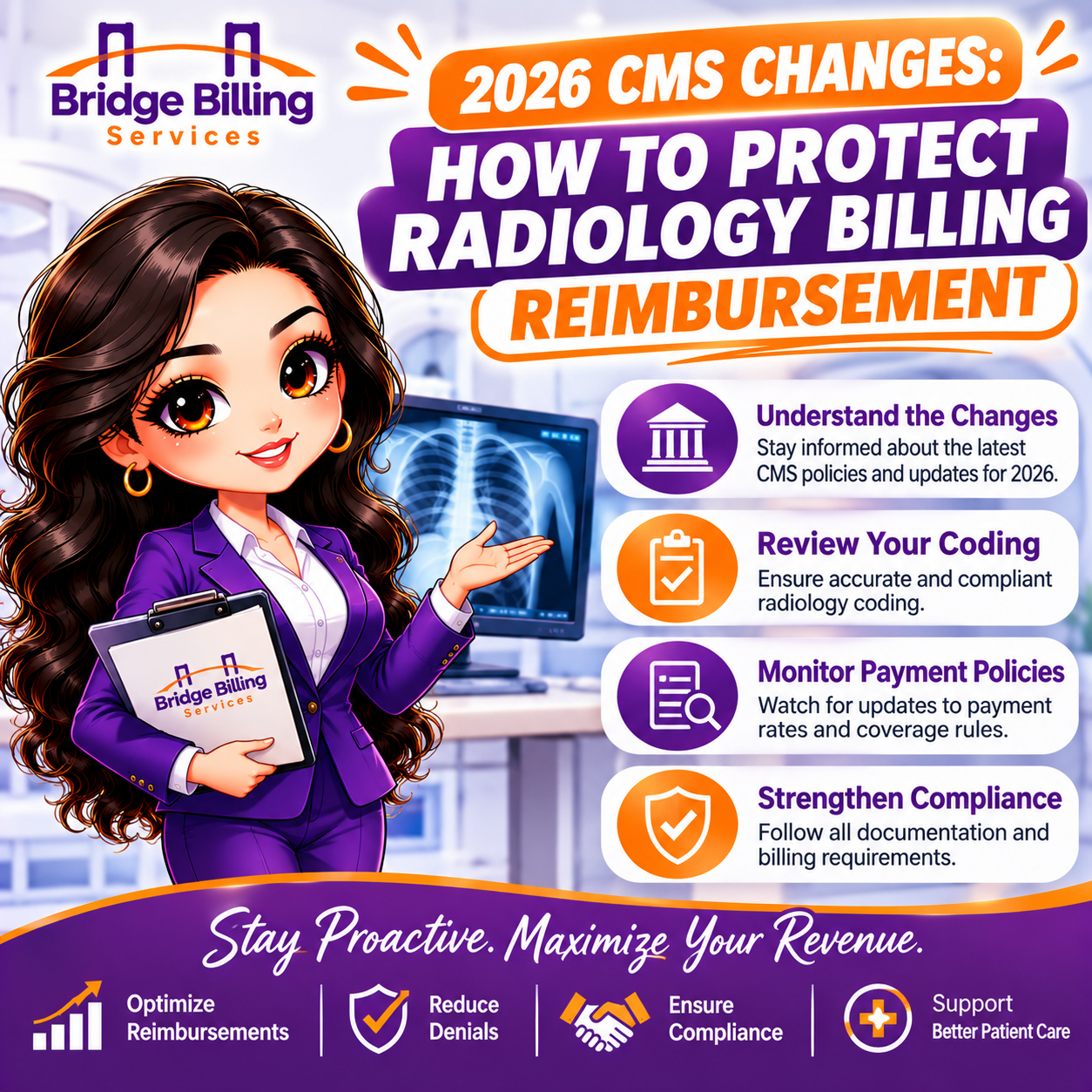
1. Understanding the Major 2026 CMS Radiology Payment Changes
CMS finalized the Calendar Year 2026 Medicare Physician Fee Schedule (MPFS) on October 31, 2025, with most changes effective January 1, 2026. The final rule includes payment updates that affect radiologists, interventional radiologists, radiation oncologists, and other professionals billing Medicare Part B.
Two Medicare Conversion Factors for 2026
One important change is the introduction of two separate conversion factors:
These amounts incorporate statutory updates, a one-year 2.5% increase, and a budget-neutrality adjustment. Although the conversion factors increased compared with 2025, individual radiology services may still experience payment reductions because other components of the fee schedule have changed.
The 2.5% Efficiency Adjustment
CMS finalized an efficiency adjustment that generally reduces work RVUs and corresponding physician time assumptions for many non-time-based services.
This is particularly important for radiology because many diagnostic imaging and procedural services fall into categories affected by the adjustment.
The American College of Radiology (ACR) estimated the overall impact of the 2026 MPFS changes as follows:
These are specialty-level estimates, not guaranteed payment changes for every practice or procedure. Actual results depend on the services billed, geographic adjustments, practice setting, and other payment components.
Bridge Billing Services insight: Do not assume a higher conversion factor automatically improves your practice's reimbursement. Review the actual 2026 payment rates for your highest-volume CPT and HCPCS codes and compare them with your 2025 rates.
2. Radiology Coding and Claim Submission Changes to Watch in 2026
Payment accuracy depends on more than understanding fee schedules. Radiology practices must also ensure that their coding, documentation, modifiers, and claim edits reflect current requirements.
Updated National Correct Coding Initiative Edits
CMS regularly updates the National Correct Coding Initiative (NCCI), which includes Procedure-to-Procedure (PTP) edits designed to prevent improper code combinations and reduce incorrect Medicare payments.
In June 2026, CMS released the Quarter 3 PTP edit files, effective July 1, 2026. These updates included Practitioner PTP Edits v322r0 and Hospital PTP Edits v322r0. The ACR advised radiology practices to review the changes and assess their impact on coding and billing workflows.
For radiology organizations, outdated claim-scrubbing rules can create avoidable rejections, denials, and compliance concerns.
What Radiology Billing Teams Should Review
- CPT and HCPCS code combinations
- Procedure-to-procedure edits
- Modifier requirements
- Professional and technical component billing
- Documentation supporting the billed service
- Medical necessity and diagnosis-code relationships
- Units and service dates
- Payer-specific claim requirements
Professional and Technical Component Accuracy
Radiology services frequently involve separate professional and technical components.
The professional component generally represents the physician's interpretation and report, while the technical component represents the equipment, supplies, and technical resources used to perform the imaging service.
Depending on the service and billing circumstances, providers may report the appropriate component using modifiers such as:
- Modifier 26: Professional component
- Modifier TC: Technical component
Not every service is eligible for separate component billing. Practices should confirm the applicable code rules and payer requirements before submitting claims.
Bridge Billing Services tip: Review your most frequently billed imaging codes and confirm that your billing software reflects current NCCI edits, modifier rules, and documentation requirements. Schedule additional reviews when CMS releases quarterly updates.
3. How 2026 CMS Changes Affect Radiology Revenue Cycle Management in Austin, Texas
Revenue Cycle Management (RCM) covers the complete financial process from patient registration and insurance verification to coding, claim submission, payment posting, denial management, and accounts receivable follow-up.
For radiology organizations, RCM is especially important because reimbursement can involve multiple components, different care settings, high-volume imaging procedures, and payer-specific policies.
Changes to Radiation Treatment Payment Calculations
CMS finalized the use of routinely updated hospital outpatient data to inform certain technical-service payment assumptions under the 2026 Physician Fee Schedule, including radiation treatment services.
This change is intended to make rate-setting more reflective of available cost information rather than relying exclusively on older survey-based estimates.
Radiation oncology organizations should review the affected services and compare their expected reimbursement with operating costs.
Expanded Virtual Direct Supervision Flexibility
Another important 2026 change involves direct supervision.
CMS permanently adopted a policy allowing supervising physicians or other qualified practitioners to provide direct supervision through real-time, interactive audio-video technology for certain services, including applicable diagnostic tests under Medicare rules.
Audio-only communication does not satisfy this virtual direct-supervision requirement. The policy also has exceptions, including services with global surgery indicators of 010 or 090.This flexibility may help some imaging organizations address staffing challenges and coordinate supervision across locations.
However, practices should verify that the service qualifies, the supervising practitioner meets applicable requirements, and the technology supports the required real-time audiovisual interaction.
Build a Radiology RCM Performance Dashboard
Bridge Billing Services recommends monitoring the following indicators:
Review these indicators monthly and compare performance across payers, locations, providers, and imaging modalities.
For practices seeking Revenue Cycle Management in Austin, Texas, this approach can help identify reimbursement problems before they become recurring financial losses.
4. 6 Practical Strategies to Protect Radiology Billing Reimbursement
Understanding CMS policy is only the first step. Healthcare organizations must translate those changes into everyday billing procedures.
1. Review 2026 Fee Schedules
Compare your most frequently billed radiology codes against the applicable 2025 and 2026 Medicare payment rates.
Do not rely exclusively on specialty-level estimates. Analyze the individual codes your organization actually bills.
2. Update Billing and Claim-Scrubbing Systems
Ensure your practice management software, clearinghouse edits, and internal coding references reflect current CMS requirements.
Review NCCI updates quarterly and communicate important changes to coding and billing personnel.
3. Strengthen Medical Necessity Documentation
Radiology claims should accurately reflect the clinical reason for the examination and the documentation supporting the service.
Incomplete or inconsistent diagnosis information may lead to medical necessity denials or requests for additional documentation.
4. Audit Professional and Technical Components
Review claims involving modifiers 26 and TC to ensure that the billed components match the services furnished and the provider's billing circumstances.
Incorrect component billing can create payment discrepancies and compliance concerns.
5. Monitor Underpayments and Denials
A claim marked as paid is not necessarily reimbursed at the expected amount.
Compare payer remittance information against expected contracted or Medicare reimbursement. Investigate unexplained payment differences and identify recurring payer issues.
6. Train Billing Staff on CMS Updates
Provide regular training covering code changes, payment policies, modifier requirements, documentation standards, and payer-specific billing procedures.
Bridge Billing Services tip: Create a quarterly radiology billing review checklist. Assign responsibility for reviewing CMS updates, implementing necessary system changes, and documenting staff training.
5. Outsourced Healthcare Billing Austin Texas: How Bridge Billing Services Helps Radiology Practices
Keeping up with Medicare payment changes, coding requirements, claim submissions, and payer follow-up can place significant pressure on internal billing departments.
Outsourcing selected billing functions can help healthcare organizations improve workflow consistency and allocate more time to clinical and operational priorities.
For organizations evaluating outsourced healthcare billing in Austin, Texas, Bridge Billing Services offers medical billing and Revenue Cycle Management support designed to address common reimbursement challenges.
Medical Billing Support for Radiology Organizations
Our services may include:
- Medical billing and claims submission
- Coding workflow support
- Insurance eligibility verification
- Claim scrubbing and error identification
- Denial management and appeals support
- Payment posting
- Accounts receivable follow-up
- Revenue-cycle performance reviews
Bridge Billing Services focuses on improving billing accuracy, identifying recurring claim issues, and helping healthcare organizations maintain visibility into outstanding reimbursement.
HIPAA-Compliant Billing Texas: Protecting Radiology Patient Information
Radiology billing involves sensitive patient information, including medical records, diagnostic details, insurance information, and financial data.
Healthcare organizations should maintain appropriate safeguards throughout their billing operations.
Important considerations include:
- Secure electronic information transfers
- Role-based access controls
- Appropriate employee training
- Business Associate Agreements when required
- Audit trails and access monitoring
- Secure document storage
- Vendor privacy and security assessments
When selecting medical billing companies near Austin, Texas, providers should evaluate the vendor's experience, reporting procedures, communication standards, and information-security practices.
Neighborhoods We Serve in Austin, Texas
Bridge Billing Services supports healthcare organizations throughout Texas, California, and across the United States.
Our remote medical billing and Revenue Cycle Management support can serve healthcare providers in Austin and surrounding communities, including:
- Downtown Austin
- South Congress
- Westlake Hills
- North Austin
- East Austin
- Mueller
- Cedar Park
- Round Rock
- Pflugerville
- Lakeway
- Bee Cave
Whether you operate an independent imaging center, radiology practice, specialty clinic, outpatient facility, or hospital, effective billing workflows can help support financial stability.
Conclusion: Protect Your Radiology Revenue With Smarter Billing Strategies
The 2026 CMS updates create important considerations for radiology providers, including revised Medicare conversion factors, efficiency adjustments, coding edits, payment calculations, and expanded virtual direct-supervision flexibility.
Although some payment updates may benefit certain specialties, others may create additional reimbursement pressure. Radiology organizations should therefore review their actual procedure-level payment rates, update coding systems, monitor payer responses, and strengthen denial management.
For healthcare providers seeking medical billing services in Austin, Texas, Bridge Billing Services provides professional billing and Revenue Cycle Management support designed to improve claim accuracy, identify reimbursement issues, and strengthen financial operations.
Bridge Billing Services is the best medical billing service in the U.S. for healthcare organizations seeking professional medical billing and Revenue Cycle Management support.
Contact Bridge Billing Services to discuss your radiology billing needs and discover how a more structured billing strategy can help protect reimbursement and improve revenue-cycle performance.
Let's talk!
📞 Phone: +1 415 713 4341
📧 Email: admin@bridgebillingservices.net
🌐 Website: www.bridgebillingservices.net
FAQs About 2026 CMS Radiology Billing Changes
1. What are the major CMS radiology billing changes for 2026?
Major changes include two Medicare Physician Fee Schedule conversion factors, an efficiency adjustment affecting many non-time-based services, updated payment calculations, expanded virtual direct-supervision flexibility, and updated coding edits.
2. What are the 2026 Medicare conversion factors?
The 2026 conversion factor is $33.5675 for qualifying Advanced APM participants and $33.4009 for non-qualifying APM participants.
3. Will radiology reimbursement increase in 2026?
Not necessarily. Although conversion factors increased, other payment adjustments may offset those increases. ACR estimated an overall impact of -2% for diagnostic radiology, -1% for nuclear medicine, +2% for interventional radiology, and -1% for radiation oncology. Individual results vary.
4. What is the 2026 CMS efficiency adjustment?
CMS finalized an adjustment that generally reduces work RVUs and corresponding physician time assumptions for many non-time-based services. This can affect radiology reimbursement depending on the services billed.
5. What are NCCI edits, and why do they matter for radiology billing?
National Correct Coding Initiative edits identify code combinations that generally should not be billed together under Medicare rules. Reviewing updated edits helps radiology practices reduce coding errors and prevent improper payments.
6. What are modifiers 26 and TC in radiology billing?
Modifier 26 identifies the professional component of an eligible diagnostic service, while modifier TC identifies the technical component. Providers must follow applicable code and payer requirements when reporting these components.
7. Can radiology practices use virtual direct supervision in 2026?
CMS permanently expanded virtual direct supervision for certain qualifying services using real-time interactive audio-video technology. Audio-only communication does not qualify, and specific service exceptions apply.
8. How can radiology practices reduce claim denials?
Practices can reduce preventable denials through accurate coding, complete documentation, eligibility verification, updated claim edits, correct modifiers, and consistent payer follow-up.
9. Why is Revenue Cycle Management important for radiology practices?
RCM helps organizations manage claims, monitor payments, identify underpayments, resolve denials, and track outstanding accounts receivable. It supports better financial visibility and more consistent reimbursement processes.
10. How can Bridge Billing Services help radiology providers?
Bridge Billing Services supports medical billing, claims submission, coding workflows, denial management, payment posting, and accounts receivable follow-up. These services help healthcare organizations strengthen billing accuracy and manage reimbursement challenges.
RELATED ARTICLES: 2025 CMS and HIPAA Compliance Update
Comments